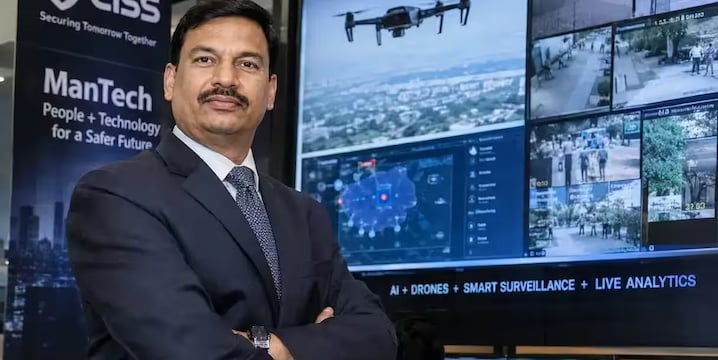
CISS Services Limited is recasting private security around a technology-heavy ManTech model that combines trained personnel with AI, drones and analytics. The company says the approach can improve detection, response and continuity across industrial sites, campuses and other large facilities while creating a more skilled workforce.
Private security is entering a new phase in India, where the value proposition is shifting from headcount to intelligence, speed and coordinated response. CISS Services Limited is positioning itself squarely in that transition, with a model that blends trained personnel and digital tools to create what it calls ManTech, a framework aimed at smarter and more adaptable protection.
According to indiasnews.net, the Mumbai-based security services provider is pushing this approach as a way to move past the old idea that safety is simply a function of more guards or more cameras. The company says the new model is designed to help clients identify threats earlier, react faster and keep human judgement at the centre of critical decisions.
From manpower to machine-assisted vigilance
The core of the strategy is a layered security setup that uses AI-powered CCTV, facial recognition, biometric access control, IoT sensors, drone surveillance and centralised command centres. These systems are meant to work together rather than as separate tools, giving security teams a single view of activity across multiple locations.
In practice, that means routine monitoring can be automated while abnormal movement, unauthorised access or other suspicious patterns are flagged in real time. The company says this reduces the burden on personnel who would otherwise spend large parts of the day watching feeds and checking alerts manually.
The shift is also intended to change the nature of the security workforce. Rather than focusing only on physical deployment, staff are being trained to interpret alerts, operate digital platforms and follow technology-enabled protocols. That, the company argues, can open up more structured career pathways in an industry that has traditionally been viewed as labour-intensive and low-tech.
Why the model matters for Indian industry
The broader pitch is not limited to guarding gates and perimeters. CISS is linking security with fire safety, facility management and business continuity, especially for industrial plants, warehouses, banks, infrastructure projects and large campuses. That framing matters because many Indian organisations now want integrated risk management rather than fragmented vendor contracts for each function.
For asset-heavy businesses, the appeal of such a model is straightforward. If surveillance, access control, alarms and sensors are connected, security teams can spot patterns faster and escalate only when needed. That can reduce response times, improve situational awareness and, in theory, lower the chance of disruption spreading into operations.
The move also reflects a wider trend in enterprise security, where technology is increasingly being used to compensate for manpower constraints while improving visibility across dispersed sites. In sectors such as logistics, manufacturing and financial services, that can become a competitive differentiator as much as a safety measure.
Training, scale and the company’s operating base
Founded in 1985 and earlier known as Central Investigation & Security Services Ltd., CISS has built a large footprint in private security over several decades. The company is headquartered in Mumbai and holds PSARA licences in 29 states, giving it a wide operating base across India.
It currently deploys more than 22,500 trained personnel, according to the report. That scale gives the company room to test how a technology-led model can be integrated into a labour-intensive service business without losing the human judgement that remains essential in emergencies.
The challenge, however, is not only technological. Security firms that adopt AI, drones and analytics also need disciplined training, reliable command structures and strong client-side adoption. Without those, sophisticated tools can become expensive add-ons rather than operational advantages. That is why the emphasis on workforce upskilling is as important as the hardware itself.
Leadership sees a longer-term industry reset
Chairman Shri Ramesh Narsingao Pimple has framed the transition as a structural change in how security will be delivered in the future. In comments cited by the report, he said the sector should not be judged by the number of guards posted or cameras installed, but by how effectively technology and manpower are combined to anticipate threats and support timely decisions.
His argument is that an intelligent security ecosystem should empower people rather than replace them. That distinction is important in India, where the private security sector remains one of the largest employers in the services economy and where clients still rely heavily on human presence for reassurance, supervision and on-the-ground response.
At the same time, the economics of security are changing. Large clients increasingly expect measurable outcomes such as faster incident detection, better compliance, stronger continuity planning and more transparent reporting. A model that can link those expectations to a single integrated platform may therefore find strong demand, particularly in regulated and asset-sensitive sectors.
A possible benchmark for the next phase of security services
The company’s ManTech approach is ultimately a bet that the next competitive edge in private security will come from blending people, process and technology into one operating system. If that works at scale, it could influence how other security providers think about service design, training and client value.
For India’s security market, the larger implication is clear. As organisations spread operations across more sites and face more complex risks, the winning model may be the one that can see more, decide faster and respond with greater precision. CISS is trying to place itself at the front of that shift.
Source Link: Economic Times Facility


It is a long established fact that a reader will be distracted.





There are many variations of passages of Lorem Ipsum available, but the majority have suffered alteration in some form, by injected humour.
Add my business arrow_forward




 Find Trusted Suppliers
 Explore Jobs
 News & Magazines
 Events
 Buy Products
 Blogs
 Community
 Podcasts
 Service Performance Index

































 More