We are hiring at VIMS Hospital, Valsad!
We are looking for an experienced Maintenance Manager to join our team.
Interested candidates can share their CV and apply today.
Source: Linkedin

#Hiring – Asst Facility Manager (Technical).
We are looking for an experienced Asst Manager / Manager– Technical for a prestigious site at Taloja, Panvel.
Experience in MEP amp; facility operations Knowledge of Electrical HT LT, Transformer, HVAC, DG, UPS, BMS amp; Fire Fighting systems
Experience in team, vendor and client management
Good technical and leadership skills
Location: Taloja,
#Hiring – Asst Facility Manager (Technical).
We are looking for an experienced Asst Manager / Manager– Technical for a prestigious site at Taloja, Panvel.
Experience in MEP amp; facility operations Knowledge of Electrical HT LT, Transformer, HVAC, DG, UPS, BMS amp; Fire Fighting systems
Experience in team, vendor and client management
Good technical and leadership skills
Location: Taloja, Panvel Interested candidates can share their updated CV, total experience, current/expected CTC amp; notice period to Samir.Shetye@cbre.co.in or connect on 7678085431.
Immediate/early joiners and those residing nearby preferred.
Source: Linkedin
Investing in a customized modular kitchen is one of the smartest ways to improve your home's functionality and overall value. Modern kitchen designs provide better organization, optimized storage, and a streamlined appearance that complements contemporary interiors. With customized cabinets and accessories, every inch of space is utilized effectively.
If you have been searching for a modu
.... Read MoreInvesting in a customized modular kitchen is one of the smartest ways to improve your home's functionality and overall value. Modern kitchen designs provide better organization, optimized storage, and a streamlined appearance that complements contemporary interiors. With customized cabinets and accessories, every inch of space is utilized effectively.
If you have been searching for a modular kitchen factory near me, choosing a manufacturer with in-house production offers several advantages. Factory-made kitchens are built using advanced machinery, ensuring consistent quality, accurate dimensions, and superior finishing. This results in a kitchen that is durable, practical, and visually appealing.
HWD Modular Kitchens delivers personalized kitchen solutions tailored to your lifestyle and available space. Our experienced professionals work closely with every client to create kitchens that balance aesthetics with everyday functionality. We use quality materials and reliable hardware to deliver lasting performance.
Serving customers across Patancheruvu, Hyderabad, Telangana, we are committed to providing exceptional craftsmanship and customer-focused service. Every project is completed with attention to detail and a commitment to quality.
Choose a professionally crafted modular kitchen from a dependable modular kitchen factory near me and experience a kitchen that is designed to serve your family for years to come.

𝐌𝐚𝐢𝐧𝐭𝐚𝐢𝐧𝐢𝐧𝐠 𝐭𝐨𝐩-𝐭𝐢𝐞𝐫 𝐡𝐲𝐠𝐢𝐞𝐧𝐞 𝐚𝐧𝐝 𝐬𝐚𝐟𝐞𝐭𝐲 𝐬𝐭𝐚𝐧𝐝𝐚𝐫𝐝𝐬 𝐚𝐜𝐫𝐨𝐬𝐬 𝐜𝐨𝐫𝐩𝐨𝐫𝐚𝐭𝐞 𝐨𝐟𝐟𝐢𝐜𝐞𝐬, 𝐢𝐧𝐝𝐮𝐬𝐭𝐫𝐢𝐚𝐥 𝐬𝐢𝐭𝐞𝐬, 𝐚𝐧𝐝 𝐜𝐨𝐦𝐦𝐞𝐫𝐜𝐢𝐚𝐥 𝐟𝐚𝐜
.... Read More𝐌𝐚𝐢𝐧𝐭𝐚𝐢𝐧𝐢𝐧𝐠 𝐭𝐨𝐩-𝐭𝐢𝐞𝐫 𝐡𝐲𝐠𝐢𝐞𝐧𝐞 𝐚𝐧𝐝 𝐬𝐚𝐟𝐞𝐭𝐲 𝐬𝐭𝐚𝐧𝐝𝐚𝐫𝐝𝐬 𝐚𝐜𝐫𝐨𝐬𝐬 𝐜𝐨𝐫𝐩𝐨𝐫𝐚𝐭𝐞 𝐨𝐟𝐟𝐢𝐜𝐞𝐬, 𝐢𝐧𝐝𝐮𝐬𝐭𝐫𝐢𝐚𝐥 𝐬𝐢𝐭𝐞𝐬, 𝐚𝐧𝐝 𝐜𝐨𝐦𝐦𝐞𝐫𝐜𝐢𝐚𝐥 𝐟𝐚𝐜𝐢𝐥𝐢𝐭𝐢𝐞𝐬 𝐬𝐭𝐚𝐫𝐭𝐬 𝐰𝐢𝐭𝐡 𝐜𝐡𝐨𝐨𝐬𝐢𝐧𝐠 𝐭𝐡𝐞 𝐫𝐢𝐠𝐡𝐭 𝐜𝐡𝐞𝐦𝐢𝐜𝐚𝐥 𝐬𝐨𝐥𝐮𝐭𝐢𝐨𝐧𝐬.
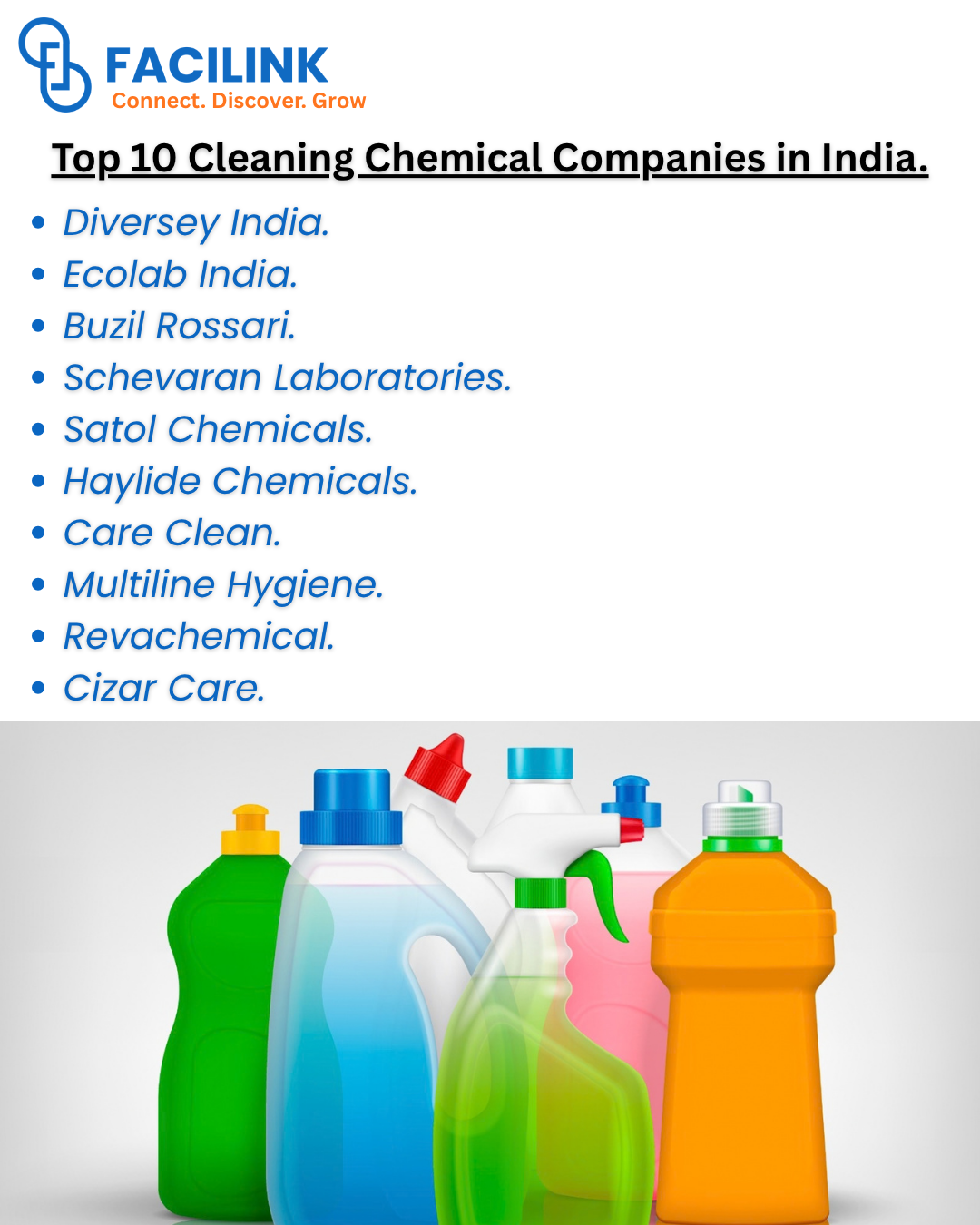
Here are 10 leading cleaning chemical brands driving industrial and commercial hygiene standards across India:
🔹 Diversey India
🔹 Ecolab India
🔹 Buzil Rossari
🔹 Schevaran Laboratories
🔹 Satol Chemicals
🔹 Haylide Chemicals
🔹 Care Clean
🔹 Multiline Hygiene
🔹 Revachemical
🔹 Cizar Care
Which of these trusted brands do you rely on for your daily facility maintenance? Let us know in the comments!
Looking to connect with verified vendors, suppliers, and facility management experts?
looking to coonect with verified suppliers, buyers or facility management expert
📞 +91 7045745345
Email: hello@facilink.co.in
#FacilityManagement #CleaningChemicals #CommercialCleaning #FACILINK #HygieneSolutions #FacilityCare #Procurement #B2BMarketplace #IndustrialCleaning #PropertyManagement #IndiaBusiness
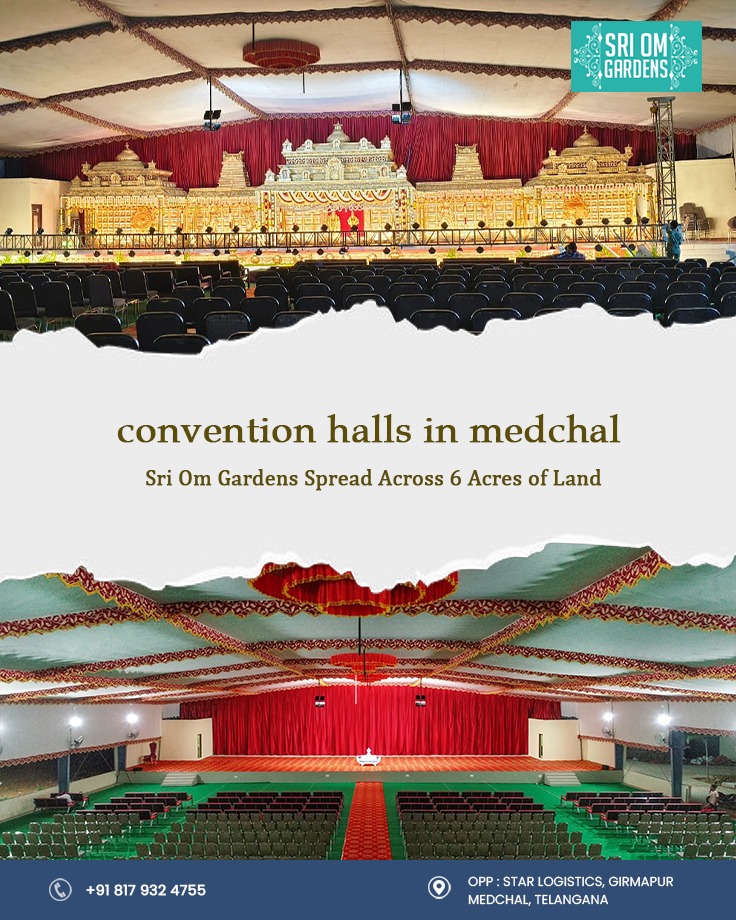
If you are searching for spacious and elegant banquet halls near Medchal, Sri Om Gardens is an excellent venue to host your special celebrations and grand events. Known for its beautiful surroundings and well-maintained facilities, Sri Om Gardens is one of the preferred banquet halls for weddings, receptions, engagements, birthday parties, anniversaries, and corporate gatherings.
Sri Om Gardens
.... Read MoreIf you are searching for spacious and elegant banquet halls near Medchal, Sri Om Gardens is an excellent venue to host your special celebrations and grand events. Known for its beautiful surroundings and well-maintained facilities, Sri Om Gardens is one of the preferred banquet halls for weddings, receptions, engagements, birthday parties, anniversaries, and corporate gatherings.
Sri Om Gardens offers a well-designed venue with ample space and a comfortable ambiance that suits both intimate functions and large-scale celebrations. The venue is thoughtfully planned to provide a pleasant environment for guests, making every event memorable and enjoyable. With a spacious seating arrangement, a wide stage area for ceremonies, and a well-organized layout, Sri Om Gardens stands out among the banquet halls near Medchal for hosting traditional and modern events.
One of the key advantages of choosing Sri Om Gardens is its convenient location and spacious surroundings. Among many banquet halls, Sri Om Gardens provides sufficient parking facilities and a large event area, ensuring that guests can attend functions without any inconvenience. The peaceful atmosphere and well-maintained infrastructure make it suitable for weddings, receptions, family gatherings, and corporate events.
Whether you are planning a wedding celebration, engagement ceremony, anniversary event, or social gathering, Sri Om Gardens offers one of the best banquet halls near Medchal to create unforgettable moments with your loved ones. The venue is designed to provide comfort, convenience, and a welcoming atmosphere for every occasion.
Sri Om Gardens is located at Gowdavalli-Railapur Road, Girmapur, Telangana 501401, making it easily accessible from Medchal and nearby areas. If you are looking for spacious and well-equipped banquet halls near Medchal, Sri Om Gardens is the perfect choice to host your celebrations with style and elegance.

Dear Candidates,
Require - HSE Managers for JLL.
Qualifications - Any Degree with HSE Certificates Location - Chennai, Tirunelveli, & Kanchipuram.
Experience - 7-12 Years In Industry/Base built Projects.
Looking for candidates who can join Immediately.
Interested candidate can share their updated resume on
Pradeep.t@jll.com
Source:LinkedIn
🚀 We’re Hiring | Lead – Admin / Unit Infra SPOC | Metropolis Healthcare Ltd.
📍 Location: Kolkata | Coverage: East & MP 💼 Experience: 6–8 Years minimum
We are looking for an experienced professional to lead Administration, Infrastructure & Facility Management across our Labs and Patient Service Centres (PSCs).
Key Responsibilities
- Manage administration, infrastructure, and
🚀 We’re Hiring | Lead – Admin / Unit Infra SPOC | Metropolis Healthcare Ltd.
📍 Location: Kolkata | Coverage: East & MP 💼 Experience: 6–8 Years minimum
We are looking for an experienced professional to lead Administration, Infrastructure & Facility Management across our Labs and Patient Service Centres (PSCs).
Key Responsibilities
- Manage administration, infrastructure, and facility operations across multiple locations.
- Oversee property acquisition, new facility setup, renovation, and maintenance.
- Manage AMC, PPM, housekeeping, security and vendor operations, including Compliance.
- Monitor CAPEX/OPEX, budgets and cost optimisation.
- Ensure statutory compliance, audits, safety, and infrastructure standards.
- Coordinate with business stakeholders and drive timely resolution of infrastructure issues.
Candidate Profile:
- 6–8 years of experience in Administration, Infrastructure, Facility Management & Real Estate.
- Strong vendor management, negotiation, and stakeholder coordination skills.
- Willingness to travel across East & MP locations.
📩 Interested candidates can share their CV at: mukul.paira@metropolisindia.com
Join Metropolis Healthcare and contribute to strengthening our healthcare infrastructure!
Source: Linkedin
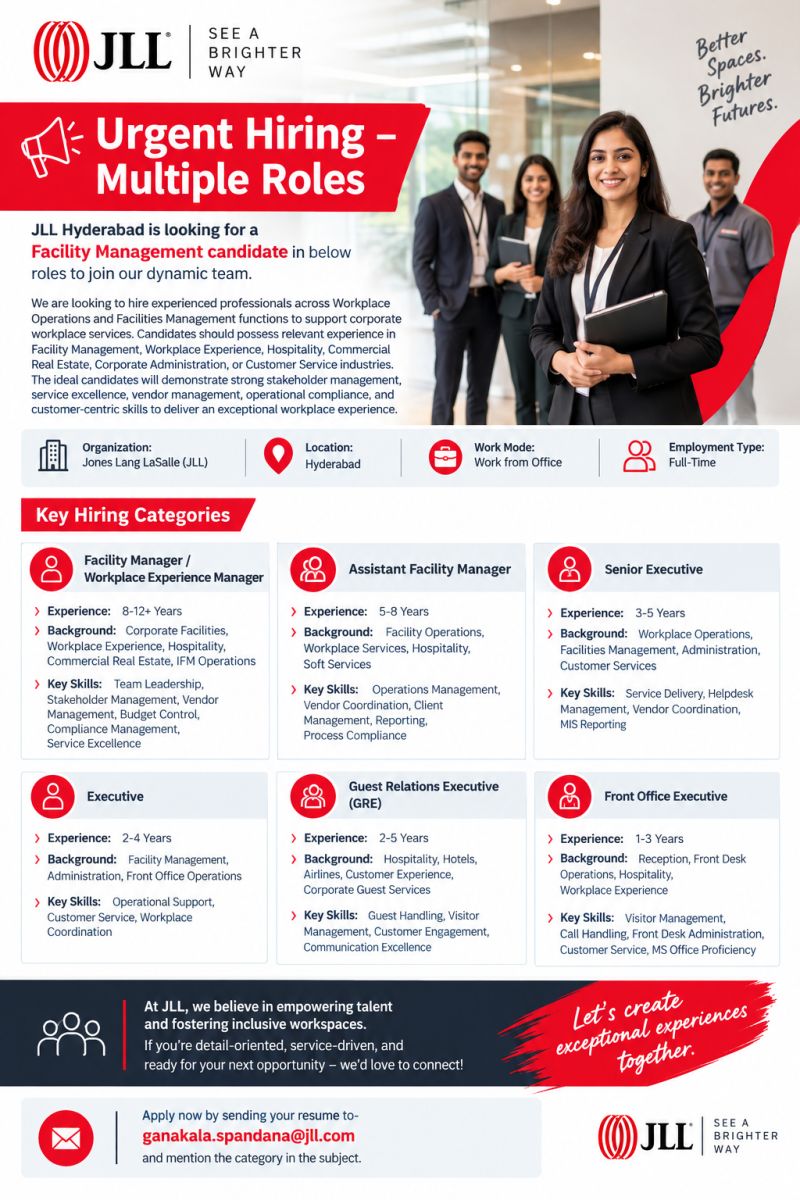
🚨 JLL is Hiring!
We are looking for experienced professionals to join our team across key Workplace & Facilities Management functions:
🔹 Soft Services – Manager, Senior executives & Executives
🔹 Client Relations – Senior executives & Executives
🔹 Engineering Services – Senior executives & Executives
📌 Application Instruction:
Please mention the role you are applying
🚨 JLL is Hiring!
We are looking for experienced professionals to join our team across key Workplace & Facilities Management functions:
🔹 Soft Services – Manager, Senior executives & Executives
🔹 Client Relations – Senior executives & Executives
🔹 Engineering Services – Senior executives & Executives
📌 Application Instruction:
Please mention the role you are applying for in the email subject line.
Source: Linkedin
📢 Hiring – Operations Manager | Facility Management | Mumbai
We are looking for an experienced Operations Manager for the Facility Management industry, with strong experience in Housekeeping and Soft Services.
Key Responsibilities
Manage day-to-day operations across multiple client locations
Handle client relationships and ensure high service standards
Lead and supervise housekeeping and
📢 Hiring – Operations Manager | Facility Management | Mumbai
We are looking for an experienced Operations Manager for the Facility Management industry, with strong experience in Housekeeping and Soft Services.
Key Responsibilities
Manage day-to-day operations across multiple client locations
Handle client relationships and ensure high service standards
Lead and supervise housekeeping and soft services teams
Manage manpower deployment, attendance, discipline, and productivity
Ensure compliance with client requirements, SOPs, and service standards
Conduct regular site visits and operational inspections
Handle client escalations and ensure timely resolution
Coordinate manpower planning, recruitment, training, and deployment
Monitor service quality and operational performance
Prepare MIS and operational reports for management
Candidate Profile
Experience in the Facility Management industry
Strong experience in Housekeeping & Soft Services
Experience managing multiple clients/sites
Excellent team-management and client-handling skills
Good knowledge of manpower planning and service operations
Strong communication, coordination, and problem-solving skills
📍 Location: Mumbai, Maharashtra
💼 Position: Operations Manager
🏢 Industry: Facility Management
🔹 Required Experience: Housekeeping & Soft Services
📧 Send your CV: sushma@smc-india.com
Interested candidates can share their updated CV at the above email address.
Source: Linkedin
🚀 WE ARE HIRING | Sr. Manager - Plant Administration
🏭 Location: Nagpur (Greenfield Project)
💼 Experience: 15-18 Years
🏢 Industry Preference: Large Manufacturing Organizations
Key Responsibilities
✅ Lead Plant Administration, Facilities, Security, Transport, Canteen & Employee Services
✅ Drive Operational Excellence, Business Continuity & Workplace Efficiency
✅ Ensure
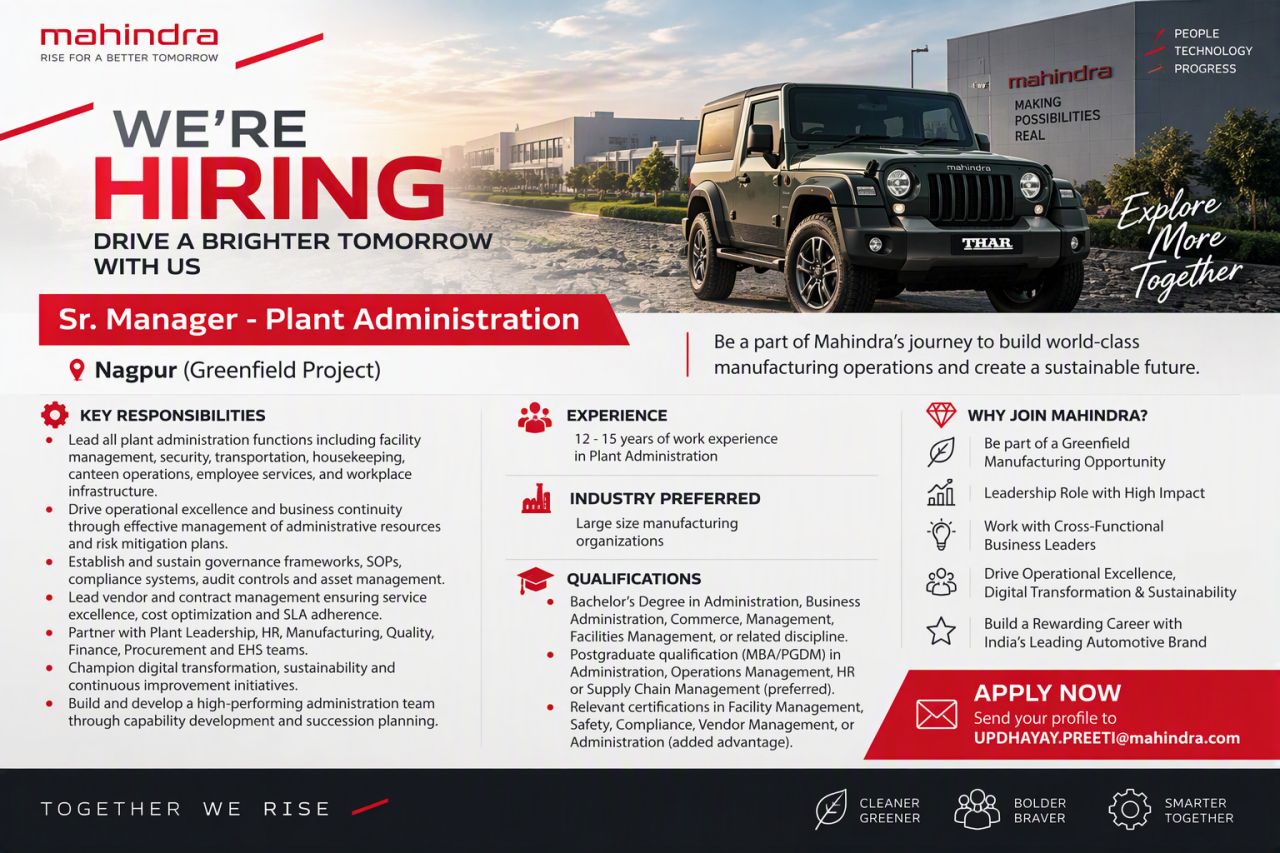
🚀 WE ARE HIRING | Sr. Manager - Plant Administration
🏭 Location: Nagpur (Greenfield Project)
💼 Experience: 15-18 Years
🏢 Industry Preference: Large Manufacturing Organizations
Key Responsibilities
✅ Lead Plant Administration, Facilities, Security, Transport, Canteen & Employee Services
✅ Drive Operational Excellence, Business Continuity & Workplace Efficiency
✅ Ensure Statutory Compliance, Governance, Audits & Asset Management
✅ Manage Vendors & Contracts with focus on Cost, Quality & SLA Excellence
✅ Partner with Plant Leadership, HR, Manufacturing, Finance & EHS Teams
✅ Lead Digitalization, Sustainability & Continuous Improvement Initiatives
✅ Develop High-Performing Teams and Strong Administrative Culture
Desired Profile
🎓 Bachelor's Degree in Administration, Management, Commerce or related field
🎓 MBA / PGDM preferred
🎓 Certifications in Facility Management, Safety, Compliance or Vendor Management are an advantage
Why Join Mahindra?
✔ Opportunity to shape administration practices in a Greenfield Manufacturing Plant
✔ Drive large-scale operational excellence initiatives
✔ Collaborate with cross-functional leadership teams
✔ Be part of Mahindra's growth and transformation journey
📩 Apply Now: UPDHAYAY.PREETI@mahindra.com
Source: Linkedin
📢 We’re Hiring | Regional EHS Director
📍 Pune | 15+ Years Experience
A leading chemical company is looking for an EHS leader to head 15 locations across South Asia, the Middle East & Africa.
Candidates from Chemical, Food, FMCG, Paints or Process Industries, preferably with MNC experience, are encouraged to apply.
📩 Share your CV: pravin@aspiremgs.co.in
Source: Linkedin
📢 We’re Hiring | Regional EHS Director
📍 Pune | 15+ Years Experience
A leading chemical company is looking for an EHS leader to head 15 locations across South Asia, the Middle East & Africa.
Candidates from Chemical, Food, FMCG, Paints or Process Industries, preferably with MNC experience, are encouraged to apply.
📩 Share your CV: pravin@aspiremgs.co.in
Source: Linkedin

🚨 WE’RE #HIRING | #ADMINISTRATION PROFESSIONAL | OMQ, #ODISHA
Tata Steel Technical Support Services Limited (TSTSL) is looking for an experienced Administration Professional to join our team at OMQ, Odisha.
If you have strong experience in #Plant Administration and enjoy managing people, stakeholders, vendors and day-to-day site operations, this opportunity could be for you! 👇
ðŸ”
🚨 WE’RE #HIRING | #ADMINISTRATION PROFESSIONAL | OMQ, #ODISHA
Tata Steel Technical Support Services Limited (TSTSL) is looking for an experienced Administration Professional to join our team at OMQ, Odisha.
If you have strong experience in #Plant Administration and enjoy managing people, stakeholders, vendors and day-to-day site operations, this opportunity could be for you! 👇
🔹 Experience: 3–6 Years
🔹 Function: Administration
🔹 Location: OMQ, Odisha
🔑 What We’re Looking For:
✅ Hands-on experience in #Plant/Site Administration
✅ Strong #Stakeholder Management & Coordination skills
✅ Exposure to #Contract & #Vendor Management
✅ Experience in #Travel & #Transport Management
✅ #Canteen Management and employee welfare activities
✅ Guest House / Guest Management
✅ Ability to coordinate effectively with internal & external stakeholders
✅ Candidates from #Plant/#Industrial or #Hospital Administration backgrounds will be preferred
✅ #Odia language proficiency is mandatory
✅ Strong communication, coordination and problem-solving abilities
🎯 Ideal Candidate: Someone who can independently manage administrative activities at a plant/site while ensuring smooth coordination among employees, vendors, contractors and other stakeholders.
📩 Interested?
Share your updated CV at arkajyoti.adhikari@tstsl.tatasteel.com me via DM or tag/refer someone who could be a great fit for this opportunity.
Be part of the journey with #TSTSL!
Source: Linkedin
🚨 WE ARE HIRING | AGM – Operations & Training
Stalwart Facilities is looking for an experienced and dynamic AGM – Operations & Training to join our leadership team and drive operational excellence across our facility management and F&B operations.
Key Responsibilities
🔹 Oversee day-to-day operations across FM & F&B sites
🔹 Design and implement effective training programs
ðŸ
🚨 WE ARE HIRING | AGM – Operations & Training
Stalwart Facilities is looking for an experienced and dynamic AGM – Operations & Training to join our leadership team and drive operational excellence across our facility management and F&B operations.
Key Responsibilities
🔹 Oversee day-to-day operations across FM & F&B sites
🔹 Design and implement effective training programs
🔹 Ensure service quality, compliance and client satisfaction
🔹 Develop and improve SOPs, processes and best practices
🔹 Lead, mentor and develop high-performing teams
🔹 Drive operational consistency and continuous improvement
Candidate Profile
✅ Facilities Management & F&B experience is mandatory
✅ Strong leadership and people-management skills
✅ Experience in operations, training and client handling
✅ Excellent communication and problem-solving abilities
✅ Proven ability to manage multi-site/service operations
💰 Salary: No bar for the right candidate.
We are open to offering a competitive package based on experience, expertise and suitability for the role.
📩 Interested candidates can send their updated CV to:
info@stalwartfacilities.com
🌐 www.stalwartfacilities.com
📞 +91 98183 35373
Stalwart Facilities
Building Spaces. Building Stronger Businesses.
Source: Linkedin
If you are looking for a spacious and elegant function hall to host your special celebrations, Sri Om Gardens is the perfect venue for weddings, receptions, engagements, birthday parties, anniversaries, and corporate gatherings. Known for its beautiful ambiance and well-maintained facilities, Sri Om Gardens is one of the preferred banquet halls for families and event organizers who want to celebra
.... Read MoreIf you are looking for a spacious and elegant function hall to host your special celebrations, Sri Om Gardens is the perfect venue for weddings, receptions, engagements, birthday parties, anniversaries, and corporate gatherings. Known for its beautiful ambiance and well-maintained facilities, Sri Om Gardens is one of the preferred banquet halls for families and event organizers who want to celebrate their occasions in a comfortable and memorable setting.
Sri Om Gardens offers a well-designed function hall that provides ample space for both small and large gatherings. The venue is designed to create a pleasant and welcoming atmosphere, making it suitable for traditional ceremonies as well as modern celebrations. With a spacious seating arrangement, a dedicated stage area for events, and an organized layout, the venue ensures that every function runs smoothly and comfortably for guests.
Among the many banquet halls available for events, Sri Om Gardens stands out because of its peaceful surroundings and convenient facilities. The venue offers sufficient parking space and a large open area that can accommodate a significant number of guests without any inconvenience. This makes it an ideal function hall for hosting grand weddings, receptions, family functions, and social gatherings.
Whether you are planning a wedding ceremony, engagement function, corporate event, or birthday celebration, Sri Om Gardens provides a reliable and elegant venue where you can celebrate your special moments with family and friends. The combination of spacious infrastructure and a pleasant environment makes it one of the most suitable banquet halls for memorable events.
Sri Om Gardens is located at Gowdavalli-Railapur Road, Girmapur, Telangana 501401, offering easy accessibility for guests traveling from nearby areas. If you are searching for a well-maintained function hall or spacious banquet halls to host your upcoming event, Sri Om Gardens is a great choice to make your celebration truly special.
Hexa World Solutions offers the best Automatic Gates in Hyderabad. We have solutions for gate automation for all types of properties like residential, commercial, and industrial. Our products include automatic sliding gates, swing gates, cantilever gates, gate motors, and sophisticated yet easy to use access control systems. We are one of the most reliable Boom Barrier Dealers in Hyderabad. Among
.... Read MoreHexa World Solutions offers the best Automatic Gates in Hyderabad. We have solutions for gate automation for all types of properties like residential, commercial, and industrial. Our products include automatic sliding gates, swing gates, cantilever gates, gate motors, and sophisticated yet easy to use access control systems. We are one of the most reliable Boom Barrier Dealers in Hyderabad. Among our clientele are apartments, offices, IT parks, educational institutions, hospitals, toll plazas, warehouses, and gated communities. Our team conducts the installation, maintenance, and after-sales support of all our products, which are of high quality and incorporate the latest automation technologies. Hexa World Solutions will provide you the automation systems you seek to either protect the entrance of your home or streamline the access of vehicles to your business. We're the solution you need for Automatic Gates in Hyderabad, and for boom barriers that safety, and efficiency to your property.

Every successful business is built on original ideas, creative branding, and innovation. Protecting these valuable assets is an important step toward sustainable growth, and IPR plays a significant role in achieving that goal. Whether you are launching a startup, expanding an established company, or introducing a new product or service, securing your intellectual property rights helps safeguard
.... Read MoreEvery successful business is built on original ideas, creative branding, and innovation. Protecting these valuable assets is an important step toward sustainable growth, and IPR plays a significant role in achieving that goal. Whether you are launching a startup, expanding an established company, or introducing a new product or service, securing your intellectual property rights helps safeguard your work from unauthorized use while strengthening your business identity.
Define IPR Solutions is committed to helping businesses protect their intellectual assets through professional and reliable IPR services. Our team assists clients with trademark registration, patent registration, copyright registration, design registration, and other related services. Every application is handled with attention to detail, ensuring that clients receive clear guidance throughout the registration process.
Strong intellectual property rights provide businesses with legal ownership of their innovations and creative work. They also improve brand recognition, increase customer confidence, and create opportunities for licensing, investment, and long-term commercial success. By protecting your intellectual assets, you can focus on business growth with greater confidence.
At Define IPR Solutions, we understand that every business has different requirements. Our approach is centered on providing practical support, timely communication, and dependable assistance throughout every stage of the registration process. We strive to make IPR protection simple and accessible for entrepreneurs, startups, manufacturers, service providers, and established organizations.
Businesses that invest in intellectual property rights today are better positioned to compete in tomorrow's marketplace. From protecting a unique business name to securing innovative products and creative works, professional IPR services help reduce legal risks and preserve the value of your business.
If you are looking for trusted IPR professionals, Define IPR Solutions welcomes you to our office in Madhapur, Hyderabad, Telangana. Our experienced team is dedicated to helping businesses protect their valuable ideas through comprehensive intellectual property rights services designed to support long-term success.

NAVCARE FACILITY MANAGEMENT
MULTI-CITY RECRUITMENT | FACILITY MANAGEMENT PROFESSIONALS
Navcare Facility Management is expanding its operations across multiple cities and is seeking experienced professionals to join our growing team.
We are looking for individuals with strong expertise in Facility Management, Operations, Technical Services, Client Management, Team Leadership and Business D
NAVCARE FACILITY MANAGEMENT
MULTI-CITY RECRUITMENT | FACILITY MANAGEMENT PROFESSIONALS
Navcare Facility Management is expanding its operations across multiple cities and is seeking experienced professionals to join our growing team.
We are looking for individuals with strong expertise in Facility Management, Operations, Technical Services, Client Management, Team Leadership and Business Development.
LOCATIONS
Ahmedabad | Vadodara | Indore | Delhi NCR | Hyderabad | Chennai | Goa
CURRENT OPPORTUNITIES
Field Officer – Facility Management
8 Positions | Salary up to ₹55,000 PM
Assistant Manager – Operations | Facility Management
4 Positions | Salary up to ₹70,000 PM
Assistant Manager – Technical | Facility Management
4 Positions | Salary up to ₹70,000 PM
Manager – Operations | Facility Management
4 Positions | Salary up to ₹90,000 PM
General Manager – Facility Management
3 Positions | Salary up to ₹1,00,000 PM
General Manager – Sales | Facility Management
1 Position | Salary up to ₹2,00,000 PM
IDEAL CANDIDATES
We welcome applications from professionals with relevant experience in:
• Facility Management and Integrated Facility Management
• Operations and Multi-Site Management
• Technical Services and Maintenance
• Manpower and Workforce Management
• Client and Stakeholder Management
• SLA, KPI and Compliance Management
• Business Development and Sales
• Team Leadership and Performance Management
Candidates with strong operational discipline, leadership capabilities and a customer-focused approach are encouraged to apply.
APPLICATIONS
Please share your updated CV at:
ncfmservices@gmail.com
Subject: Application – Position – Preferred Location
Locations: Ahmedabad | Vadodara | Indore | Delhi NCR | Hyderabad | Chennai | Goa
Navcare Facility Management is committed to building strong teams and delivering professional, reliable and consistent facility management services.
Join us and be part of our growing organization.
Source: LinkedIn
If you are searching for spacious and elegant function halls in Medchal, Sri Om Gardens is the perfect venue to host your special occasions. Known for its well-maintained facilities and pleasant atmosphere, Sri Om Gardens is one of the preferred banquet halls near Medchal for weddings, receptions, engagements, birthday parties, anniversaries, and corporate gatherings.
Sri Om Gardens offers a be
.... Read MoreIf you are searching for spacious and elegant function halls in Medchal, Sri Om Gardens is the perfect venue to host your special occasions. Known for its well-maintained facilities and pleasant atmosphere, Sri Om Gardens is one of the preferred banquet halls near Medchal for weddings, receptions, engagements, birthday parties, anniversaries, and corporate gatherings.
Sri Om Gardens offers a beautifully designed venue that provides ample space and a comfortable setting for both small and large celebrations. The function halls in Medchal at Sri Om Gardens are ideal for hosting traditional ceremonies as well as modern events. With spacious seating arrangements, a well-decorated stage area, and a welcoming ambiance, the venue ensures that every event becomes memorable for hosts and guests.
Families and event planners often choose Sri Om Gardens when looking for banquet halls near Medchal because of its convenient location and well-organized facilities. The venue offers a large event area along with sufficient parking space, allowing guests to attend functions comfortably without any inconvenience. The peaceful surroundings and spacious layout make it suitable for grand wedding celebrations and social gatherings.
Whether you are planning a wedding ceremony, reception, engagement function, or corporate event, Sri Om Gardens provides one of the best function halls in Medchal to celebrate your important occasions. The venue combines comfort, space, and accessibility to create the perfect environment for unforgettable events.
Sri Om Gardens is conveniently located at Gowdavalli-Railapur Road, Girmapur, Telangana 501401, making it easily reachable from Medchal and nearby areas. If you are looking for well-maintained function halls in Medchal or spacious banquet halls near Medchal, Sri Om Gardens is an excellent choice to host your celebrations with family and friends.
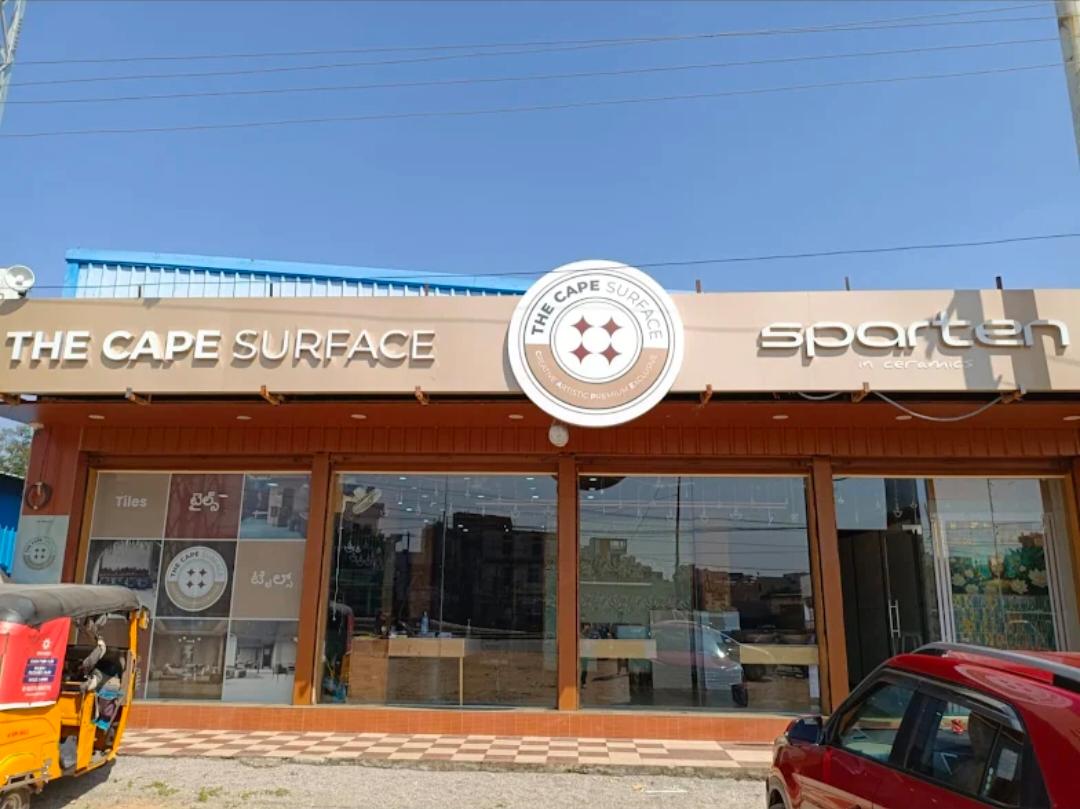
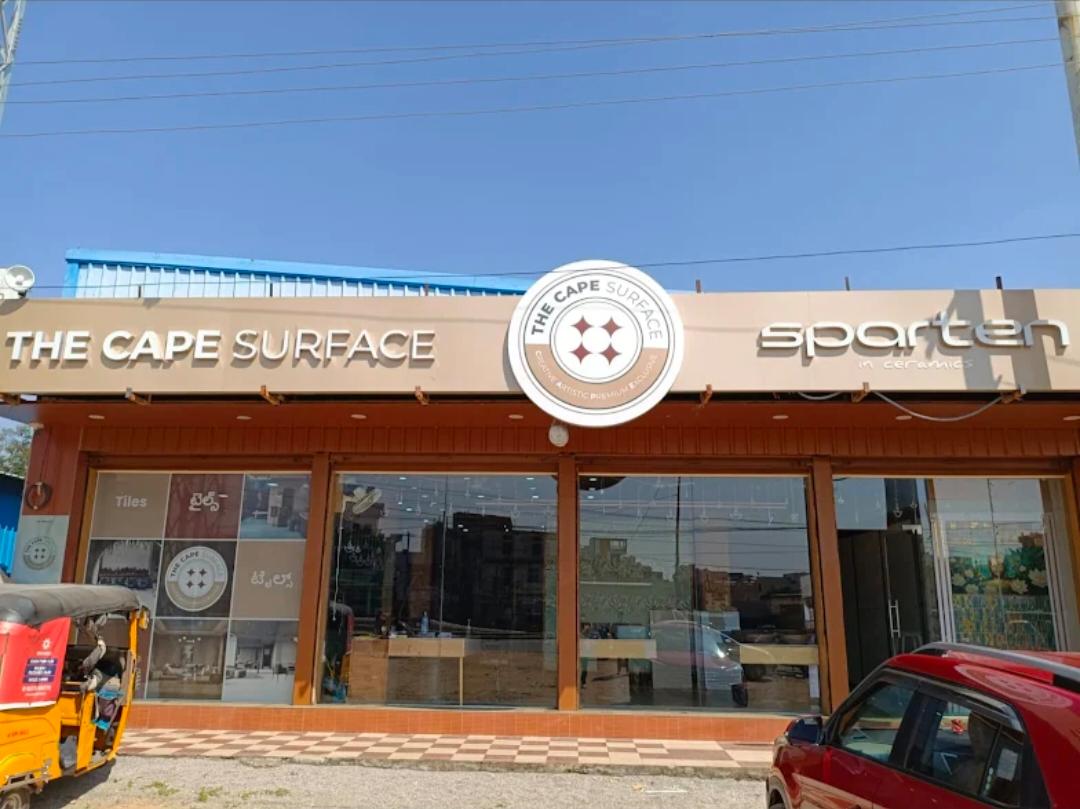
The Cape Surface is a reliable and trusted building materials supplier of high quality vitrified tiles. Our vitrified tiles are designed to be sleek and modern and offer a myriad of options and finishes that are ideal for all your residential and commercial building needs. We are a building material supplier with lots of experience in the construction and interior design of projects. You have come
.... Read MoreThe Cape Surface is a reliable and trusted building materials supplier of high quality vitrified tiles. Our vitrified tiles are designed to be sleek and modern and offer a myriad of options and finishes that are ideal for all your residential and commercial building needs. We are a building material supplier with lots of experience in the construction and interior design of projects. You have come to the right place for materials that are sure to transform your space and are chic, modern and durable.
𝐀𝐬 𝐰𝐞 𝐛𝐢𝐝 𝐟𝐚𝐫𝐞𝐰𝐞𝐥𝐥 𝐭𝐨 𝐁𝐚𝐩𝐩𝐚, 𝐰𝐞 𝐜𝐚𝐫𝐫𝐲 𝐟𝐨𝐫𝐰𝐚𝐫𝐝 𝐭𝐡𝐞 𝐯𝐚𝐥𝐮𝐞𝐬 𝐇𝐞 𝐢𝐧𝐬𝐩𝐢𝐫𝐞𝐬 — 𝐰𝐢𝐬𝐝𝐨𝐦 𝐢𝐧 𝐨𝐮𝐫 𝐝𝐞𝐜𝐢𝐬𝐢𝐨𝐧𝐬, 𝐬𝐭𝐫𝐞𝐧𝐠𝐭𝐡 𝐢𝐧 𝐨𝐮𝐫 𝐣𝐨𝐮𝐫𝐧ð�
.... Read More𝐀𝐬 𝐰𝐞 𝐛𝐢𝐝 𝐟𝐚𝐫𝐞𝐰𝐞𝐥𝐥 𝐭𝐨 𝐁𝐚𝐩𝐩𝐚, 𝐰𝐞 𝐜𝐚𝐫𝐫𝐲 𝐟𝐨𝐫𝐰𝐚𝐫𝐝 𝐭𝐡𝐞 𝐯𝐚𝐥𝐮𝐞𝐬 𝐇𝐞 𝐢𝐧𝐬𝐩𝐢𝐫𝐞𝐬 — 𝐰𝐢𝐬𝐝𝐨𝐦 𝐢𝐧 𝐨𝐮𝐫 𝐝𝐞𝐜𝐢𝐬𝐢𝐨𝐧𝐬, 𝐬𝐭𝐫𝐞𝐧𝐠𝐭𝐡 𝐢𝐧 𝐨𝐮𝐫 𝐣𝐨𝐮𝐫𝐧𝐞𝐲, 𝐚𝐧𝐝 𝐩𝐨𝐬𝐢𝐭𝐢𝐯𝐢𝐭𝐲 𝐢𝐧 𝐞𝐯𝐞𝐫𝐲 𝐧𝐞𝐰 𝐛𝐞𝐠𝐢𝐧𝐧𝐢𝐧𝐠. 🙏
May this 𝐀𝐧𝐚𝐧𝐭 𝐂𝐡𝐚𝐭𝐮𝐫𝐝𝐚𝐬𝐡𝐢 bring prosperity, progress and meaningful connections to all.
𝐆𝐚𝐧𝐩𝐚𝐭𝐢 𝐁𝐚𝐩𝐩𝐚 𝐌𝐨𝐫𝐲𝐚! 𝐏𝐮𝐝𝐡𝐜𝐡𝐲𝐚 𝐕𝐚𝐫𝐬𝐡𝐢 𝐋𝐚𝐯𝐤𝐚𝐫 𝐘𝐚! 🌺
🔹 Connect. Discover. Grow.
Email: hello@facilink.co.in
Contact: +91 7045745345
#AnantChaturdashi #GanpatiBappaMorya #FACILINK #NewBeginnings #Growth #FacilityManagement #workplacesolutions #Strongerconnections #Growth #ConnectDiscoverGrow #Positivebeginnings #CorporateIndia #FestiveGreetings #Vendormanagement #Buildingmanagement #B2Bmarketplace #BusinessGrowth

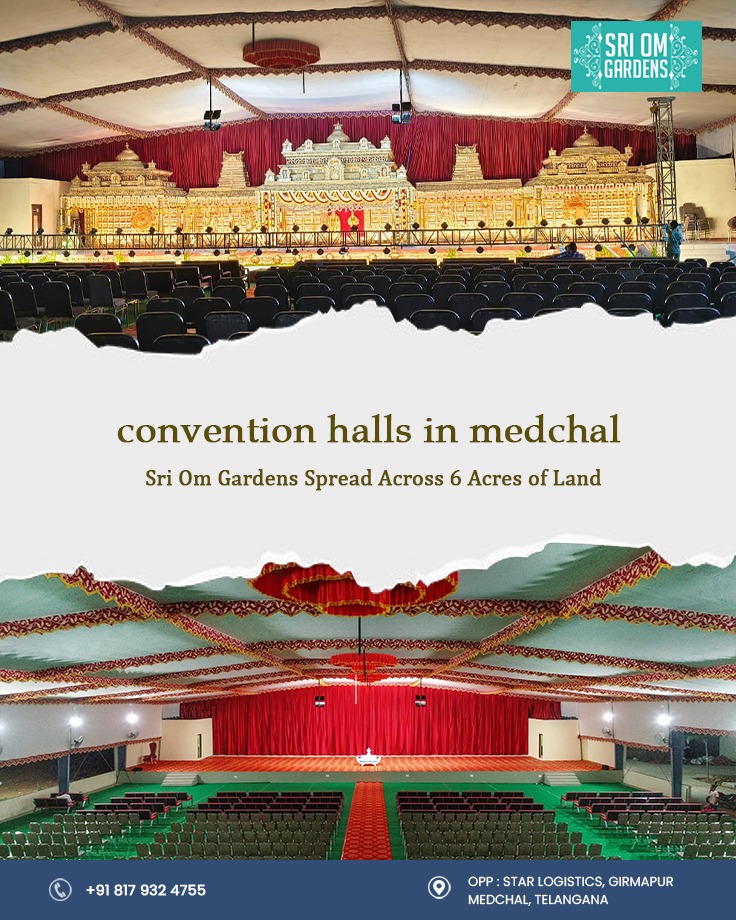
If you are searching for spacious and well-maintained convention halls in Medchal, Sri Om Gardens is an excellent choice for hosting grand celebrations and memorable events. Known for its elegant ambiance and large event space, Sri Om Gardens is a preferred function hall for weddings, receptions, engagements, birthday parties, corporate meetings, and family gatherings.
Sri Om Gardens offers a b
.... Read MoreIf you are searching for spacious and well-maintained convention halls in Medchal, Sri Om Gardens is an excellent choice for hosting grand celebrations and memorable events. Known for its elegant ambiance and large event space, Sri Om Gardens is a preferred function hall for weddings, receptions, engagements, birthday parties, corporate meetings, and family gatherings.
Sri Om Gardens offers a beautifully designed venue that provides a comfortable and welcoming environment for all types of celebrations. The function hall is spacious and well-organized, making it suitable for both small and large gatherings. With ample seating capacity, a wide stage area, and a pleasant atmosphere, it creates the perfect setting for traditional ceremonies as well as modern events.
One of the reasons many families prefer Sri Om Gardens when searching for convention halls in Medchal is its convenient location and well-planned facilities. The venue offers enough parking space for guests and a well-maintained environment that ensures every event runs smoothly. The spacious layout allows hosts to organize decorations, dining arrangements, and entertainment comfortably.
Whether you are planning a grand wedding ceremony, reception, anniversary celebration, or corporate event, Sri Om Gardens provides a reliable and elegant function hall where you can celebrate your special occasions with ease. The venue is designed to deliver both comfort and convenience, ensuring a pleasant experience for hosts and guests alike.
Sri Om Gardens is located at Gowdavalli-Railapur Road, Girmapur, Telangana 501401, making it easily accessible for people from Medchal and nearby areas. If you are looking for one of the best convention halls in Medchal with a spacious function hall for your upcoming celebration, Sri Om Gardens is a perfect venue to host unforgettable events with family and friends.
🔧 We're Hiring: AGM/DGM – Maintenance & Utility 🔧
📍 Location: Faridabad
📅 Experience: 15+ years in Utility & Maintenance leadership
✅ Boilers, Chillers, Compressors, HVAC, Cooling Towers
✅ ETP/STP/WTP Operations & Compliance
✅ Preventive & Predictive Maintenance (Vibration Analysis, Thermography)
✅ Statutory & Environmental Compliance (PCB/CPCB liaison)
✅ SAP-PM,
🔧 We're Hiring: AGM/DGM – Maintenance & Utility 🔧
📍 Location: Faridabad
📅 Experience: 15+ years in Utility & Maintenance leadership
✅ Boilers, Chillers, Compressors, HVAC, Cooling Towers
✅ ETP/STP/WTP Operations & Compliance
✅ Preventive & Predictive Maintenance (Vibration Analysis, Thermography)
✅ Statutory & Environmental Compliance (PCB/CPCB liaison)
✅ SAP-PM, Budget Control, CAPEX Planning
✅ Team Leadership & Cross-functional Coordination
📩 Apply Now: hrd10@polymedicure.com
Source: Linkedin
📢 We are Hiring | Senior Manager / AGM – Administration
We are looking for an experienced professional to join our Administration team.
Key Responsibilities:
• Contract Labour Management
• Housekeeping & Laundry Management
• Security Management
• Consumables & Administrative Purchase
• QMS documentation and compliance related to Administration
• Overall administration
📢 We are Hiring | Senior Manager / AGM – Administration
We are looking for an experienced professional to join our Administration team.
Key Responsibilities:
• Contract Labour Management
• Housekeeping & Laundry Management
• Security Management
• Consumables & Administrative Purchase
• QMS documentation and compliance related to Administration
• Overall administration and facility management activities
• Coordination with internal departments and external agencies
Candidate Profile:
• Relevant experience in Administration / Facility Management, preferably in the pharmaceutical industry
• Strong experience in contract labour and service-provider management
• Good knowledge of administrative processes, compliance and QMS
• Strong communication, coordination and team-management skills
📍 Location: Ahmedabad / Bavla, Gujarat
Interested candidates can share their updated CV on sagart@coronaremedies.com
Source: Linkedin
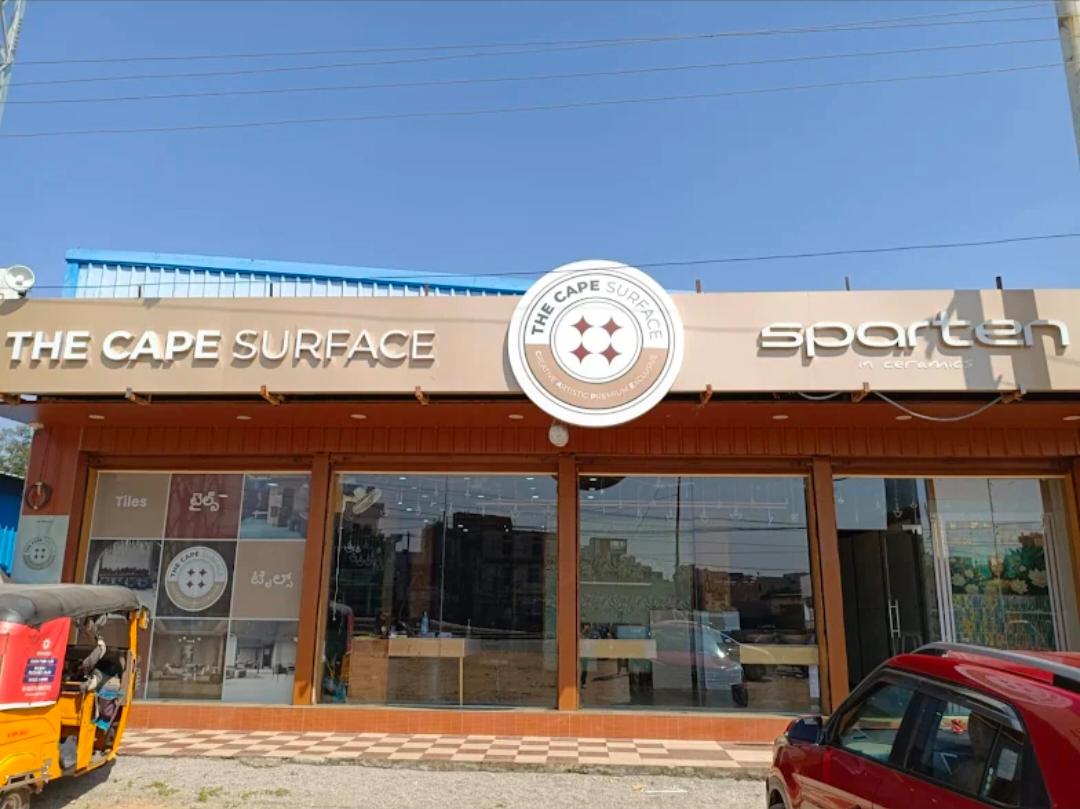
The Cape Surface carries high end ceramic tiles and flooring options made of marble. You can find ceramic tiles in all different styles, colors, and finishes on our website. These help you to achieve any style you want to have in your interior. We have a variety of sophisticated marble based flooring and wall covering products as well. With all the options we have available, you can start and fi
.... Read MoreThe Cape Surface carries high end ceramic tiles and flooring options made of marble. You can find ceramic tiles in all different styles, colors, and finishes on our website. These help you to achieve any style you want to have in your interior. We have a variety of sophisticated marble based flooring and wall covering products as well. With all the options we have available, you can start and finish any project. The Cape Surface has everything you need to complete your vision, and in style.
Hiring for Gurgaon!
EHS Exec/AM - ~ 6lpa
Cafeteria Executive - ~ 5lpa
Must have good communication and relevant experience in corporate and cafeteria environment respectively.
Candidates available in Gurgaon and on short notice are preferred.
Email - saurabh.singh8@cbre.com
Source: LinkedIn
Job Description – Key Account Manager
Position: KAM Or Property Manager
Location: Sector V, Kolkata
Department: Facility Management
Employment Type: Full-Time
Job Summary
We are looking for a Facility Executive to manage and coordinate day-to-day facility operations at our Sector V, Kolkata site. The candidate will be responsible for ensuring smooth functioning of building services, main
Job Description – Key Account Manager
Position: KAM Or Property Manager
Location: Sector V, Kolkata
Department: Facility Management
Employment Type: Full-Time
Job Summary
We are looking for a Facility Executive to manage and coordinate day-to-day facility operations at our Sector V, Kolkata site. The candidate will be responsible for ensuring smooth functioning of building services, maintenance activities, vendors, and workplace facilities while maintaining safety and service standards.
Interested candidates directly text me your CV on priyanka.chanda@colliers.com
Sayan SrimaniColliersrealestateSoumyajit Mukherjee
Key Responsibilities
· Manage day-to-day facility operations and ensure smooth functioning of the site.
· Coordinate with technicians, housekeeping, security, and other support staff.
· Monitor and coordinate preventive and corrective maintenance activities.
· Supervise HVAC, chillers, electrical systems, DG, UPS, plumbing, fire & safety systems, and other building services.
· Attend to facility-related complaints and ensure timely resolution.
· Maintain daily operation logs, checklists, maintenance records, and service reports.
· Conduct regular site inspections and identify maintenance or safety-related issues.
· Ensure compliance with facility management, safety, and operational procedures.
· Monitor consumption of utilities and support initiatives for efficient energy management.
· Assist the Facility Manager in preparing MIS reports and operational updates.
· Coordinate with clients/occupants and address facility-related requirements professionally.
Eligibility & Qualifications
· Diploma/B.Tech in Electrical Engineering or a related technical discipline.
· Experience in facility management/building operations will be preferred.
· Good knowledge of HVAC and chiller systems is required.
· Basic knowledge of electrical, mechanical, plumbing, fire & safety, and other MEP services.
· Good communication and coordination skills.
Source: LinkedIn
Head – Facilities & Property Management
We are seeking a seasoned Facilities & Property Management professional to lead strategic and operational management of a large, multi-city corporate facilities portfolio.
Key Responsibilities:
Lead end-to-end facilities operations covering Engineering, Soft Services, Cafeteria, Transport, Space Management, and Workplace Experience.
Develop facilitie
Head – Facilities & Property Management
We are seeking a seasoned Facilities & Property Management professional to lead strategic and operational management of a large, multi-city corporate facilities portfolio.
Key Responsibilities:
Lead end-to-end facilities operations covering Engineering, Soft Services, Cafeteria, Transport, Space Management, and Workplace Experience.
Develop facilities strategy, governance frameworks, SLAs, KPIs, and service standards across locations.
Manage OPEX/CAPEX budgets, cost optimization, vendor contracts, commercial negotiations, and service delivery.
Ensure statutory compliance, workplace safety, risk management, business continuity, and regulatory requirements.
Drive employee-centric workplace initiatives, sustainability, ESG, energy efficiency, and workplace transformation.
Partner with senior leadership and cross-functional teams on expansion, consolidation, and workplace modernization.
Lead, mentor, and develop high-performing facilities teams across regions.
Key Requirements:
10+ years of experience in Facilities/Property Management, with 4+ years in a leadership role.
Proven experience managing large, multi-city or multi-site operations.
Strong knowledge of engineering systems, compliance, budgeting, vendor management, and risk management.
Excellent strategic thinking, stakeholder management, commercial acumen, and people leadership skills.
Bachelor’s degree in Engineering, Architecture, Facilities Management, or a related field; MBA/PG qualification preferred.
Certifications such as IFMA, RICS, CoreNet, PMP, or NEBOSH are desirable.
Location Hyderabad
Exp 20yrs
CV to vimal@livecjobs.com
Source: LinkedIn
📌 || SILA is hiring an Infra Engineer || 📌
Looking for an opportunity where your MEP, asset management and technical operations expertise can directly drive reliability, safety and operational performance?
🔹 What You’ll Work On:
• Electrical | HVAC | DG | Plumbing | BMS | Fire & Life Safety
• Asset & maintenance management
• Breakdown response & Root Cause Analysis
• T
📌 || SILA is hiring an Infra Engineer || 📌
Looking for an opportunity where your MEP, asset management and technical operations expertise can directly drive reliability, safety and operational performance?
🔹 What You’ll Work On:
• Electrical | HVAC | DG | Plumbing | BMS | Fire & Life Safety
• Asset & maintenance management
• Breakdown response & Root Cause Analysis
• Technical team & vendor management
• Safety, compliance & client coordination
🎯 We’re Looking For:
Degree/Diploma in Electrical, Mechanical or related Engineering with relevant Facility Management & MEP experience.
📩 Share your CV: sonali.singh@silagroup.co.in
📱 WhatsApp: 8425985621
Ready to take the next step and make an impact in facility engineering? Apply now!
Source: Linkedin
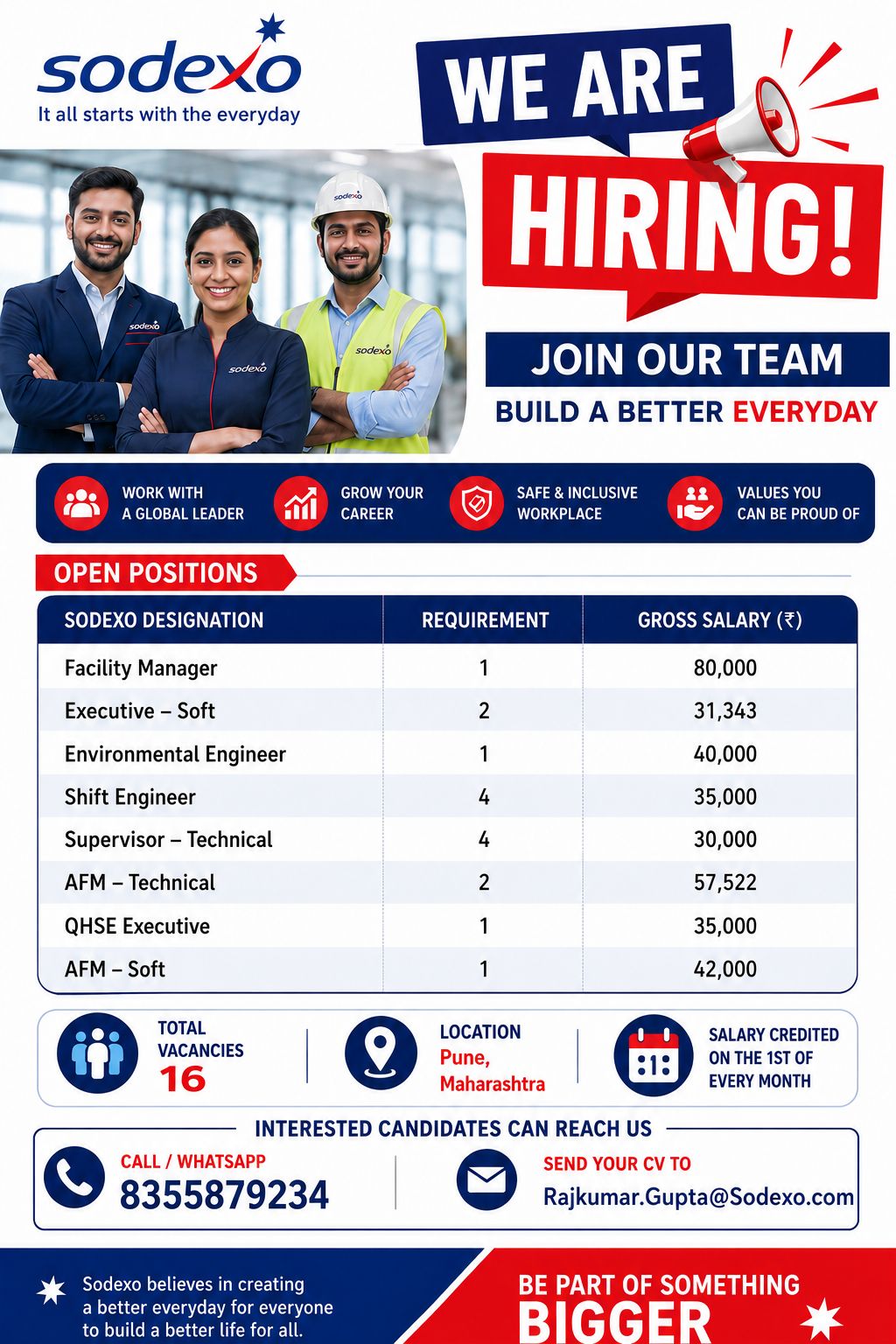
🚨 WE ARE HIRING | Sodexo India
📍 Location: Pune, Maharashtra
Sodexo is expanding its team and looking for talented professionals to join us across Facilities Management, Engineering, Technical, Soft Services & QHSE roles.
🔹 Open Positions
PositionVacanciesGross SalaryFacility Manager1
Executive –Soft- 2
Environmental Engineer-1
Shift Engineer- 4
Supervisor – Tech
🚨 WE ARE HIRING | Sodexo India
📍 Location: Pune, Maharashtra
Sodexo is expanding its team and looking for talented professionals to join us across Facilities Management, Engineering, Technical, Soft Services & QHSE roles.
🔹 Open Positions
PositionVacanciesGross SalaryFacility Manager1
Executive –Soft- 2
Environmental Engineer-1
Shift Engineer- 4
Supervisor – Technical -4
AFM – Technical- 2
QHSE Executive-1
AFM – Soft - 1
💰 Salary credited on the 1st of every month
Why Join Sodexo?
✅ Work with a global leader
✅ Career growth opportunities
✅ Safe & inclusive workplace
✅ Professional work environment
📩 Interested candidates can apply
📞 Call / WhatsApp: 8355879234
📧 Send your CV: Rajkumar.Gupta@Sodexo.com
If you are looking for your next career opportunity in Pune, share your CV with us.
Source: Linkedin
📢 We’re Hiring – Assistant Facility Manager (Gurgaon)
We are looking for an Assistant Facility Manager to join our team.
Requirements:
Experience in facility management, preferably with a hotel/hospitality background
Strong communication and interpersonal skills
Roles & Responsibilities :
- Assist the Facility Manager in managing day-to-day soft services operations.
- Supervise
📢 We’re Hiring – Assistant Facility Manager (Gurgaon)
We are looking for an Assistant Facility Manager to join our team.
Requirements:
Experience in facility management, preferably with a hotel/hospitality background
Strong communication and interpersonal skills
Roles & Responsibilities :
- Assist the Facility Manager in managing day-to-day soft services operations.
- Supervise and coordinate housekeeping, cleaning, waste management, pest control, landscaping, pantry and other soft services.
- Ensure high standards of cleanliness, hygiene, appearance and service quality across the facility.
- Manage and monitor housekeeping staff, supervisors, outsourced manpower and service vendors.
- Prepare and maintain daily checklists, attendance records, inspection reports and service reports.
- Conduct regular inspections of common areas, washrooms, offices, service areas and other facility spaces.
- Monitor vendor performance and ensure compliance with agreed SLA/KPI standards.
- Coordinate with clients, employees, visitors and internal departments to resolve service-related issues.
- Handle complaints and ensure timely resolution with proper follow-up.
- Monitor consumption and availability of cleaning materials, consumables and housekeeping supplies.
- Support manpower planning, duty allocation, training and performance monitoring.
- Ensure compliance with health, safety, hygiene and facility SOPs.
- Assist with audits, client inspections and periodic facility reviews.
- Maintain proper documentation and support the Facility Manager in administrative activities.
- Coordinate with engineering/security/administration teams wherever required for smooth facility operations.
📍 Location: Gurgaon
💼 Experience: 5+ YearsSource: Linkedin
📩 Interested candidates: Please share your CV or contact us at payal.kapoor@compass-group.co.in / alok.mishra2@compass-group.co.in. Kindly mention your current CTC & Expectations.
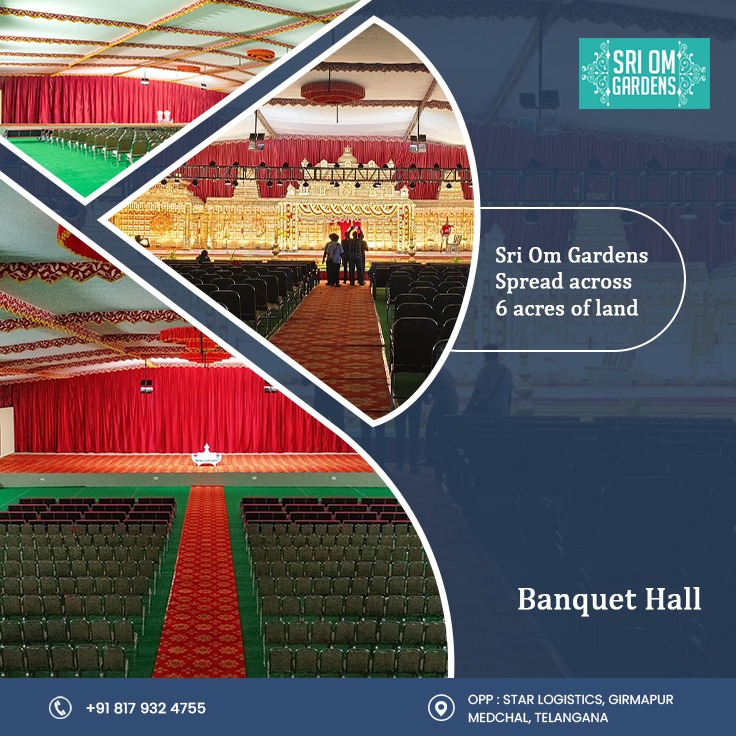
If you are looking for spacious and elegant banquet halls near Medchal, Sri Om Gardens is an ideal destination for hosting memorable celebrations and grand events. Known for its well-maintained venue and pleasant surroundings, Sri Om Gardens is a popular choice for families and event planners searching for quality convention halls in Medchal to conduct weddings, receptions, engagements, birthday p
.... Read MoreIf you are looking for spacious and elegant banquet halls near Medchal, Sri Om Gardens is an ideal destination for hosting memorable celebrations and grand events. Known for its well-maintained venue and pleasant surroundings, Sri Om Gardens is a popular choice for families and event planners searching for quality convention halls in Medchal to conduct weddings, receptions, engagements, birthday parties, corporate meetings, and social gatherings.
Sri Om Gardens offers beautifully designed banquet halls that provide ample space and a comfortable ambiance for both small and large gatherings. The venue is thoughtfully designed to ensure guests enjoy a smooth and pleasant experience during every function. With spacious seating arrangements, a well-decorated stage area, and an open atmosphere, the venue creates the perfect setting for weddings and special occasions.
When choosing convention halls in Medchal, accessibility and convenience are important factors. Sri Om Gardens provides easy access and sufficient parking space for guests, making it convenient for families and visitors attending events. The peaceful surroundings and well-organized facilities make it one of the preferred venues for hosting celebrations and cultural events in the region.
Whether you are planning a grand wedding, reception, anniversary celebration, or corporate event, Sri Om Gardens offers one of the best banquet halls near Medchal to make your event successful and memorable. The venue provides the ideal combination of space, comfort, and a welcoming environment to ensure every celebration becomes special.
Sri Om Gardens is conveniently located at Gowdavalli-Railapur Road, Girmapur, Telangana 501401, making it easily reachable for guests from Medchal and nearby areas. If you are searching for spacious banquet halls or well-equipped convention halls in Medchal, Sri Om Gardens is a perfect venue to celebrate your important occasions with family, friends, and colleagues.
𝐒𝐭𝐫𝐨𝐧𝐠 𝐬𝐞𝐜𝐮𝐫𝐢𝐭𝐲 𝐬𝐭𝐚𝐫𝐭𝐬 𝐰𝐢𝐭𝐡 𝐭𝐡𝐞 𝐫𝐢𝐠𝐡𝐭 𝐩𝐞𝐨𝐩𝐥𝐞.
Explore 10 leading Security & Man Guarding service providers in India, supporting businesses with professional guarding, workplace security and protection services.
𝐋𝐨𝐨𝐤𝐢𝐧𝐠 𝐟𝐨𝐫 𝐭𝐡𝐞 𝐫𝐢𝐠ð�
.... Read More𝐒𝐭𝐫𝐨𝐧𝐠 𝐬𝐞𝐜𝐮𝐫𝐢𝐭𝐲 𝐬𝐭𝐚𝐫𝐭𝐬 𝐰𝐢𝐭𝐡 𝐭𝐡𝐞 𝐫𝐢𝐠𝐡𝐭 𝐩𝐞𝐨𝐩𝐥𝐞.
Explore 10 leading Security & Man Guarding service providers in India, supporting businesses with professional guarding, workplace security and protection services.
𝐋𝐨𝐨𝐤𝐢𝐧𝐠 𝐟𝐨𝐫 𝐭𝐡𝐞 𝐫𝐢𝐠𝐡𝐭 𝐒𝐞𝐜𝐮𝐫𝐢𝐭𝐲 & 𝐌𝐚𝐧 𝐆𝐮𝐚𝐫𝐝𝐢𝐧𝐠 𝐩𝐚𝐫𝐭𝐧𝐞𝐫 𝐟𝐨𝐫 𝐲𝐨𝐮𝐫 𝐛𝐮𝐬𝐢𝐧𝐞𝐬𝐬?
🔗 Explore & connect on
📩 hello@facilink.co.in |
📞 +91 7045745345
𝐂𝐨𝐧𝐧𝐞𝐜𝐭. 𝐃𝐢𝐬𝐜𝐨𝐯𝐞𝐫. 𝐆𝐫𝐨𝐰.
#SecurityServices #ManGuarding #SecurityManagement #CorporateSecurity #FacilityManagement #FacilityManagementIndia #SecurityProfessionals #WorkplaceSecurity #FMSuppliers #VendorManagement #FACILINK

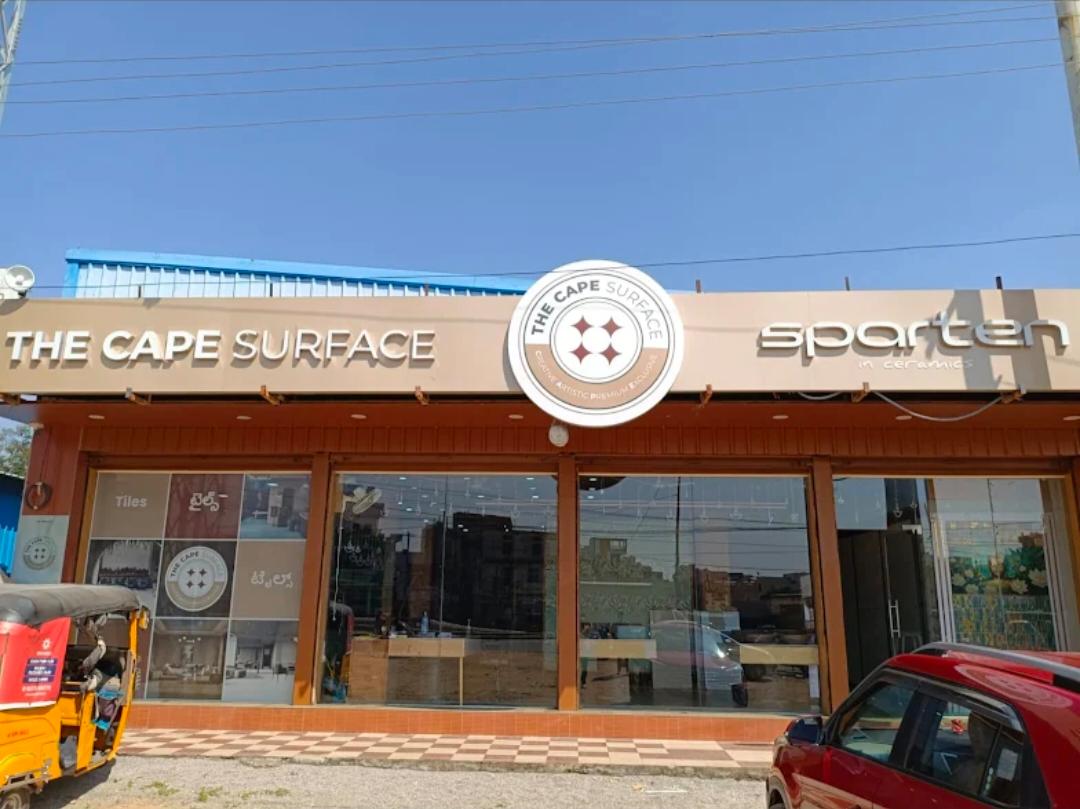
Customers looking for floor tiles dealers near me or high-quality bathroom tiles come to The Cape Surface. We offer a vast selection of tiles that include modern designs, patterns, textures and finishes that would look great in a variety of modern designs. If you're looking for strong floors or bath surfaces, we have tile options for you. Visit The Cape Surface to see our line of beautiful tile so
.... Read MoreCustomers looking for floor tiles dealers near me or high-quality bathroom tiles come to The Cape Surface. We offer a vast selection of tiles that include modern designs, patterns, textures and finishes that would look great in a variety of modern designs. If you're looking for strong floors or bath surfaces, we have tile options for you. Visit The Cape Surface to see our line of beautiful tile solutions that combine aesthetics, utility, and strength.
🚨 WE ARE HIRING | ADMIN MANAGER
Ritwik Finance is looking for an experienced and responsible Admin Manager to join our team in Jaipur, Rajasthan.
📍 Location: Jaipur
💼 Position: Admin Manager
🏢 Company: Ritwik Finance
If you have strong experience in administration, office management, vendor coordination, facility management, and branch management, we would love to hear from you.
🚨 WE ARE HIRING | ADMIN MANAGER
Ritwik Finance is looking for an experienced and responsible Admin Manager to join our team in Jaipur, Rajasthan.
📍 Location: Jaipur
💼 Position: Admin Manager
🏢 Company: Ritwik Finance
If you have strong experience in administration, office management, vendor coordination, facility management, and branch management, we would love to hear from you.
📩 Share your updated CV: hr@ritwikfinance.com
Join Ritwik Finance and grow with us!
Source: LinkedIn
Follow
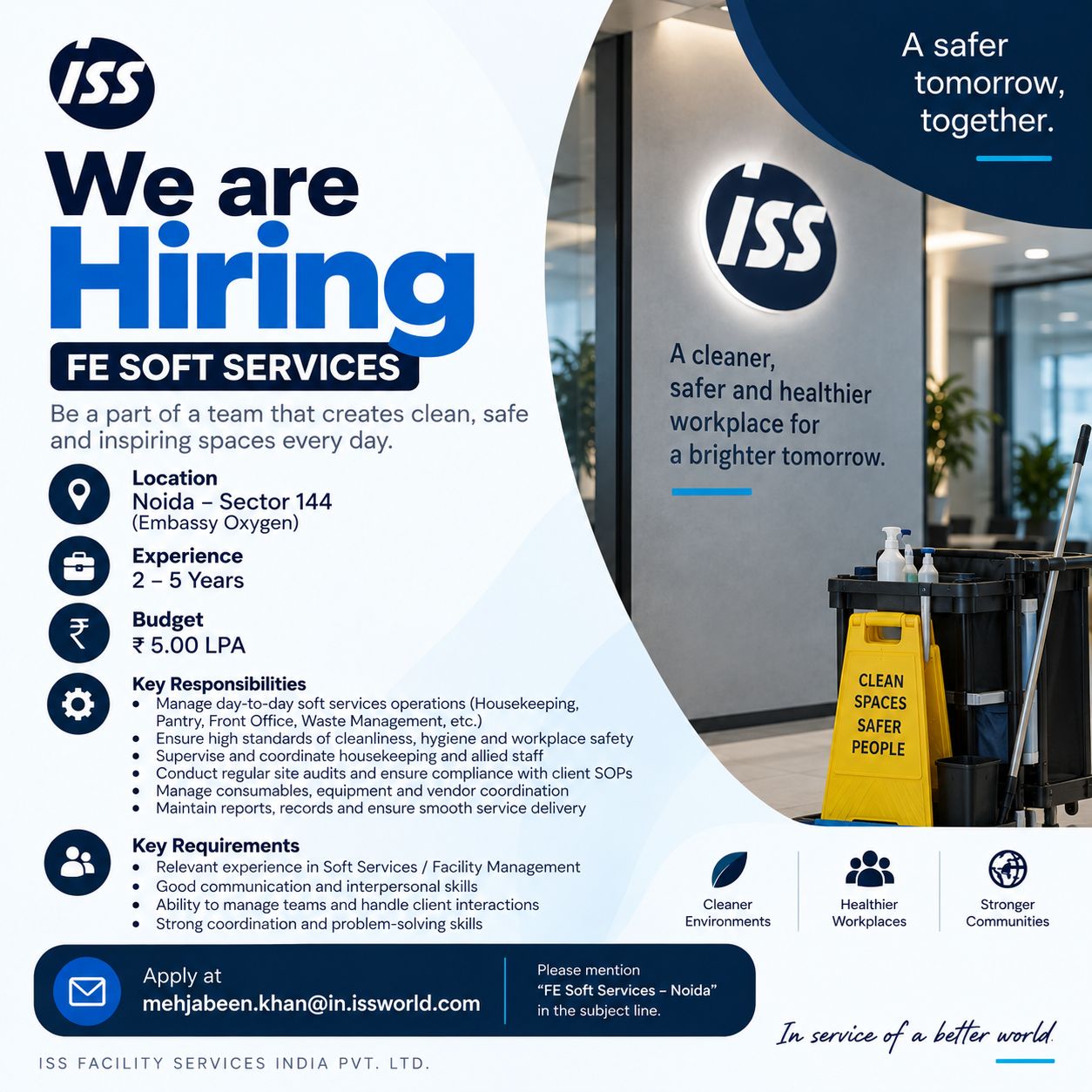
🚨 WE ARE HIRING | FE SOFT SERVICES 🚨
ISS Facility Services India is looking for a Facility Executive – Soft Services to join our team at Embassy Oxygen, Noida Sector 144.
📍 Location: Noida – Sector 144, Embassy Oxygen
💼 Experience: 2–5 Years
💰 Budget: ₹5.00 LPA
Key Responsibilities
• Manage day-to-day soft services operations including Housekeep
Follow
🚨 WE ARE HIRING | FE SOFT SERVICES 🚨
ISS Facility Services India is looking for a Facility Executive – Soft Services to join our team at Embassy Oxygen, Noida Sector 144.
📍 Location: Noida – Sector 144, Embassy Oxygen
💼 Experience: 2–5 Years
💰 Budget: ₹5.00 LPA
Key Responsibilities
• Manage day-to-day soft services operations including Housekeeping, Pantry, Front Office and Waste Management
• Ensure high standards of cleanliness, hygiene and workplace safety
• Supervise and coordinate housekeeping and allied staff
• Conduct regular site audits and ensure compliance with client SOPs
• Manage consumables, equipment and vendor coordination
• Maintain operational reports and ensure smooth service delivery
What We’re Looking For
✔ Relevant experience in Soft Services / Facility Management
✔ Good communication and interpersonal skills
✔ Ability to manage teams and handle client interactions
✔ Strong coordination and problem-solving skills
📩 Interested candidates can share their CV at:
mehjabeen.khan@in.issworld.com
Source: Linkedin
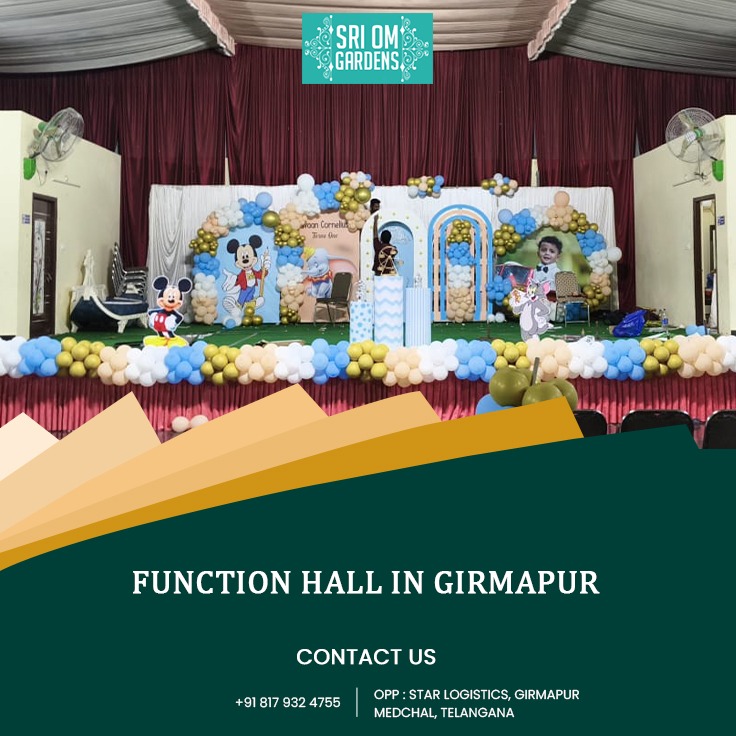
If you are searching for the best Function Hall in Girmapur, Sri Om Gardens is the perfect venue to host your special occasions with elegance and comfort. Designed to accommodate weddings, receptions, engagements, birthday parties, corporate meetings, and family gatherings, our function hall offers a spacious and well-maintained environment suitable for events of all sizes.
Sri Om Gardens is kn
.... Read MoreIf you are searching for the best Function Hall in Girmapur, Sri Om Gardens is the perfect venue to host your special occasions with elegance and comfort. Designed to accommodate weddings, receptions, engagements, birthday parties, corporate meetings, and family gatherings, our function hall offers a spacious and well-maintained environment suitable for events of all sizes.
Sri Om Gardens is known for its beautiful surroundings, ample space, and convenient facilities that make every celebration memorable. Our function hall in Girmapur provides a well-organized venue with comfortable seating arrangements, a large stage area, and a pleasant ambiance that enhances the experience for both hosts and guests. Whether you are planning a traditional wedding ceremony or a grand reception, Sri Om Gardens offers the perfect setting for your celebration.
One of the key advantages of choosing our function hall is its accessible location and spacious parking facilities, ensuring a hassle-free experience for your guests. The venue is designed to handle large gatherings while maintaining comfort and convenience for everyone attending the event.
Located at Gowdavalli-Railapur Road, Girmapur, Telangana 501401, Sri Om Gardens has become a preferred choice for families and event organizers looking for a reliable and spacious function hall in Girmapur. Our venue is ideal for wedding functions, pre-wedding ceremonies, anniversaries, cultural events, and corporate programs.
At Sri Om Gardens, we focus on providing a pleasant atmosphere and quality facilities so that every event becomes a cherished memory. If you are looking for a well-maintained and spacious function hall in Girmapur, Sri Om Gardens is the perfect destination to celebrate your special moments with family and friends.

We are Hiring!
We are looking for an Assistant Facility Manager based in Mumbai, with 5-7 years of experience in facility management/operations. Candidates with experience in hospitality or the co-working/managed office industry will be preferred. Strong client-handling and customer service skills, along with a hands-on approach to managing vendors, teams, and day-to-day centre operations, are
We are Hiring!
We are looking for an Assistant Facility Manager based in Mumbai, with 5-7 years of experience in facility management/operations. Candidates with experience in hospitality or the co-working/managed office industry will be preferred. Strong client-handling and customer service skills, along with a hands-on approach to managing vendors, teams, and day-to-day centre operations, are essential.
If you are interested please share your resume with subject line Assitant facility manager @akash.abnave@tablespace.com
Source: Linkedin
Hiring for Corporate Admin - Office Facility Management- Soft & Technical Services.
Experience required - 4 to 8 years
Job Location - Sindhu bhavan , Ahmedabad.
Soft Services and Administration
•Supervise housekeeping, security, pantry, cafeteria, pest control, waste management, courier, transport, reception, and other administrative services.
•Ensure cleanliness, hygiene, presentat
Hiring for Corporate Admin - Office Facility Management- Soft & Technical Services.
Experience required - 4 to 8 years
Job Location - Sindhu bhavan , Ahmedabad.
Soft Services and Administration
•Supervise housekeeping, security, pantry, cafeteria, pest control, waste management, courier, transport, reception, and other administrative services.
•Ensure cleanliness, hygiene, presentation, and proper upkeep of the workplace.
•Monitor availability of office supplies, stationery, pantry consumables, and maintenance materials.
•Coordinate visitor management, meeting-room arrangements, employee requests, and administrative support.
Technical Facilities Operations
•Manage daily operations of the office facility and ensure uninterrupted workplace services.
•Coordinate building maintenance, electrical, HVAC, plumbing, civil, fire safety, elevators, DG sets, and other technical services.
•Plan and monitor preventive, predictive, and corrective maintenance activities.
•Conduct regular facility inspections and ensure timely closure of identified issues.
•Maintain equipment records, maintenance logs, checklists, and service reports.
•Coordinate office repairs, renovation, relocation, space planning, and workplace improvement projects.
•Monitor utility consumption, including electricity, water, fuel, and other operational resources.
Qualification and Experience
•Bachelor’s degree in Facilities Management, Administration, Engineering, Hospitality, Business Administration, or a related field.
•Typically 5–8 years of experience in facilities, workplace, administration, property, or integrated facility management.
•Experience in managing corporate offices, commercial buildings, multiple locations, or large employee facilities will be preferred.
•Working knowledge of vendor management, budgeting, procurement, maintenance, safety, compliance, and MIS reporting.
•Experience with Excel, PowerPoint, ERP or procurement systems, ticketing tools, and facility-management software.
Required Skills
•Facility operations and workplace management.
•Vendor, contract, and SLA management.
•Budgeting, cost control, and invoice verification.
•Preventive maintenance and technical coordination.
•Housekeeping, security, pantry, and soft-service management.
•Asset tracking and inventory control.
•Statutory compliance, fire safety, and emergency management.
•Team supervision and stakeholder coordination.
•Report preparation, data analysis, and presentation skills.
•Strong communication, negotiation, follow-up, and problem-solving abilities.
Interested candidate can connect cv on manish.barot@gtpl.net
Source: Linkedin
91Springboard is looking for a Facilities professional to join our Pune team and take ownership of day-to-day facility operations across our workspace.
🔹 Role: Facility
📍 Location: Pune, Chennai
What you’ll be responsible for:
• Managing day-to-day facility & infrastructure operations
• Vendor & AMC management
• Housekeeping, security, maintenance & service coordination
•
91Springboard is looking for a Facilities professional to join our Pune team and take ownership of day-to-day facility operations across our workspace.
🔹 Role: Facility
📍 Location: Pune, Chennai
What you’ll be responsible for:
• Managing day-to-day facility & infrastructure operations
• Vendor & AMC management
• Housekeeping, security, maintenance & service coordination
• Ensuring safety, hygiene and compliance standards
• Handling preventive & corrective maintenance
• Managing facility-related budgets and operational costs
• Coordinating with internal teams, clients and vendors
• Ensuring an excellent workplace experience for our members
📩 **Interested? Share your profile pragati.kulshrestha@91springboard.com
Source: Linkedin
Build better facilities through better service.
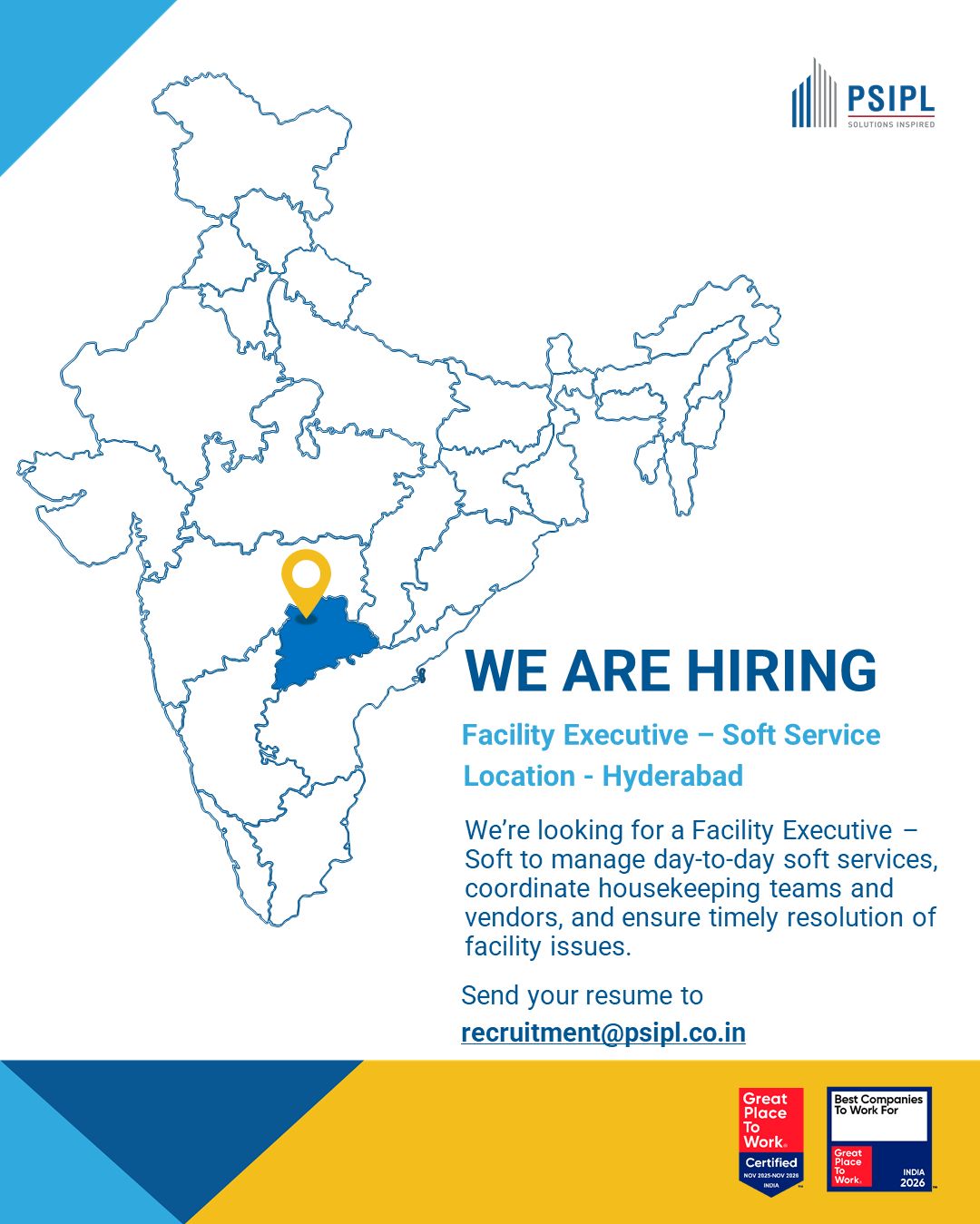
We are looking for a Facility Executive – Soft to support day-to-day soft services operations and ensure smooth service delivery at the facility.
The role will involve coordinating with housekeeping teams, conducting facility rounds, identifying and resolving issues, maintaining reports and records, supporting compliance requirements, and
Build better facilities through better service.
We are looking for a Facility Executive – Soft to support day-to-day soft services operations and ensure smooth service delivery at the facility.
The role will involve coordinating with housekeeping teams, conducting facility rounds, identifying and resolving issues, maintaining reports and records, supporting compliance requirements, and coordinating with vendors and other stakeholders.
If you have relevant experience in facility management/soft services, strong communication skills and the ability to work effectively with teams, we’d like to hear from you.
Location: Hyderabad
Apply now: recruitment@psipl.co.in
Source: Linkedin
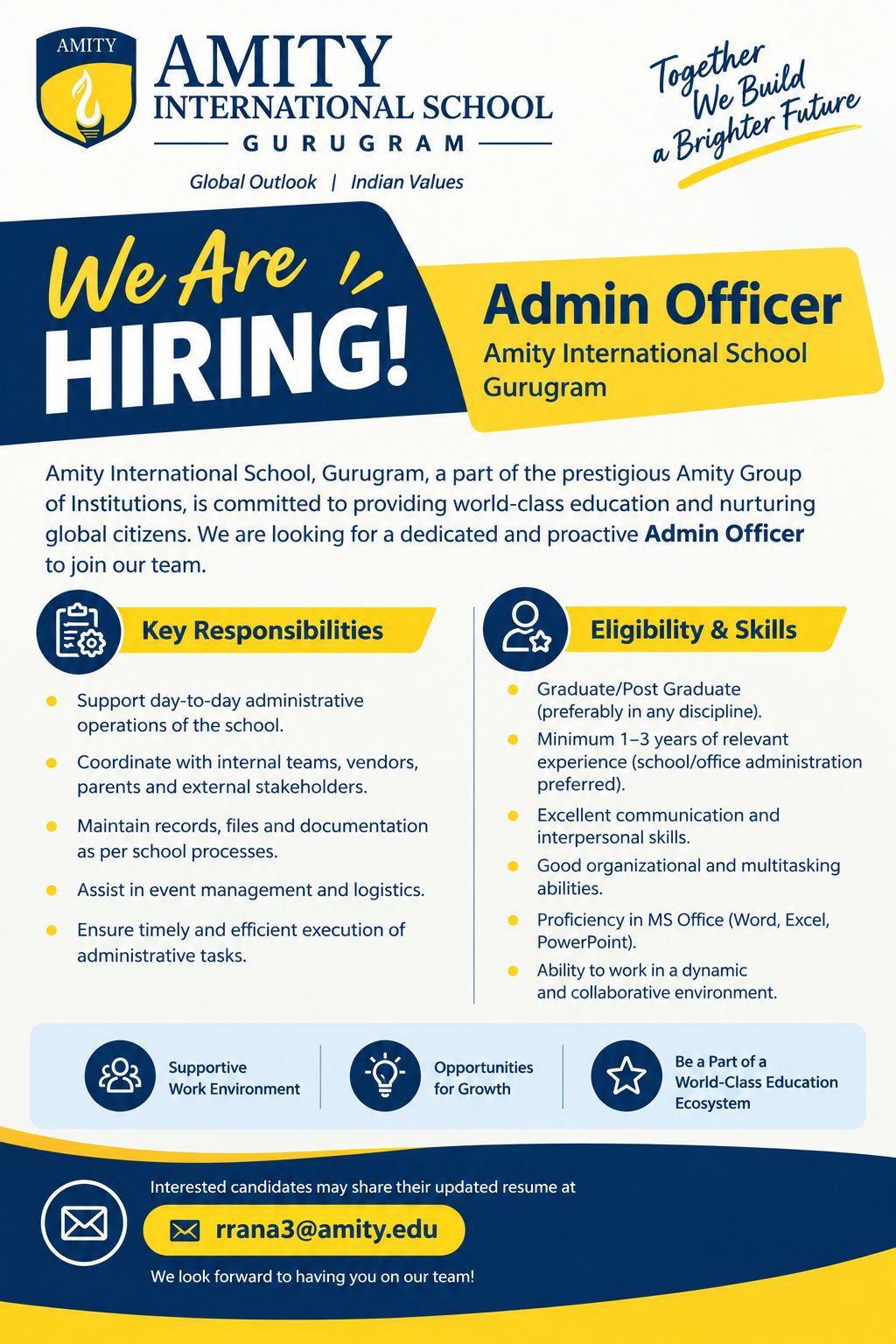
*HIRING ALERT* *ADMIN OFFICER* *AMITY INTERNATIONAL SCHOOL, GURUGRAM*
Source: Linkedin
🏢 WE’RE HIRING | PROPERTY MANAGER – RESIDENTIAL
📍 Location: Dhapa, Kolkata
💼 Experience: 7+ Years
🎓 Education: Graduation
Hospitality/ Soft Service Background Only
Key Responsibilities:
Manage day-to-day operations of a premium residential property.
Ensure smooth delivery of Soft, Technical Services, Security & Housekeeping operations.
Manage and coordinate with vendors
🏢 WE’RE HIRING | PROPERTY MANAGER – RESIDENTIAL
📍 Location: Dhapa, Kolkata
💼 Experience: 7+ Years
🎓 Education: Graduation
Hospitality/ Soft Service Background Only
Key Responsibilities:
Manage day-to-day operations of a premium residential property.
Ensure smooth delivery of Soft, Technical Services, Security & Housekeeping operations.
Manage and coordinate with vendors, contractors and service partners.
Handle resident complaints, escalations and service requests.
Monitor statutory compliance, safety and emergency preparedness.
Manage site teams, manpower deployment and performance.
Prepare MIS reports, operational dashboards and client/resident reports.
Ensure adherence to SOPs, SLAs, KPIs and quality standards.
Drive cost optimization and operational excellence.
Candidate Profile:
Graduate in any discipline.
7+ years of experience in Property Management / Facility Management.
Experience in residential property management is preferred.
Strong knowledge of building operations, housekeeping, security and vendor management.
Excellent communication, leadership and stakeholder-management skills.
Ability to manage large residential communities and handle escalations effectively.
📩 Interested candidates can share their updated CV at nawazullah.a@silagroup.co.in
Source: Linkedin
If you’re searching for a “tiles showroom near me,” you’ve found the right place. Our showroom specializes in your desired range of stunning, high-quality tile offerings. With numerous options for kitchen tiles, we strive for the right balance of design, durability, and ease of maintenance. With neutral colors or more contemporary patterns and textures, find kitchen theme and decor matchin
.... Read MoreIf you’re searching for a “tiles showroom near me,” you’ve found the right place. Our showroom specializes in your desired range of stunning, high-quality tile offerings. With numerous options for kitchen tiles, we strive for the right balance of design, durability, and ease of maintenance. With neutral colors or more contemporary patterns and textures, find kitchen theme and decor matching tiles, whether you prefer a more classic style or a more edgy and/or modern look. Visit The Cape Surface showroom to give your kitchen a new, modern and sophisticated look!
We are hiring for the position of Director / Managing Director in Property Management, located in Hyderabad.
Experience: 20+ years
Budget: ₹1.2 – 1.5 Cr Key Criteria: - Current Fixed CTC must be ≥ ₹90 LPA - Candidates should be Hyderabad-based or have prior work experience in Hyderabad
Required Qualifications: - 10+ years of Property Management experience & 5+ years in a leadershi
.... Read MoreWe are hiring for the position of Director / Managing Director in Property Management, located in Hyderabad.
Experience: 20+ years
Budget: ₹1.2 – 1.5 Cr Key Criteria: - Current Fixed CTC must be ≥ ₹90 LPA - Candidates should be Hyderabad-based or have prior work experience in Hyderabad
Required Qualifications: - 10+ years of Property Management experience & 5+ years in a leadership role - Manage Facility Operations: Lead facilities management operations across multiple cities and large campuses, ensuring consistency of service delivery while accommodating local regulatory and cultural nuances - Own the full spectrum of FM services, including engineering & hard services (MEP, HVAC, BMS, critical systems) - Proven experience managing multi-city or multi-state operations - Strong knowledge of engineering systems, safety regulations, statutory compliance, and FM best practices - Demonstrated capability in budget ownership, cost optimization, and vendor governance - Experience in large corporates, MNCs, BFSI, IT/ITES, or similarly complex environments preferred - Bachelor’s degree in Engineering, Architecture, Facilities Management, or related field - MBA or Postgraduate qualification in Operations, Real Estate, or General Management (preferred) - Certifications such as CoreNet, IFMA, RICS, PMP, NEBOSH, or equivalent (desirable) If you have relevant experience, please share your CV to madhavreddy@livecjobs.com
Source: LinkedIn
For a variety of tiles that will help you reinvent your space, look no further than The Cape Surface, Hyderabad’s number one tile shop. We have just the right combination of modern, long-lasting tiles that will fit your space. As dealers of Best Tile Shop in Hyderabad, we provide a myriad of floor and wall tiles, decorative tiles, and designer tiles for your homes, offices, hotels and all your
.... Read MoreFor a variety of tiles that will help you reinvent your space, look no further than The Cape Surface, Hyderabad’s number one tile shop. We have just the right combination of modern, long-lasting tiles that will fit your space. As dealers of Best Tile Shop in Hyderabad, we provide a myriad of floor and wall tiles, decorative tiles, and designer tiles for your homes, offices, hotels and all your commercial needs. With the focus on quality and design, The Cape Surface is here to help you create that unique, stunning, and functional space.
📢 WE’RE HIRING | SMC India – Nashik, Maharashtra
SMC Integrated Facility Management Solutions Pvt. Ltd. is hiring experienced professionals to join our team for a prestigious client – a leading educational institution in Nashik.
🔹 Facility Manager (FM) – School Operations
Experience: 4+ years
Qualification: Graduate/Diploma in Hotel Management, Facility Management, or Engineering
📢 WE’RE HIRING | SMC India – Nashik, Maharashtra
SMC Integrated Facility Management Solutions Pvt. Ltd. is hiring experienced professionals to join our team for a prestigious client – a leading educational institution in Nashik.
🔹 Facility Manager (FM) – School Operations
Experience: 4+ years
Qualification: Graduate/Diploma in Hotel Management, Facility Management, or Engineering
Key Responsibilities:
• Lead housekeeping, soft services & technical operations
• Manage hygiene, housekeeping and maintenance activities
• Oversee electrical, plumbing, HVAC, STP/WTP, DG and general maintenance
• Drive preventive maintenance through CMMS and digital systems
• Ensure fire safety, compliance, risk assessments and child-safe operations
• Manage vendors, consumables, audits and operational KPIs
🔹 Training Manager (TM) – Soft Services & Operations
Experience: 4–7 years
Qualification: Degree/Diploma in Hotel Management, Hospitality, L&D or HR
Key Responsibilities:
• Design and deliver practical training for frontline staff
• Conduct training on housekeeping SOPs, hygiene and mechanized cleaning
• Train teams on PPE, chemical handling, cross-contamination prevention and safety
• Conduct child safety, POCSO, POSH and workplace etiquette sensitization
• Drive on-floor coaching, quality audits and skill development
• Deliver training in Marathi & Hindi
📍 Location: Nashik, Maharashtra
🏫 Client: Prestigious Educational Institution
We are looking for professionals with strong operational expertise, people-management skills and a service-oriented mindset who are passionate about delivering high standards in facility management.
📩 Interested candidates can share their updated CV at: sushma@smc-india.com
Subject Line: Application – FM/TM | Nashik
Source: Linkedin
Looking out for the candidates for the front office & GRE role at our Head Office (WTC, Bikaji Cama, Delhi).
The candidate should be comfortable working 6 days a week.
Job Role:
* Managing front desk & visitor coordination
* Manages front desk interactions, helps maintain a professional office atmosphere.
* Handling calls, emails & appointments
* Maintaining office records & documentatio
Looking out for the candidates for the front office & GRE role at our Head Office (WTC, Bikaji Cama, Delhi).
The candidate should be comfortable working 6 days a week.
Job Role:
* Managing front desk & visitor coordination
* Manages front desk interactions, helps maintain a professional office atmosphere.
* Handling calls, emails & appointments
* Maintaining office records & documentation
* Coordination with internal departments
Required Skills:
* Excellent communication (Hindi & English)
* Professional appearance & etiquette
* Prior experience in Real Estate / Corporate office preferred
Interested candidates can share their resumes at sarabjeet.k@alphacorp.in or DM
Source: Linkedin
We’re Hiring | Admin & Facility Manager
Wangda Technologies Private Limited is looking for an experienced Admin & Facility Manager to join our team in Noida.
📍 Location: Noida, Uttar Pradesh
💼 Experience: 7+ Years
🏭 Preferred Background: EMS / Manufacturing Industry
🔹 Key Requirements:
Strong experience in Administration & Facility Management
Hands-on experience in manag
We’re Hiring | Admin & Facility Manager
Wangda Technologies Private Limited is looking for an experienced Admin & Facility Manager to join our team in Noida.
📍 Location: Noida, Uttar Pradesh
💼 Experience: 7+ Years
🏭 Preferred Background: EMS / Manufacturing Industry
🔹 Key Requirements:
Strong experience in Administration & Facility Management
Hands-on experience in managing day-to-day admin operations
Facility maintenance and infrastructure management
Vendor management and coordination
Housekeeping, security, transport and other facility-related activities
Employee welfare and workplace support
Strong coordination and communication skills
Ability to independently manage administrative functions in a manufacturing environment
Candidates with strong Admin & Facility Management experience in the EMS/Manufacturing sector will be preferred.
📩 Interested candidates can share their updated CV at Tamanna.gupta@wangda-in.com
Source: Linkedin
JLL Bengaluru is Hiring!
📍 When & Where:
Saturday, 26 Sep 2026 | 10:00 AM – 1:00 PM
JLL Site Office, Floor 3, Torrey Pines, Embassy Golf Links Business Park, Challaghatta, Bengaluru 560071
Hiring: MEP Lead | Engineers | Soft Services | F&B | Events | Helpdesk | Transport
Experience: 1-9 years across roles
Requirements: Updated resume + relevant experience
Join a global leader in real e
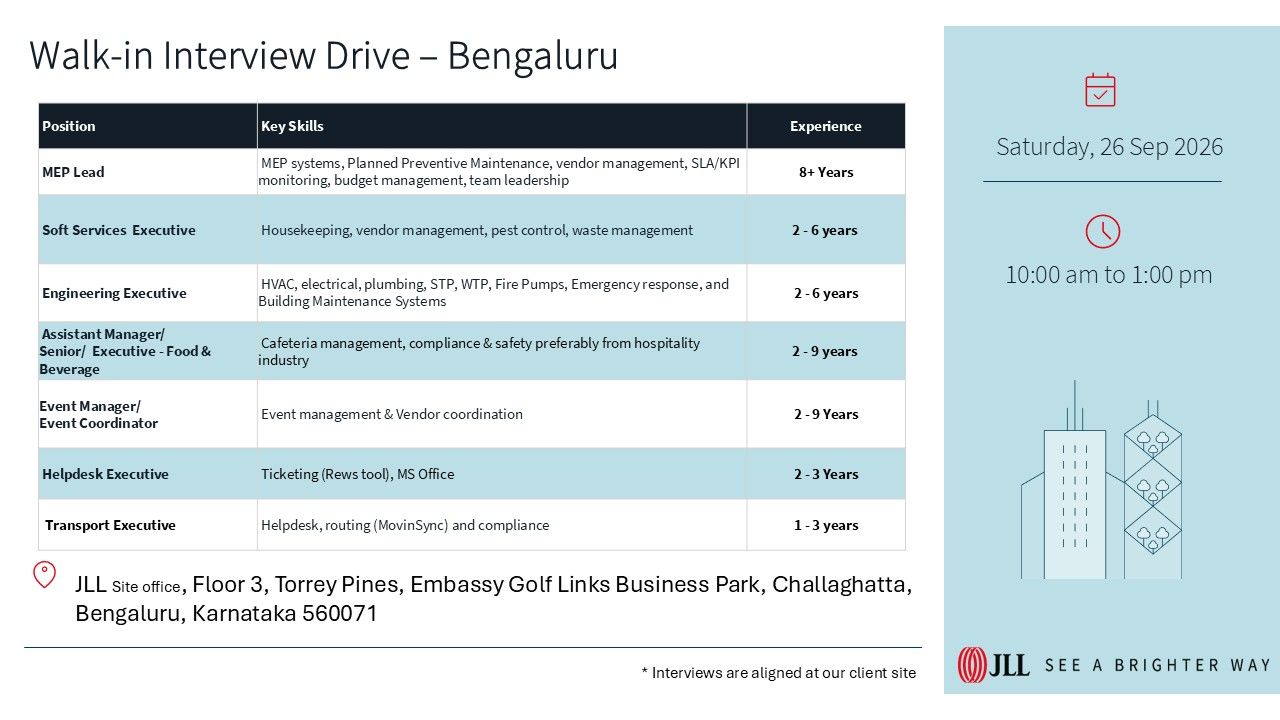
JLL Bengaluru is Hiring!
📍 When & Where:
Saturday, 26 Sep 2026 | 10:00 AM – 1:00 PM
JLL Site Office, Floor 3, Torrey Pines, Embassy Golf Links Business Park, Challaghatta, Bengaluru 560071
Hiring: MEP Lead | Engineers | Soft Services | F&B | Events | Helpdesk | Transport
Experience: 1-9 years across roles
Requirements: Updated resume + relevant experience
Join a global leader in real estate services
Source: Linkedin
Compass is Hiring | Multiple Technical & Facility Management Positions 📢
Compass Group India is looking for talented and passionate professionals to join our growing team across Maharashtra.
Open Positions
🔹 SME - Instrumentation 📍 Nashik (Dindori)
🔹 Facility Manager (Technical) 📍 Pune - Hinjewadi | Yerawada | Viman Nagar
🔹 Facility Executive (Technical) 📍 Pune (Hinje
Compass is Hiring | Multiple Technical & Facility Management Positions 📢
Compass Group India is looking for talented and passionate professionals to join our growing team across Maharashtra.
Open Positions
🔹 SME - Instrumentation 📍 Nashik (Dindori)
🔹 Facility Manager (Technical) 📍 Pune - Hinjewadi | Yerawada | Viman Nagar
🔹 Facility Executive (Technical) 📍 Pune (Hinjewadi) | Nagpur
🔹 Shift In-charge 📍 Pune (Kharadi)
🔹 Safety In-charge 📍 Pune (Kharadi)
🔹 Fit-out Coordinator 📍 Pune (Kharadi)
What We're Looking For
✅ Experience in Facility Management / Technical Operations / Engineering Services
✅ Strong problem-solving and team management skills
✅ Client-focused approach and commitment to operational excellence
📩 Interested candidates can share their resumes at: Kamalesh.More@compass-group.co.in
📞 Contact: +91 8929326114 +91 7066646522
Source: LinkedIn
🔥 𝐅𝐢𝐫𝐞 & 𝐒𝐚𝐟𝐞𝐭𝐲 𝐬𝐭𝐚𝐫𝐭𝐬 𝐰𝐢𝐭𝐡 𝐭𝐡𝐞 𝐫𝐢𝐠𝐡𝐭 𝐞𝐱𝐩𝐞𝐫𝐭𝐢𝐬𝐞.Explore 10 leading Fire & Safety companies operating in India helping businesses strengthen protection, preparedness and workplace safety.
𝐅𝐢𝐧𝐝 𝐭𝐡𝐞 𝐫𝐢𝐠𝐡𝐭 𝐅𝐢𝐫𝐞 & 𝐒𝐚𝐟𝐞𝐭𝐲 ð
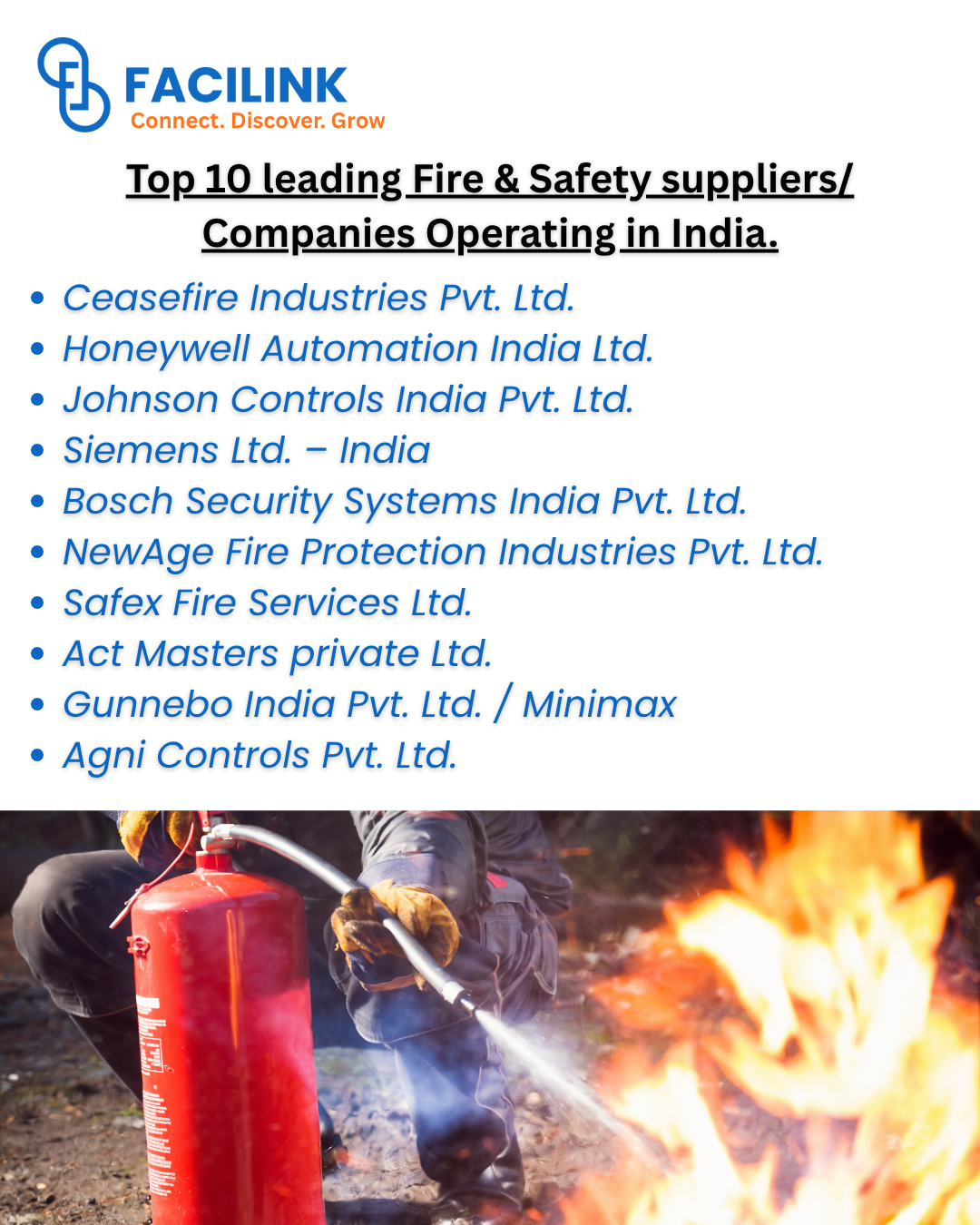
.... Read More🔥 𝐅𝐢𝐫𝐞 & 𝐒𝐚𝐟𝐞𝐭𝐲 𝐬𝐭𝐚𝐫𝐭𝐬 𝐰𝐢𝐭𝐡 𝐭𝐡𝐞 𝐫𝐢𝐠𝐡𝐭 𝐞𝐱𝐩𝐞𝐫𝐭𝐢𝐬𝐞.Explore 10 leading Fire & Safety companies operating in India helping businesses strengthen protection, preparedness and workplace safety.
𝐅𝐢𝐧𝐝 𝐭𝐡𝐞 𝐫𝐢𝐠𝐡𝐭 𝐅𝐢𝐫𝐞 & 𝐒𝐚𝐟𝐞𝐭𝐲 𝐩𝐚𝐫𝐭𝐧𝐞𝐫𝐬 𝐟𝐨𝐫 𝐲𝐨𝐮𝐫 𝐛𝐮𝐬𝐢𝐧𝐞𝐬𝐬:𝐅𝐢𝐧𝐝 𝐭𝐡𝐞 𝐫𝐢𝐠𝐡𝐭 𝐅𝐢𝐫𝐞 & 𝐒𝐚𝐟𝐞𝐭𝐲 𝐩𝐚𝐫𝐭𝐧𝐞𝐫𝐬 𝐟𝐨𝐫 𝐲𝐨𝐮𝐫 𝐛𝐮𝐬𝐢𝐧𝐞𝐬𝐬:
Explore:
𝐖𝐞𝐛𝐬𝐢𝐭𝐞: 𝐅𝐀𝐂𝐈𝐋𝐈𝐍𝐊.𝐂𝐎.𝐈𝐍
𝐄𝐦𝐚𝐢𝐥: 𝐡𝐞𝐥𝐥𝐨@𝐟𝐚𝐜𝐢𝐥𝐢𝐧𝐤.𝐜𝐨.𝐢𝐧
𝐏𝐡𝐨𝐧𝐞: +𝟗𝟏 𝟕𝟎𝟒𝟓𝟕𝟒𝟓𝟑𝟒𝟓
Connect. Discover. Grow.
#CeasefireIndustries #HoneywellIndia #JohnsonControls #SiemensIndia #BoschIndia #NewAgeFireProtection #SafexFireServices #ActMasters #GunneboIndia #Minimax #AgniControls #FireSafety #FireProtection #FireAndSafety #FacilityManagement #WorkplaceSafety #FireSafetyIndia #EHS #HSE #SafetyManagement #EmergencyPreparedness #FACILINK
URGENT HIRING | FACILITY MANAGEMENT TEAM
Facility Manager | Assistant Facility Manager
📍 Location: Bhubaneswar – Near InfoCity-2
🏢 Project: Premium New Campus / Guest House Facility
📅 Date of Joining: 1st October 2026
We are looking for experienced and quality professionals to manage our upcoming project at Bhubaneswar. The newly developed campus is IGBC Platinum Certified, requi
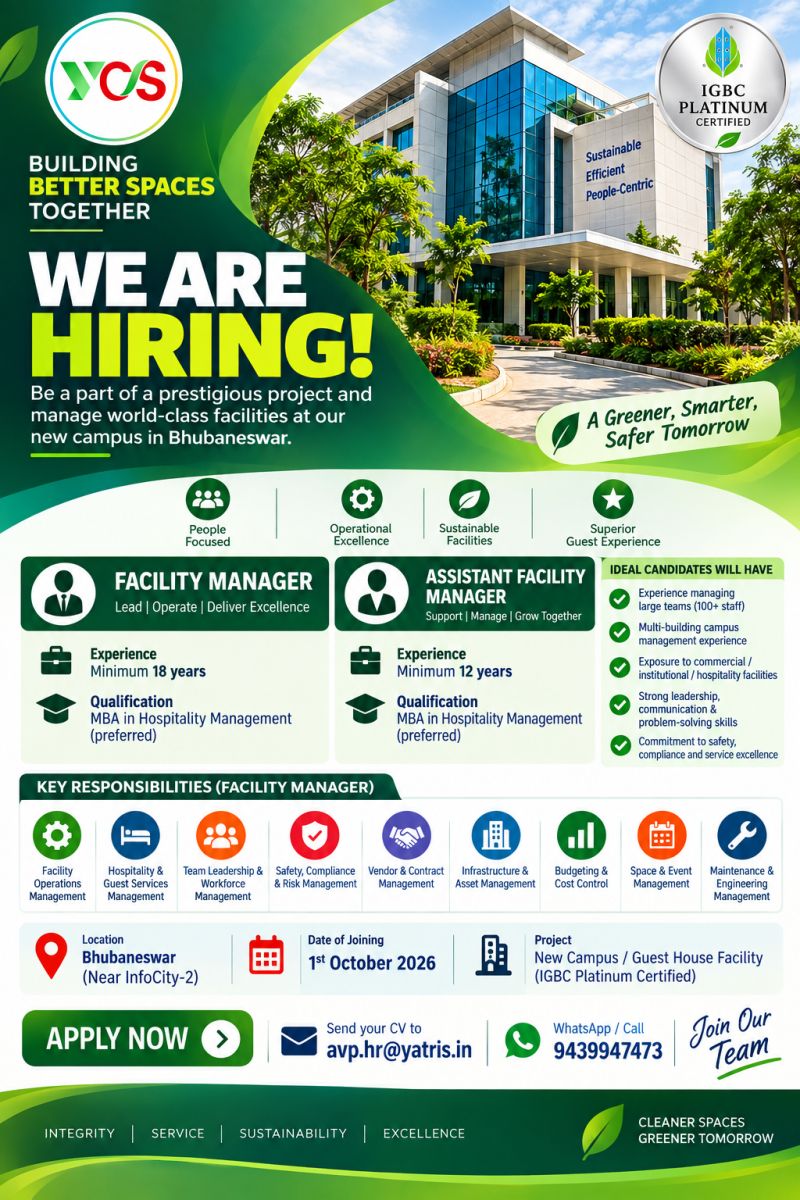
URGENT HIRING | FACILITY MANAGEMENT TEAM
Facility Manager | Assistant Facility Manager
📍 Location: Bhubaneswar – Near InfoCity-2
🏢 Project: Premium New Campus / Guest House Facility
📅 Date of Joining: 1st October 2026
We are looking for experienced and quality professionals to manage our upcoming project at Bhubaneswar. The newly developed campus is IGBC Platinum Certified, requiring a high standard of facility operations, hospitality, maintenance, safety and service delivery.
🔹 FACILITY MANAGER – KEY RESPONSIBILITIES
The Facility Manager will be responsible for the end-to-end management, operation and maintenance of multiple high-profile facilities, including residential, training, hospitality and research buildings.
Key Responsibilities:
• Facility Operations & Administration
• Hospitality & Guest Services Management
• Team Leadership & Workforce Management
• Safety, Compliance & Risk Management
• Vendor & Contract Management
• Infrastructure & Asset Management
• Budgeting & Cost Control
• Space & Event Management
• Engineering & Preventive Maintenance
• Service Quality & Customer Experience
🎓 QUALIFICATION & EXPERIENCE
• MBA in Hospitality Management preferred
• Facility Manager: Minimum 18 years of relevant experience
• Assistant Facility Manager: Minimum 12 years of relevant experience
• Experience managing large teams of 100+ employees
• Experience in managing large commercial / institutional / hospitality facilities
• Multi-building campus management experience will be an advantage
• Strong leadership, communication, coordination and problem-solving skills.
🌟 WHAT WE ARE LOOKING FOR
Professionals who can deliver operational excellence, superior guest experience, asset reliability, statutory compliance and high-quality facility services in a large and complex campus environment.
📩 Send your CV: avp.hr@yatris.in
📱 WhatsApp / Call: 9439947473
Join us in managing a premium, IGBC Platinum-certified campus and building a world-class facility experience.
Source: LinkedIn
Hiring: Front Office & Admin Executive | Immediate Joiner
We are looking for a Front Office & Admin Executive to join our team at Newtown, Kolkata.
Company: Anmol Feeds Pvt Ltd
Location: DLF Galleria,Newtown
Key Responsibilities:
• Manage front desk, calls, visitors & correspondence
• Handle day-to-day administrative activities
• Coordinate with internal teams and vendors
•
Hiring: Front Office & Admin Executive | Immediate Joiner
We are looking for a Front Office & Admin Executive to join our team at Newtown, Kolkata.
Company: Anmol Feeds Pvt Ltd
Location: DLF Galleria,Newtown
Key Responsibilities:
• Manage front desk, calls, visitors & correspondence
• Handle day-to-day administrative activities
• Coordinate with internal teams and vendors
• Maintain office records, documents & supplies
. Should handle issuance of office stationery for new and existing employees
• Support smooth functioning of the office
Requirements:
• Immediate joiner mandatory
• Good communication in English and Hindi and interpersonal skills
• Good hands on experience of MS Office
• Well-organised, proactive and presentable
• Prior experience in Front Office/Admin is required for 2-3 years.
Age should be within 28 years.
📍 Location: Newtown, Kolkata
🕘 Working Hours: 9:00 AM – 5:30 PM
📅 Working Days: 6 days a week
📩 Interested candidates can apply/share their CV at hr@anmolgroups.com or call at +91 824-0997708
Source: LinkedIn
Maflow India is hiring EHS Officer
Are you passionate about Environment, Health & Safety and looking for an opportunity to make a meaningful impact in the automotive manufacturing industry?
Maflow India is looking for a dedicated EHS Officer to join our team.
🔹 Position: Environment, Health & Safety (EHS)
🔹 Qualification: Diploma in Advanced Industrial Safety (ADIS)
🔹 Experience:
Maflow India is hiring EHS Officer
Are you passionate about Environment, Health & Safety and looking for an opportunity to make a meaningful impact in the automotive manufacturing industry?
Maflow India is looking for a dedicated EHS Officer to join our team.
🔹 Position: Environment, Health & Safety (EHS)
🔹 Qualification: Diploma in Advanced Industrial Safety (ADIS)
🔹 Experience: Relevant experience in EHS; Industry/Manufacturing experience preferred
🔹 Industry: Automobile / Auto Components Manufacturing
🔹 Location: Pune – Hinjawadi
Key Responsibilities:
✅ Safety inspections, audits, HIRA/JSA and PPE compliance
✅ Incident investigation and corrective/preventive actions
✅ Statutory and environmental compliance
✅ Contractor safety management
✅ Emergency preparedness, mock drills and safety training
✅ ISO 45001 & ISO 14001 implementation and maintenance
✅ Waste management and environmental compliance
✅ EHS reporting and performance monitoring
📩 Interested candidates can share their updated resume at:
ashwini.chavan@maflow.com
atul.patil@maflow.com
Join us in building a safer workplace, a cleaner planet and a stronger tomorrow!
Source: LinkedIn
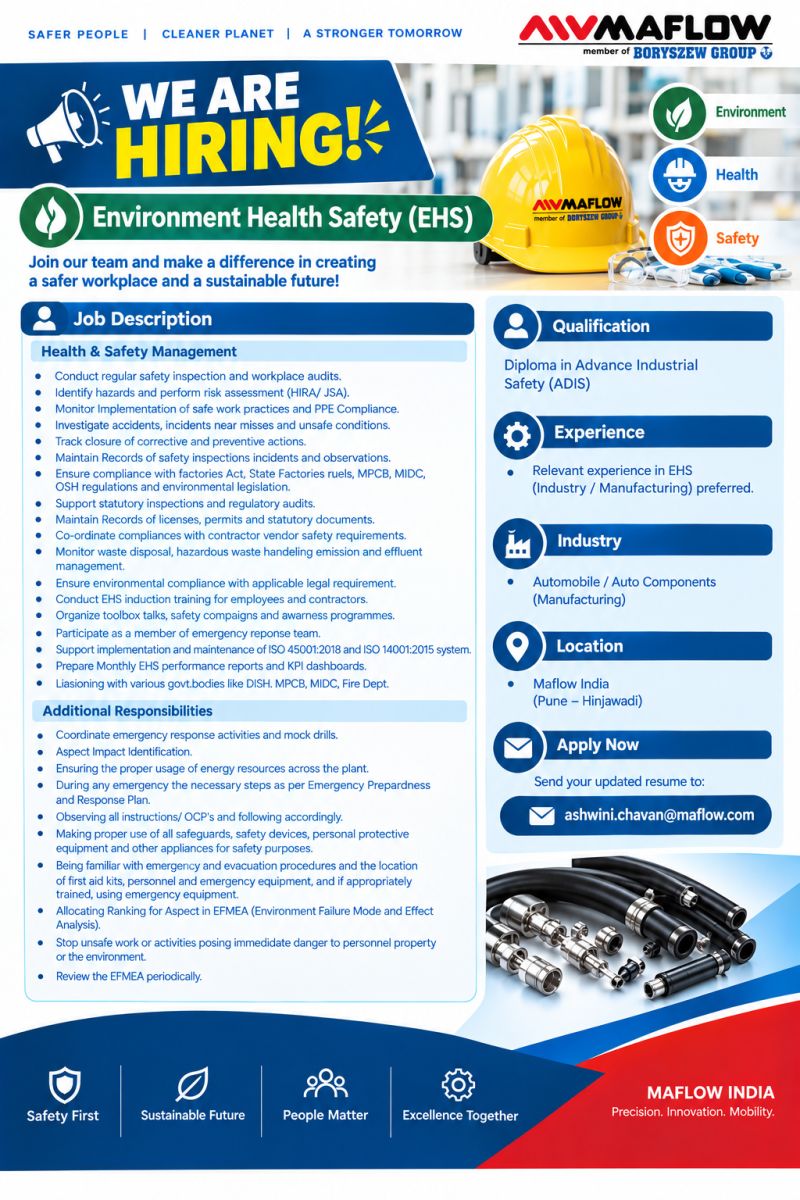
JOIN JLL - Walk-in Interview Drive at Hyderabad!
We're excited to announce a Walk-in Interview opportunity at JLL's site location. Come meet our team and explore exciting career opportunities in facility management, technical services, and engineering excellence.
📅 Event Details:
• Date: Saturday, September 19
• Time: 10:00 AM to 2:00 PM
• Venue: JLL Site office, Building No 9, F
JOIN JLL - Walk-in Interview Drive at Hyderabad!
We're excited to announce a Walk-in Interview opportunity at JLL's site location. Come meet our team and explore exciting career opportunities in facility management, technical services, and engineering excellence.
📅 Event Details:
• Date: Saturday, September 19
• Time: 10:00 AM to 2:00 PM
• Venue: JLL Site office, Building No 9, Floor S, Training Room, Raheja Mindspace IT Park, Mindspace Madhapur Rd, Opposite The Westin Hyderabad Mindspace, HITEC City, Hyderabad, Telangana 500081
✅ What to Bring: • Updated resume
📋 For complete role details and requirements, please refer to the attached template below.
Ready to See A Brighter Way with your career? Walk in on 19 Sep 2026 - no appointment necessary!
Source: LinkedIn
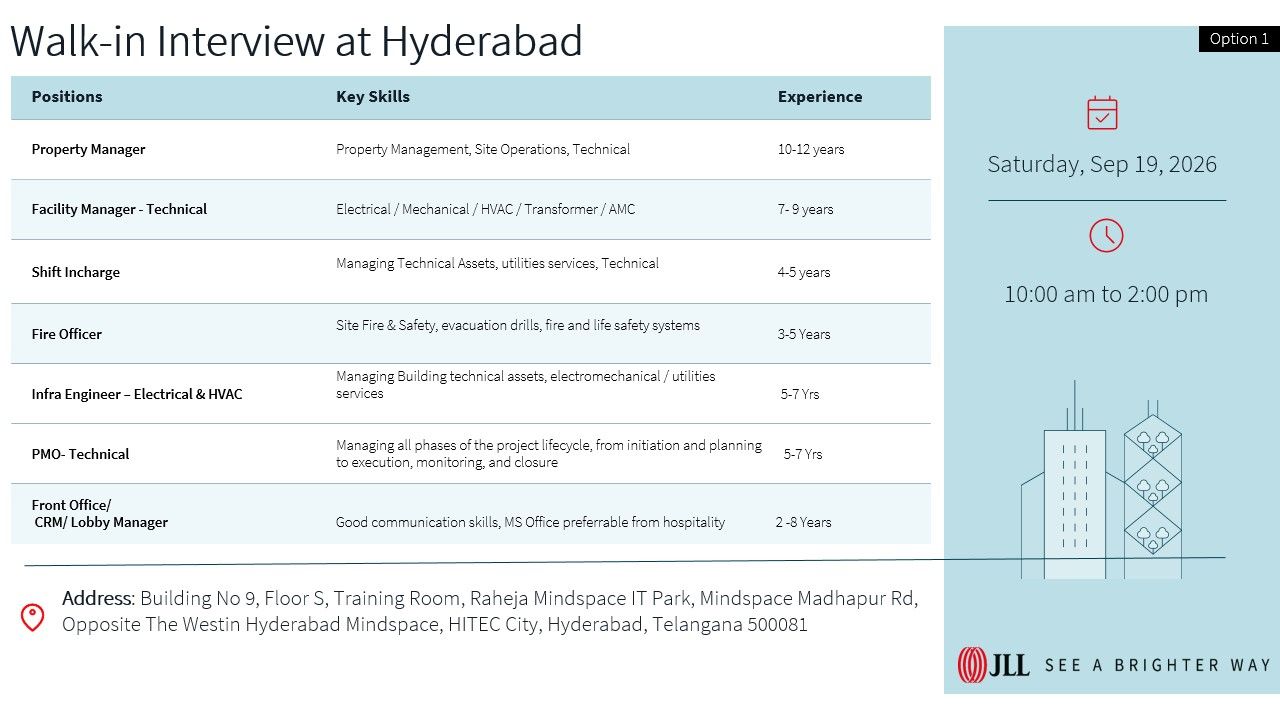
Novotel Ahmedabad is Hiring!
We are looking for a well-experienced and skilled Engineering Manager to join our dynamic team.
If you are passionate about Engineering, have strong leadership skills, and possess relevant hotel experience, we would love to hear from you!
📍 Location: Novotel Ahmedabad
💼 Position: Engineering Manager
Interested candidates can apply through the link be
Novotel Ahmedabad is Hiring!
We are looking for a well-experienced and skilled Engineering Manager to join our dynamic team.
If you are passionate about Engineering, have strong leadership skills, and possess relevant hotel experience, we would love to hear from you!
📍 Location: Novotel Ahmedabad
💼 Position: Engineering Manager
Interested candidates can apply through the link below or share his/her profile on Brawny.chaturvedi@accor.com
Know someone who could be the right fit? Feel free to share this opportunity!
Source: LinkedIn
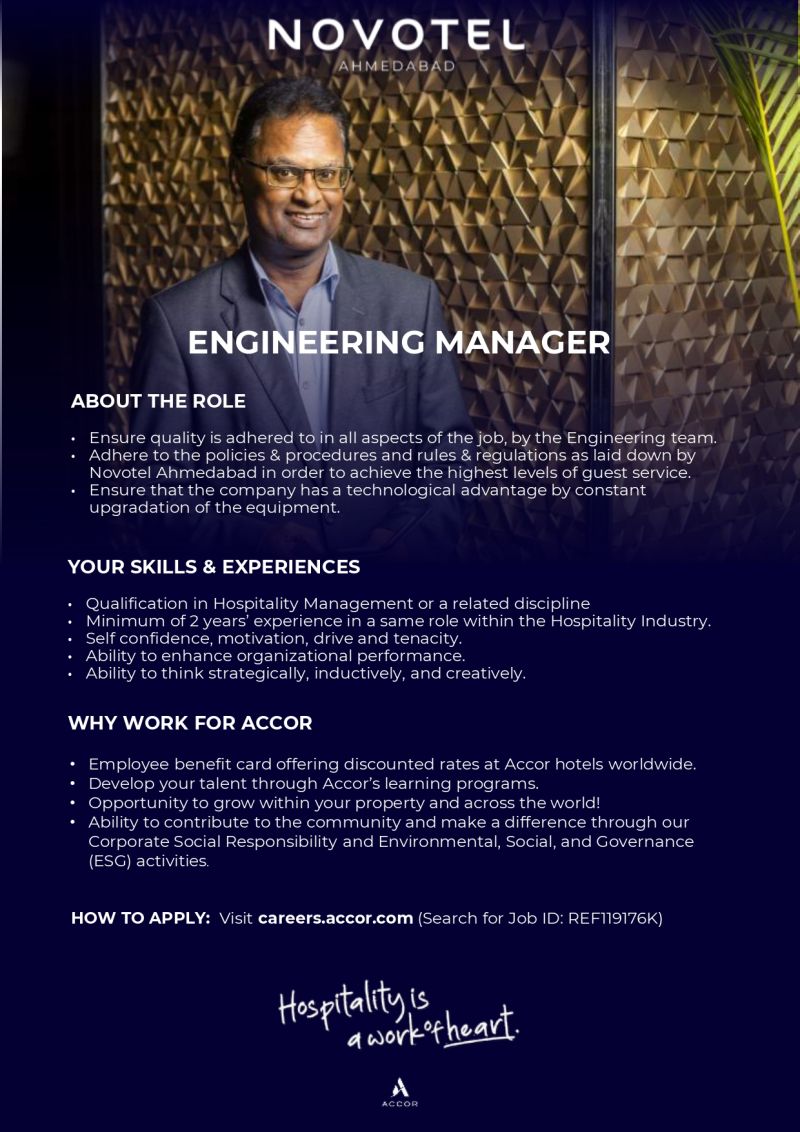
Secure 24 is looking for an 𝐀𝐬𝐬𝐨𝐜𝐢𝐚𝐭𝐞 𝐕𝐢𝐜𝐞 𝐏𝐫𝐞𝐬𝐢𝐝𝐞𝐧𝐭 – 𝐎𝐩𝐞𝐫𝐚𝐭𝐢𝐨𝐧𝐬 to lead and manage security operations across multiple sites.
If you have 10+ years of experience in security guarding or facility management, strong leadership and communication skills, and the ability to manage large teams and mult
Secure 24 is looking for an 𝐀𝐬𝐬𝐨𝐜𝐢𝐚𝐭𝐞 𝐕𝐢𝐜𝐞 𝐏𝐫𝐞𝐬𝐢𝐝𝐞𝐧𝐭 – 𝐎𝐩𝐞𝐫𝐚𝐭𝐢𝐨𝐧𝐬 to lead and manage security operations across multiple sites.
If you have 10+ years of experience in security guarding or facility management, strong leadership and communication skills, and the ability to manage large teams and multiple locations, this could be the right opportunity for you.
𝐊𝐞𝐲 𝐑𝐞𝐬𝐩𝐨𝐧𝐬𝐢𝐛𝐢𝐥𝐢𝐭𝐢𝐞𝐬:
• Manage security operations across multiple sites
• Build strong client relationships and ensure customer satisfaction
• Plan manpower deployment and reduce attrition
• Ensure high security standards and handle incidents
• Ensure compliance with SOPs and statutory requirements
• Control operational costs and drive performance
𝐂𝐚𝐧𝐝𝐢𝐝𝐚𝐭𝐞 𝐏𝐫𝐨𝐟𝐢𝐥𝐞:
• 10+ years of experience in security/facility management
• Experience managing multiple sites and large teams
• Strong leadership and communication skills
• Willingness to travel extensively
• Ex-Serviceman from the Army / Navy / Air Force preferred
• Experience in administration and manpower management preferred
• Graduate preferred
𝐋𝐨𝐜𝐚𝐭𝐢𝐨𝐧: Pan India / Mumbai
𝐄𝐦𝐩𝐥𝐨𝐲𝐦𝐞𝐧𝐭: Full-time
𝐑𝐞𝐩𝐨𝐫𝐭𝐢𝐧𝐠 𝐓𝐨: Managing Director / Director – Operations
Interested candidates can share their CV at hrmanager@secure24.co.in or contact on 9930015341. Visit www.secure24.co.in
Source: LinkedIn
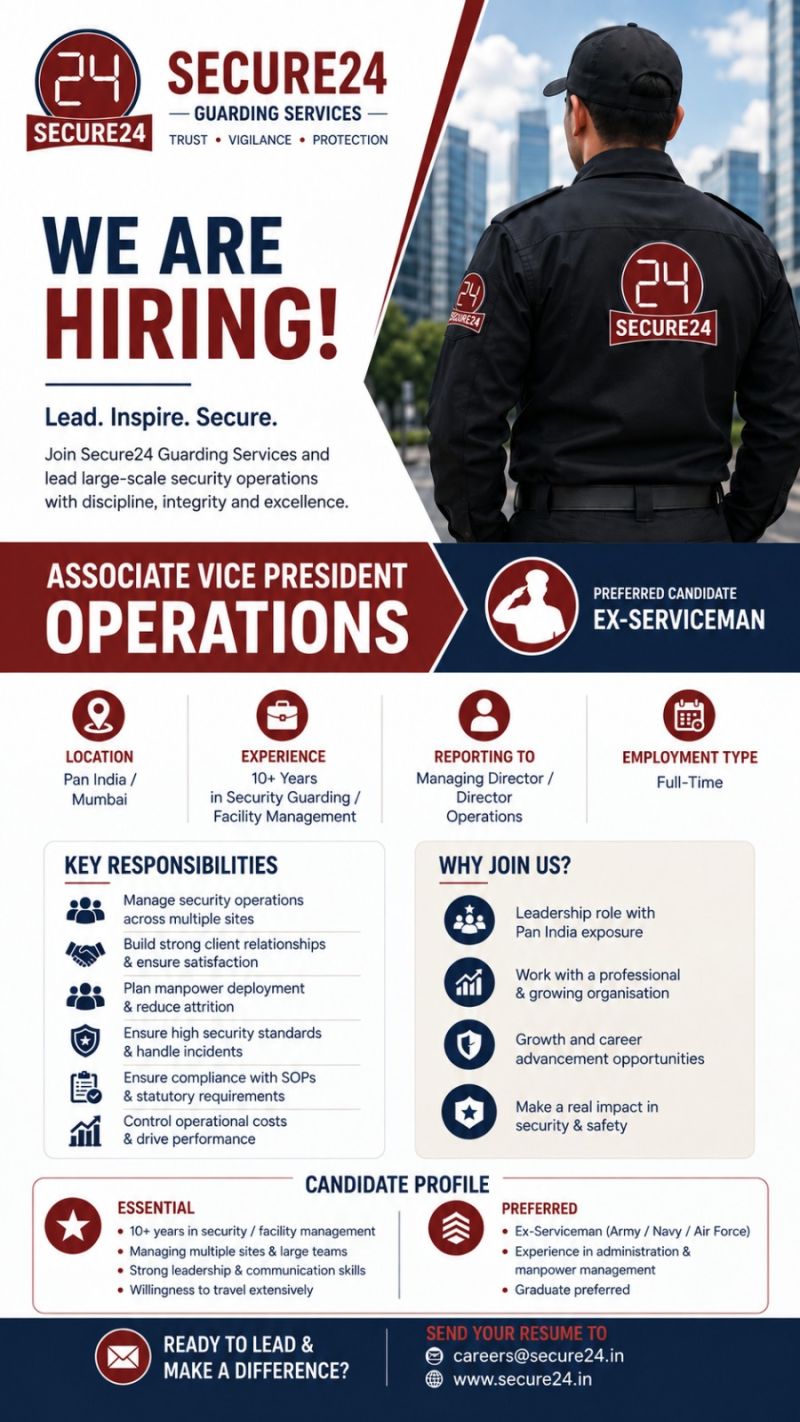
WE ARE HIRING | HEAD – SECURITY & FACILITY 🚨
Easy Source HR Solutions is looking for an experienced and dynamic leader to build and establish our Security & Facility Management vertical from scratch!
📌 Position: Head – Security & Facility
📍 Location: Delhi / Gurgaon
💼 Experience: 15+ Years (Core Industry Experience)
💰 CTC: upto 25 LPA
🎯 Age: Below 50 Years
🔹 K
WE ARE HIRING | HEAD – SECURITY & FACILITY 🚨
Easy Source HR Solutions is looking for an experienced and dynamic leader to build and establish our Security & Facility Management vertical from scratch!
📌 Position: Head – Security & Facility
📍 Location: Delhi / Gurgaon
💼 Experience: 15+ Years (Core Industry Experience)
💰 CTC: upto 25 LPA
🎯 Age: Below 50 Years
🔹 Key Opportunity
We currently hold 4 PASARA Licenses and are looking for a strategic leader who can take complete ownership of operationalising these licenses and building a scalable Security & Facility Management business.
The ideal candidate should have a proven track record of setting up security and facility operations from the ground up.
🔹 Key Responsibilities
✅ Establish and build the Security & Facility vertical
✅ Operationalise existing PASARA licenses
✅ Drive business development and client acquisition
✅ Build operational teams and service delivery processes
✅ Manage compliance, profitability, and business growth
✅ Lead the department's overall expansion and success
🔹 Who Are We Looking For?
🔸 15+ years of relevant industry experience
🔸 Proven experience in setting up operations from scratch
🔸 Strong knowledge of security services, PASARA licensing & compliance
🔸 Business development and client management expertise
🔸 Excellent leadership and team-building capabilities
📩 Interested candidates or relevant referrals are welcome to connect with me. yogendra.bairwa@easysourceindia.com
Let's build and scale something impactful together! 🚀
Source: LinkedIn
Berry Alloys Ltd Hiring | Administration & Facilities Manager
Berry Alloys Limited is looking for an experienced Administration & Facilities Manager to join our team in Visakhapatnam.
🔹 Experience: 2–5 years
🔹 Qualification: Bachelor’s degree in Business Administration, Management, Commerce, Facilities Management, or related field
🔹 Preferred Gender: Male
🔹 Key Skills: Adm
Berry Alloys Ltd Hiring | Administration & Facilities Manager
Berry Alloys Limited is looking for an experienced Administration & Facilities Manager to join our team in Visakhapatnam.
🔹 Experience: 2–5 years
🔹 Qualification: Bachelor’s degree in Business Administration, Management, Commerce, Facilities Management, or related field
🔹 Preferred Gender: Male
🔹 Key Skills: Administration • Facility Management • Vendor Management • MS Office • Communication • Negotiation
📩 Send your CV: ea.md@berryalloys.in
🌐 www.berryalloys.com
Source: LinkedIn
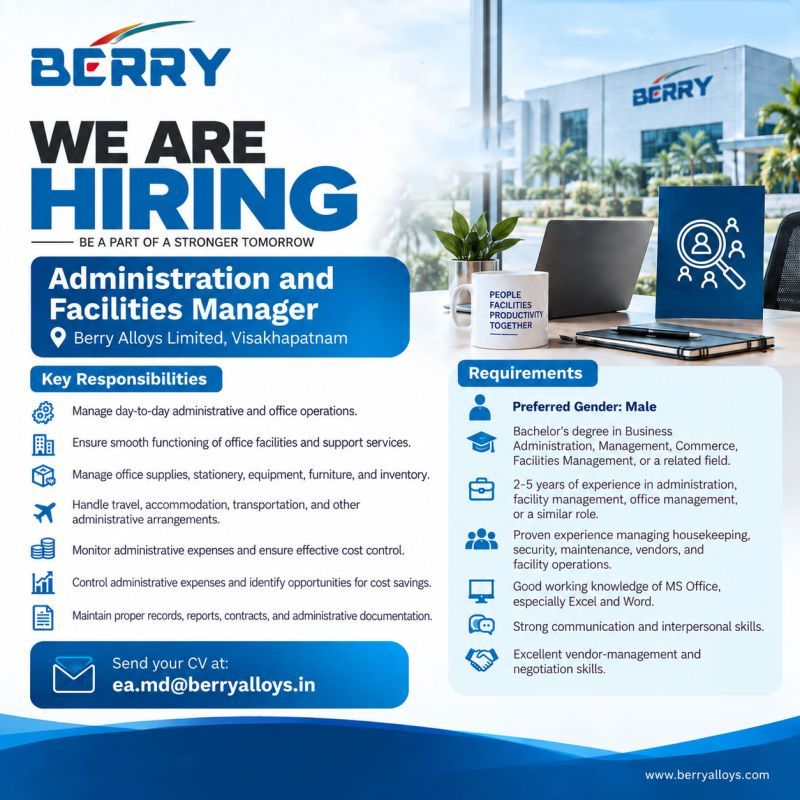
Simpliwork is hiring
We’re expanding our Facility team and looking for driven professionals to join us in key roles across India.
Multiple roles. Pan-India opportunities. A chance to grow with a team shaping the future of offices.
Think you’re a fit? We’d love to hear from you.
Apply now by sending your resume to careers@simpliwork.com or through the careers section of our websit
Simpliwork is hiring
We’re expanding our Facility team and looking for driven professionals to join us in key roles across India.
Multiple roles. Pan-India opportunities. A chance to grow with a team shaping the future of offices.
Think you’re a fit? We’d love to hear from you.
Apply now by sending your resume to careers@simpliwork.com or through the careers section of our website.
Source: LinkedIn
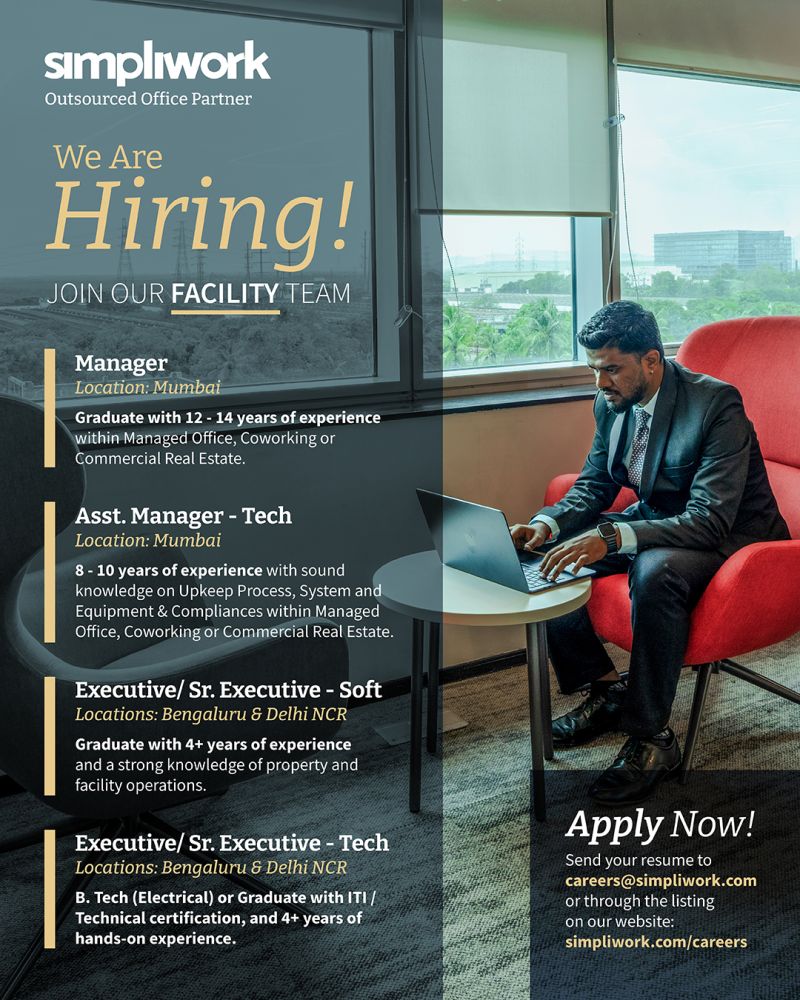
UDS is hiring!
We are looking for Assistant property Managar for residential complex in panvel Navi Mumbai.
Intrested candidate can DM or WhatsApp!
Source: LinkedIn
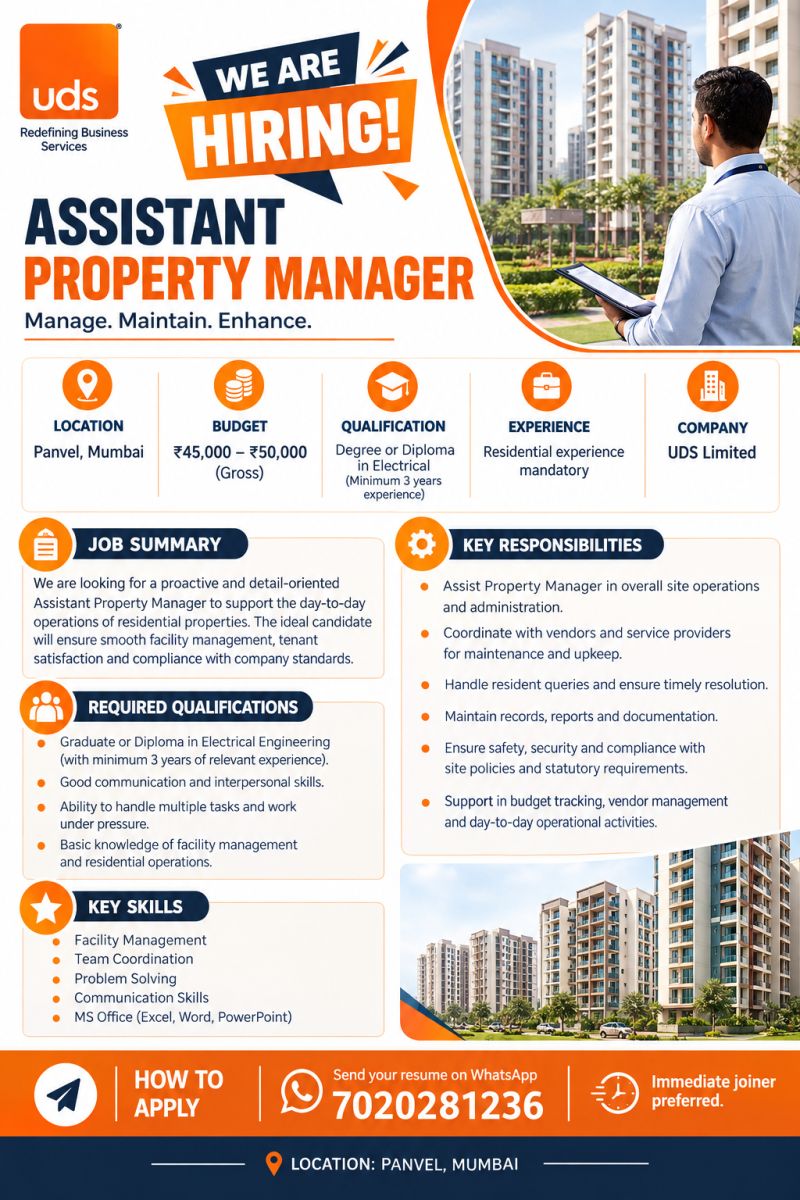
AMRUT HOSPITALITY SERVICES LLP in Ahmedabad
Position: UNIT MANAGER
Industrial Catering Services (Manufacturing)
2 Positions
JOB DETAILS
Location: Sanand, Ahmedabad
Education: Graduate and IHM, BHM and HM Holder
Experience: 7–10 Years
Food & Accommodation: Will be provided by company
ROLE OVERVIEW
We are looking for dynamic and experienced
.... Read MoreAMRUT HOSPITALITY SERVICES LLP in Ahmedabad
Position: UNIT MANAGER
Industrial Catering Services (Manufacturing)
2 Positions
JOB DETAILS
Location: Sanand, Ahmedabad
Education: Graduate and IHM, BHM and HM Holder
Experience: 7–10 Years
Food & Accommodation: Will be provided by company
ROLE OVERVIEW
We are looking for dynamic and experienced Unit Managers to manage and oversee our industrial catering operations efficiently, with a focus on quality, hygiene, people management and client satisfaction.
APPLICATION
Interested candidates may share their updated CV:
📧 Email: gmoperation@amruthospitality.com
📱 WhatsApp: 85111 73497
Immediate Joiner Preferred!
Be a part of a growing team and build a successful career with us!
Source: LinkedIn
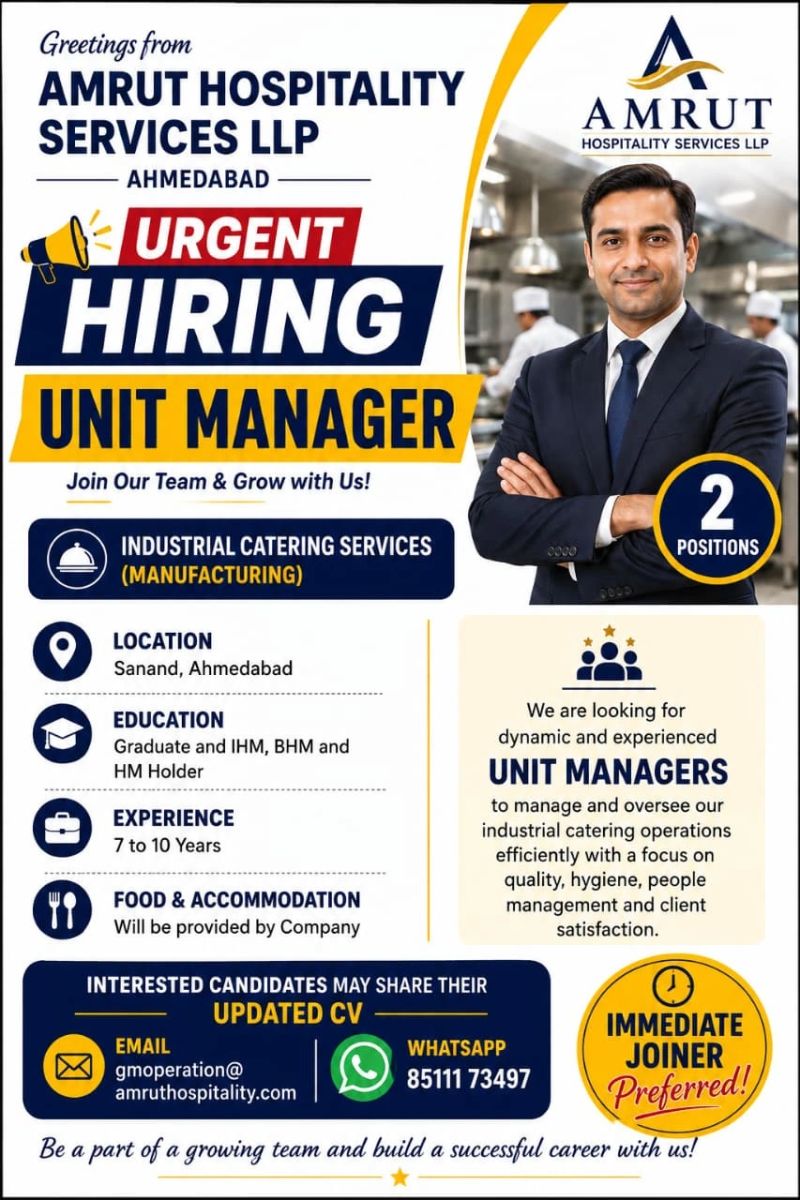
Prestige Group in retail is hiring for Forum South Bengaluru (Bengaluru location).
Source: LinkedIn
WE ARE HIRING! | ISS Facility Services India Pvt. Ltd.
Join ISS Facility Services India Pvt. Ltd. and be part of a team that keeps the world running smoothly! 🌍
📍 Location: Hinjewadi Phase 2, Pune
1️⃣ Facility Executive
• 3–4 years of experience
• Soft Services & Technical knowledge required
• 💰 Salary: ₹35,000 – ₹40,000 Gross
2️⃣ Front Office Executive
• M
WE ARE HIRING! | ISS Facility Services India Pvt. Ltd.
Join ISS Facility Services India Pvt. Ltd. and be part of a team that keeps the world running smoothly! 🌍
📍 Location: Hinjewadi Phase 2, Pune
1️⃣ Facility Executive
• 3–4 years of experience
• Soft Services & Technical knowledge required
• 💰 Salary: ₹35,000 – ₹40,000 Gross
2️⃣ Front Office Executive
• Minimum 3 years of Front Office experience
• 💰 Salary: ₹25,000 – ₹30,000 Gross
✨ Why Join Us?
✔ Stable Organization
✔ Growth Opportunities
✔ Supportive Work Culture
✔ Global Presence
📩 Interested candidates can share their updated profiles at the earliest.
Apply Now & Join ISS!
Source: LinkedIn
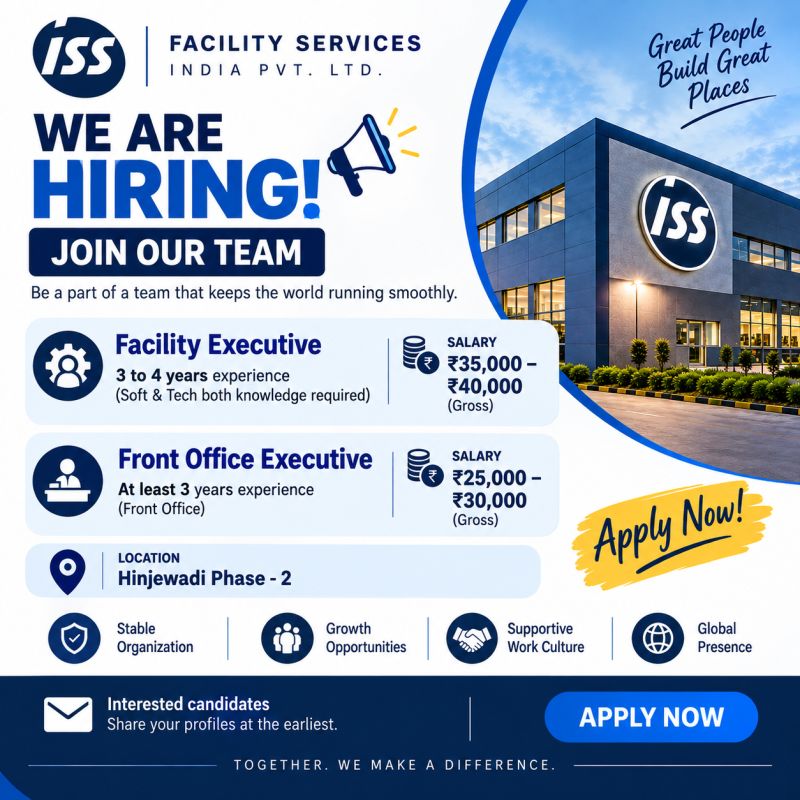
Truliv is on an exciting growth journey, and we are looking for a dynamic Assistant General Manager – Operations to lead our chennai operations. This role is ideal for someone who thrives in fast-paced environments, brings strong operational expertise, and is passionate about driving excellence and growth.If you’re ready to take on a leadership role and grow with Truliv, we’d love to hear fr
.... Read MoreTruliv is on an exciting growth journey, and we are looking for a dynamic Assistant General Manager – Operations to lead our chennai operations. This role is ideal for someone who thrives in fast-paced environments, brings strong operational expertise, and is passionate about driving excellence and growth.If you’re ready to take on a leadership role and grow with Truliv, we’d love to hear from you!
Source: LinkedIn
🚀 JLL is HIRING: Civil & Construction Project & Senior Project Coordinator | Gurugram
Ready to elevate construction project delivery on a global stage?
What We Need:
✅ Civil Engineering degree/diploma
✅ 2–6 years in construction project coordination
✅ Client-facing experience (preferred)
✅ Proficiency: MS Project, Asana, Smartsheet, AutoCAD, REVIT
✅ Sharp organizational &
🚀 JLL is HIRING: Civil & Construction Project & Senior Project Coordinator | Gurugram
Ready to elevate construction project delivery on a global stage?
What We Need:
✅ Civil Engineering degree/diploma
✅ 2–6 years in construction project coordination
✅ Client-facing experience (preferred)
✅ Proficiency: MS Project, Asana, Smartsheet, AutoCAD, REVIT
✅ Sharp organizational & communication skills
What You'll Do:
• Drive project planning, scheduling & progress tracking
• Manage documentation, variance analysis & stakeholder reporting
• Enable seamless cross-geography collaboration
• Support budget tracking & quality delivery
The Details:
📍 Sector-30, Gurugram (Hybrid)
⏰ EMEA/UK hours (1:00 PM – 10:00 PM IST)
Why JLL? Work with a global real estate leader. Build impactful projects. Grow your career alongside industry experts in an inclusive, innovative environment.
Ready to make your mark?
📧 Send your resume to prince.praj@jll.com
Source: Linkedin
We’re Hiring | Assistant Facility Manager – Soft Services | Gurgaon
JLL is looking for a motivated Assistant Facility Manager – Soft Services to join a prestigious client account in Gurgaon.
What we’re looking for:
- Minimum 5–7 years of experience in Facilities Management (Corporate or Hospitality background preferred)
- Strong communication and stakeholder management skills
-
We’re Hiring | Assistant Facility Manager – Soft Services | Gurgaon
JLL is looking for a motivated Assistant Facility Manager – Soft Services to join a prestigious client account in Gurgaon.
What we’re looking for:
- Minimum 5–7 years of experience in Facilities Management (Corporate or Hospitality background preferred)
- Strong communication and stakeholder management skills
- Solid hands-on knowledge of core FM areas: manpower management, vendor management, and day-to-day soft services operations
- Self-driven, proactive, and ready to take ownership
No gender constraints. Role is on JLL payroll.
If this sounds like you (or someone in your network), please share the CV at rohit.sharma9@jll.com.
Looking forward to connecting with the right talent!
Source:Linkedin
Dear Connections!!🚶♂️
🚶♂️ Walk-In Interview Drive! 🚶♀️
Join Our Admin Team
We’re Hiring Skilled Professionals to Drive Success!
📅 Date: 9th Sep 2026
🕘 Time: 10:30 AM to 3:30 PM
📍 Venue: Godrej Properties Ltd.
3rd Floor (Gate No.2), Um House Tower A, Plot No - 35, Sector 44, Gurgaon – 122003
Landmark – Post Office
Contact Person: Ms. Garim
Dear Connections!!🚶♂️
🚶♂️ Walk-In Interview Drive! 🚶♀️
Join Our Admin Team
We’re Hiring Skilled Professionals to Drive Success!
📅 Date: 9th Sep 2026
🕘 Time: 10:30 AM to 3:30 PM
📍 Venue: Godrej Properties Ltd.
3rd Floor (Gate No.2), Um House Tower A, Plot No - 35, Sector 44, Gurgaon – 122003
Landmark – Post Office
Contact Person: Ms. Garima Singh (HR)
Share your resume on below mentioned email ids:
garima.singh01@godrejproperties.com
Source: Linkedin
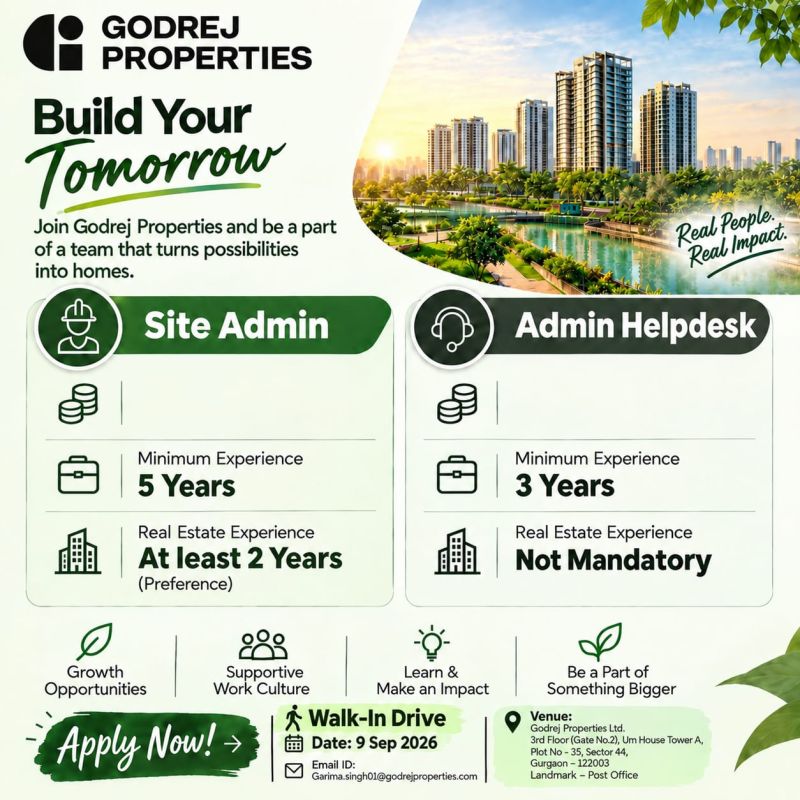
We're expanding! Join thekilowatt (a CLR company) – Multiple Engineering Roles in Gujarat! ⚡
Post:
Are you an experienced engineer ready for your next challenge in the power and operations sector? thekilowatt, partnering with CLR (Simply Better), is hiring multiple key engineering positions across our locations in Gujarat.
We are looking for dedicated professionals to fill the following
We're expanding! Join thekilowatt (a CLR company) – Multiple Engineering Roles in Gujarat! ⚡
Post:
Are you an experienced engineer ready for your next challenge in the power and operations sector? thekilowatt, partnering with CLR (Simply Better), is hiring multiple key engineering positions across our locations in Gujarat.
We are looking for dedicated professionals to fill the following roles:
🔧 Service Engineer
Locations: Ahmedabad (1) & Surat (1)
Qualifications: 2+ yrs exp., Diploma/ITI, FAS, BMS, CCTV, Access Control, Preventive & Breakdown Maintenance.
⚙️ Installation & Commissioning Engineer
Location: Jamnagar (8)
Qualifications: 6-8 yrs exp., BE/BTech, Installation, Testing, Loop Checks, Commissioning, Site Handover.
✅ Site Quality Engineer
Location: Jamnagar (1)
Qualifications: 6-8 yrs exp., BE/BTech, Construction QA/QC, ITPs, Method Statements, Site Inspections.
Ready to make an impact? Power your career with us.
How to Apply: Share your CV directly with us!
📩 Email: Paresh.Rathod@Clrservices.com
📞 Mobile: +91 88570 55534
Source: Linkedin
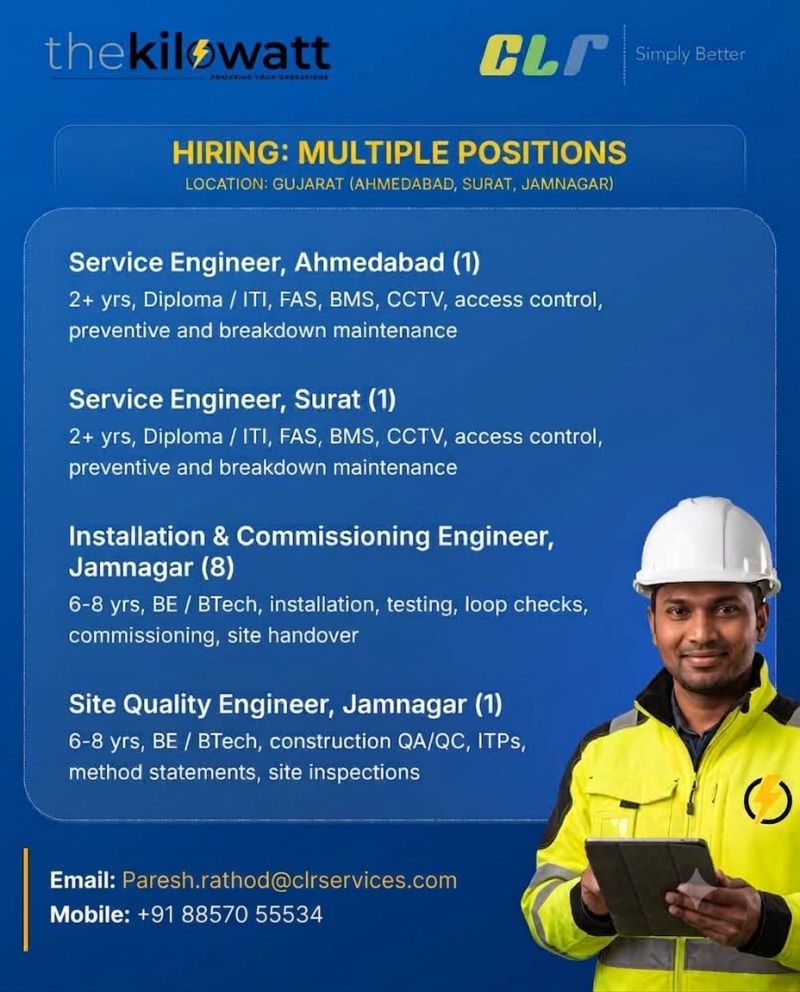
We are looking for a Manager – Facilities to join our growing team in Gurugram and drive seamless facility operations with a strong focus on service excellence.
The ideal candidate should have a solid professional background in Hospitality and Housekeeping, with proven experience in managing operations, teams, and service standards in a healthcare environment.
If you are ready to take on a
We are looking for a Manager – Facilities to join our growing team in Gurugram and drive seamless facility operations with a strong focus on service excellence.
The ideal candidate should have a solid professional background in Hospitality and Housekeeping, with proven experience in managing operations, teams, and service standards in a healthcare environment.
If you are ready to take on a leadership role and contribute to delivering a safe, efficient and well-managed hospital environment, we would love to hear from you.
Apply now: mohit.bakshi@ckbhospital.com
Source: Linkedin
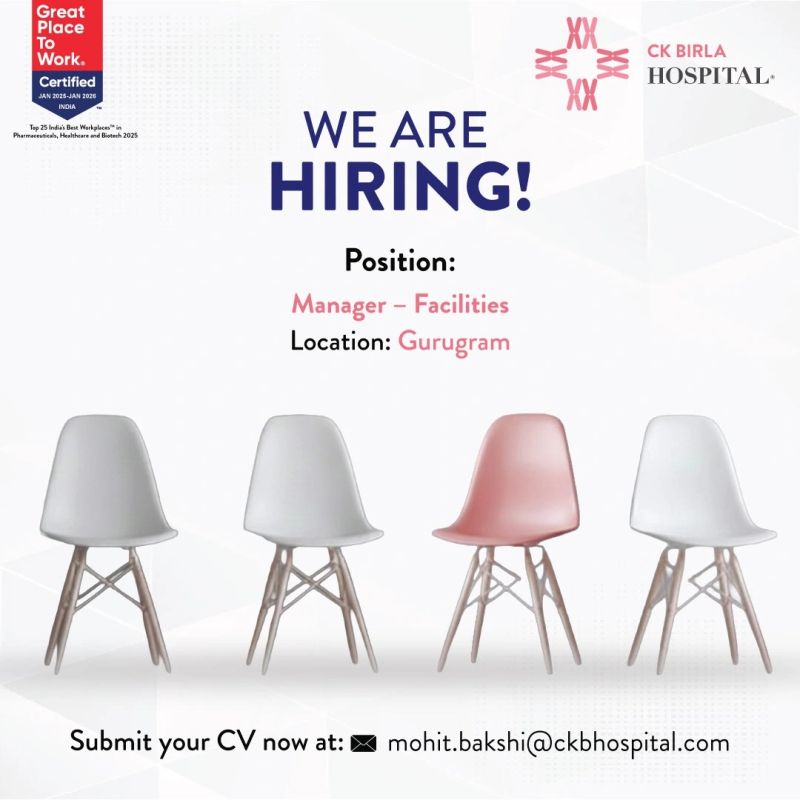
We’re Hiring | Administration In-Charge – Eicher Group Foundation
Behind every mission-driven organization that creates impact is a strong operational backbone.
At Eicher Group Foundation (EGF), we’re looking for an experienced, proactive and people-oriented Administration In-Charge who can take ownership of the smooth functioning of our Gurgaon office and create an environment where our
We’re Hiring | Administration In-Charge – Eicher Group Foundation
Behind every mission-driven organization that creates impact is a strong operational backbone.
At Eicher Group Foundation (EGF), we’re looking for an experienced, proactive and people-oriented Administration In-Charge who can take ownership of the smooth functioning of our Gurgaon office and create an environment where our teams can focus on what matters most — driving impact.
Location: Gurugram, Delhi NCR
Experience: 6+ yrs
What will you own?
From ensuring that our workplace runs seamlessly to managing vendors, facilities, procurement, travel and office systems, you’ll be the person who makes sure the details are taken care of - often before anyone else notices they need attention.
Your role will include:
- Office & Facility Management - Keeping the workplace safe, efficient and welcoming while managing facilities, maintenance, security, housekeeping, utilities, assets and office infrastructure.
- Vendor & Procurement Management - Build strong vendor partnerships, manage contracts, evaluate quotations, support procurement and ensure quality, compliance and cost-effectiveness.
- Travel & Logistics - Coordinate travel and logistics for our teams, visiting stakeholders, field visits, workshops and events.
- Systems & Processes - Build and maintain organized records, SOPs, trackers and administrative systems that keep the office running efficiently.
- Events & Leadership Support - Provide seamless logistical support for meetings, team events, external visitors and leadership/Board engagements.
- Compliance & Reporting - Keep administrative documentation audit-ready and ensure relevant statutory, safety and operational compliances are in place.
Why this role matters
This isn’t just about keeping an office running. It’s about creating the systems, environment and operational support that enable people working towards a larger purpose to do their best work.
If you are someone who loves bringing structure to complexity, enjoys working with people and takes pride in making things work seamlessly, we’d love to hear from you.
📩 Interested? Please share your profile at egfhr@eichermotors.com
Know someone who could be a great fit? Please share this opportunity with them.
Source: Linkedin
🚨 WE ARE HIRING | FACILITY & ADMIN MANAGER 🚨
Vodafone Idea Limited is hiring for the position of Facility & Admin Manager in Chennai.
📌 Position: Facility & Admin Manager
📍 Location: Chennai
🎓 Qualification: MBA
💼 Experience: Minimum 5 years of experience in Administration & Facility Management
🗣️ Language: Regional language – Tamil is mandatory
🔹 Candidate
🚨 WE ARE HIRING | FACILITY & ADMIN MANAGER 🚨
Vodafone Idea Limited is hiring for the position of Facility & Admin Manager in Chennai.
📌 Position: Facility & Admin Manager
📍 Location: Chennai
🎓 Qualification: MBA
💼 Experience: Minimum 5 years of experience in Administration & Facility Management
🗣️ Language: Regional language – Tamil is mandatory
🔹 Candidates with relevant experience in facility management, administration, vendor management, workplace operations and employee support are encouraged to apply.
📩 Interested candidates can share their updated resume at:
Prabhu.s2@vodafoneidea.com
Please feel free to like, share and tag suitable candidates in your network.
Source: Linkedin
Are you ready to take the next step in your career with one of the world's leading real estate and facilities management organizations?
Cushman & Wakefield is expanding its team and invites passionate, ambitious, and talented professionals to attend our Walk-In Interview Drive in Mumbai.
📅 Date: 26th September 2026
⏰ Time: 10:00 AM to 2:00 PM
📍 Venue: Cushman & Wakefield Office, BK
Are you ready to take the next step in your career with one of the world's leading real estate and facilities management organizations?
Cushman & Wakefield is expanding its team and invites passionate, ambitious, and talented professionals to attend our Walk-In Interview Drive in Mumbai.
📅 Date: 26th September 2026
⏰ Time: 10:00 AM to 2:00 PM
📍 Venue: Cushman & Wakefield Office, BKC (Bandra Kurla Complex), Mumbai
Why Join Cushman & Wakefield?
✅ Opportunity to work with leading multinational clients and marquee properties.
✅ Exposure to best-in-class industry practices and global standards.
✅ Structured learning, training, and career development programs.
✅ Clear growth pathways and opportunities for internal advancement.
✅ Collaborative and inclusive work culture that encourages innovation and excellence.
✅ Chance to be part of a high-performing team driving impactful client solutions.
Whether you are looking to accelerate your career, broaden your experience, or join a globally recognized organization that invests in its people, this is an opportunity you won't want to miss.
Join us and discover how a career with Cushman & Wakefield can help you grow professionally, develop new skills, and unlock exciting opportunities for the future.
We look forward to meeting you on 26th September 2026!
Source:Linkedin
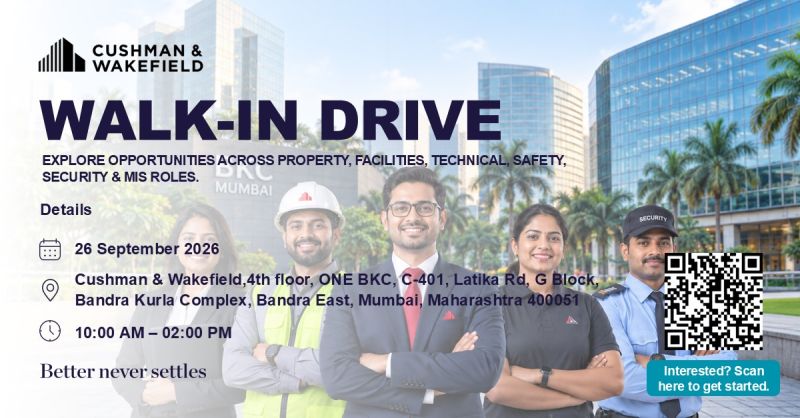
We are hiring:
🔹 AGM/DGM – Facilities Management | Navi Mumbai
🔹 Sr. Manager/AGM – Facilities Management | Malad
🔹 Manager – Facilities Management | Worli
Qualification: B.E. (Electrical/Mechanical)
If you have relevant experience in Facilities Management, MEP, building operations, maintenance, vendor management and site operations, we would love to hear from you.
📩 S
We are hiring:
🔹 AGM/DGM – Facilities Management | Navi Mumbai
🔹 Sr. Manager/AGM – Facilities Management | Malad
🔹 Manager – Facilities Management | Worli
Qualification: B.E. (Electrical/Mechanical)
If you have relevant experience in Facilities Management, MEP, building operations, maintenance, vendor management and site operations, we would love to hear from you.
📩 Share your updated profile:
sneha.chavan@rahejauniversal.com
Please mention Position | Current CTC | Expected CTC | Notice Period | Current Location in your email.
Source: Linkedin
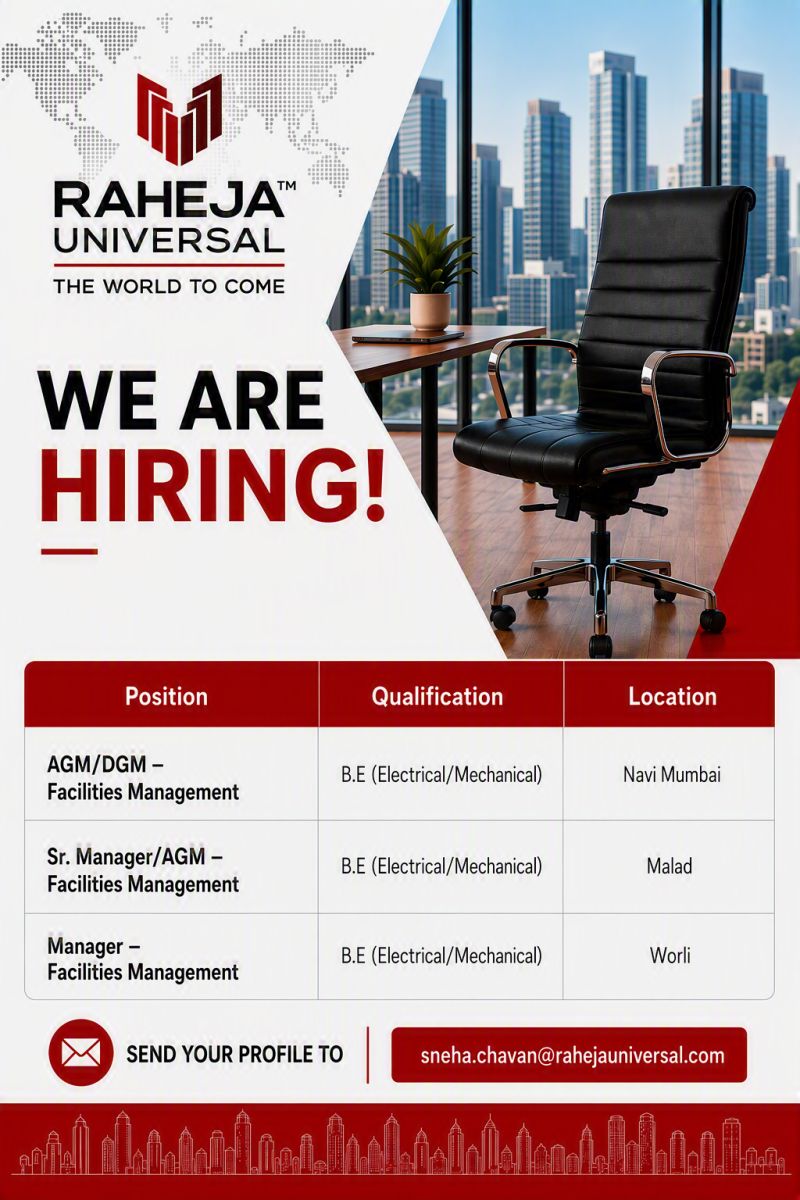
🚨 Excellent Career Opportunity | Immediate Joiners Preferred
We are looking for candidates with relevant experience and background are encouraged to apply.
Source: Linkedin
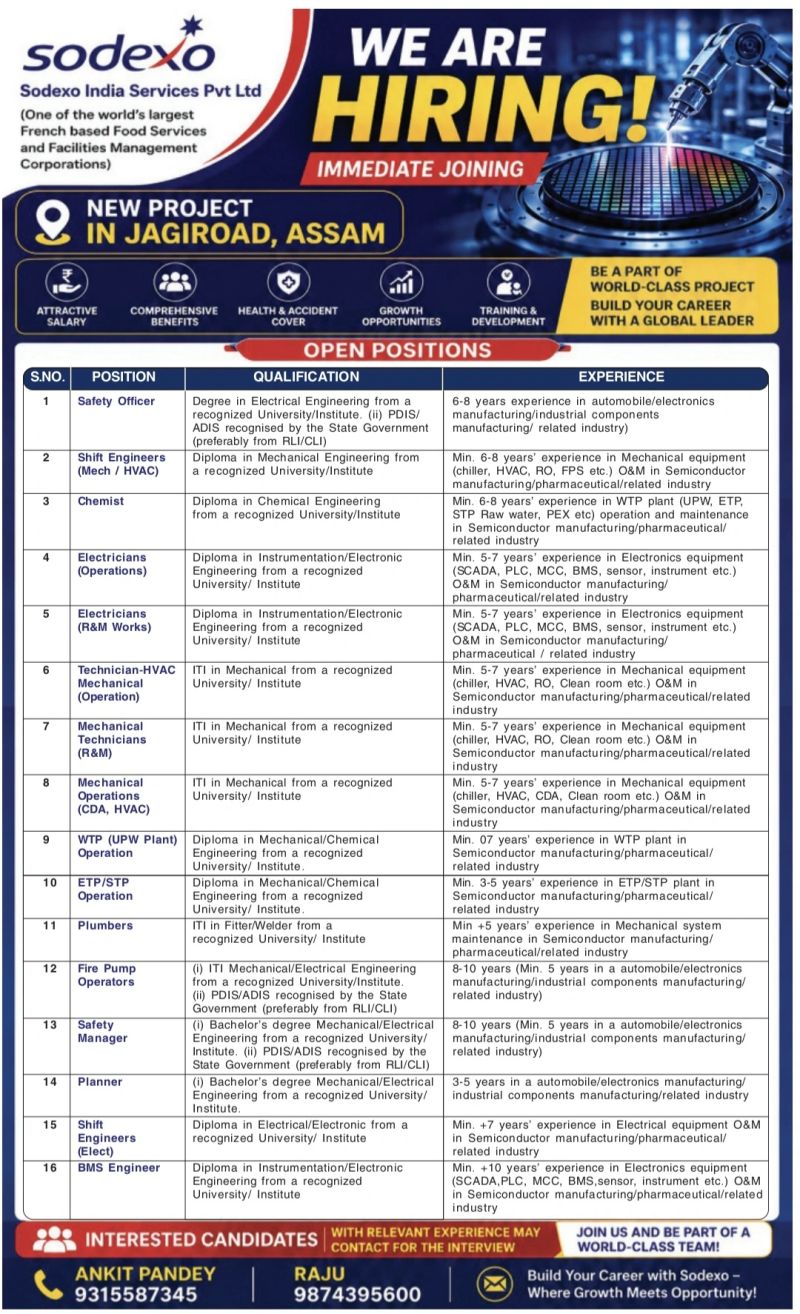
🚨 URGENT HIRING – TECHNICAL ARM | PUNE 🚨
DTSS Facility Management is looking for an experienced Technical ARM (Area Relationship Manager).
🔹 Key Responsibilities: • Technical operations across multiple sites
• Technical team recruitment & candidate screening
• Site audits & technical training
• AMC & vendor management
• Multiple client handling & technical escalation
🚨 URGENT HIRING – TECHNICAL ARM | PUNE 🚨
DTSS Facility Management is looking for an experienced Technical ARM (Area Relationship Manager).
🔹 Key Responsibilities: • Technical operations across multiple sites
• Technical team recruitment & candidate screening
• Site audits & technical training
• AMC & vendor management
• Multiple client handling & technical escalations
• SLA, safety, compliance & service quality.
🎓 Qualification: Diploma/Degree in Electrical Engineering
💼 Experience: 4–5+ years in Technical/Facility Management
📍 Location: Pune
💰 Salary: As per market standards & experience.
📩 Share your resume: amit.thakar@dtss.in
Note: Please share your profile only if your experience and skills closely match the above JD.
Source: Linkedin
Maintaining proper nutrition during cancer treatment and bone marrow transplant recovery can support the body's changing needs. Cancer therapies and BMT may affect appetite, digestion, taste, and the body's ability to maintain strength, making adequate nutrition an important part of supportive care.
A balanced diet may include appropriate sources of protein, carbohydrates, healthy fats, f
.... Read MoreMaintaining proper nutrition during cancer treatment and bone marrow transplant recovery can support the body's changing needs. Cancer therapies and BMT may affect appetite, digestion, taste, and the body's ability to maintain strength, making adequate nutrition an important part of supportive care.
A balanced diet may include appropriate sources of protein, carbohydrates, healthy fats, fruits and vegetables, and sufficient fluids, depending on the patient's treatment plan. Protein can help support muscle maintenance and tissue repair, while adequate calories can help prevent unwanted weight loss.
After a bone marrow transplant, food safety may become especially important because patients can have increased infection risks during certain stages of recovery. The treating team may provide specific recommendations regarding food preparation, hygiene, and foods to avoid.
Every patient's nutritional requirements are different. Factors such as cancer type, treatment, transplant stage, blood counts, medications, and existing nutritional concerns can influence dietary recommendations.
Patients undergoing cancer treatment or BMT should discuss their nutritional needs with their healthcare team rather than following a restrictive diet or taking supplements without professional advice.

Compass is Hiring – Soft Services, F&B, Housekeeping & Stores | Gurgaon
🚨 WE’RE HIRING | MULTIPLE OPENINGS | GURGAON 🚨
We are looking for experienced professionals across Soft Services, F&B, Housekeeping & Storekeeper Cum MIS.
📍 Location: Gurgaon / Gurugram
🔹 Sr. Executive / AFM – Soft Services
Experience: 5+ Years
In-Hand Salary: ₹45,000/month
Preferred: Cand
Compass is Hiring – Soft Services, F&B, Housekeeping & Stores | Gurgaon
🚨 WE’RE HIRING | MULTIPLE OPENINGS | GURGAON 🚨
We are looking for experienced professionals across Soft Services, F&B, Housekeeping & Storekeeper Cum MIS.
📍 Location: Gurgaon / Gurugram
🔹 Sr. Executive / AFM – Soft Services
Experience: 5+ Years
In-Hand Salary: ₹45,000/month
Preferred: Candidates with experience in managing corporate offices
Hotellier preferred
Excellent English communication skills are mandatory
🔹 F&B Executive
Experience: 4–6 Years
In-Hand Salary: ₹40,000/month
Preferred: Candidates with experience in corporate office F&B operations
Hotellier preferred
Excellent English communication skills are mandatory
🔹 Assistant Manager – F&B
Experience: 7–10 Years
In-Hand Salary: ₹55,000–₹60,000/month
Preferred: Candidates experienced in managing corporate office F&B operations
Hotellier preferred
Excellent English communication skills are mandatory
🔹 HK Executive
Experience: 3+ Years
In-Hand Salary: ₹25,000–₹30,000/month
Preference: Candidates with corporate office / facility management experience
Basic English communication skills required
🔹 Storekeeper cum MIS Executive
Experience: 2–4 Years
In-Hand Salary: ₹30,000/month
Must have knowledge of:
Housekeeping & F&B consumables
Chemicals
Inventory management
Inventory tools/software
Stock management & MIS
Basic English communication skills required
⭐ Key Preference: For AFM and F&B profiles, candidates with corporate office management experience and excellent English communication skills will be strongly preferred.
📩 Interested candidates can share their updated CV at: Payal.Kapoor@compass-group.co.in/ Alok.Mishra2@compass-group.co.in
📌 Subject Line:
Profile | Location | Current CTC | Expected CTC | Notice Period
Please mention the required details in the subject line while sharing your CV.
🔄 If you know someone who fits these requirements, please share/tag them!
Source: LinkedIn
We are Hiring | MEP Manager – Corporate Interior Fit-Out🚀
Location: Delhi NCR
Experience: 7–12 Years
Industry: Corporate Interior Fit-Out / Commercial Interiors
Employment Type: Full-Time
We are looking for an experienced MEP Manager to lead the complete MEP execution for our corporate interior fit-out projects.
Key Responsibilities🧷
1.Manage end-to-end MEP execution from mo
We are Hiring | MEP Manager – Corporate Interior Fit-Out🚀
Location: Delhi NCR
Experience: 7–12 Years
Industry: Corporate Interior Fit-Out / Commercial Interiors
Employment Type: Full-Time
We are looking for an experienced MEP Manager to lead the complete MEP execution for our corporate interior fit-out projects.
Key Responsibilities🧷
1.Manage end-to-end MEP execution from mobilization to project handover.
2.Coordinate HVAC, Electrical, Fire Fighting, Plumbing, ELV & BMS services.
3.Review drawings, BOQs, specifications, shop drawings and technical submissions.
Coordinate with Design, Projects, Procurement, Consultants, Contractors and Clients.
4.Monitor site execution, quality, timelines, manpower and material requirements.
Identify and resolve MEP coordination issues and site clashes.
5.Manage MEP contractors/vendors and ensure timely completion.
6.Conduct testing, commissioning, snag closure and final handover.
7.Ensure as-built drawings, O&M manuals, test reports and handover documentation are completed.
8.Ensure compliance with project specifications, safety and statutory requirements.
What We’re Looking For✔️
1Degree/Diploma in Electrical / Mechanical Engineering or related field.
2.Strong knowledge of MEP services and site execution.
3.Experience in contractor management and client/consultant coordination.
4.Strong project planning, problem-solving and communication skills.
5.Good knowledge of AutoCAD and MS Office.
Preferred: Candidates with experience in Grade-A corporate offices, IT parks, commercial buildings and high-end interior fit-out projects.
📩 Interested candidates can share their updated CV at: anju.samadhiya@morphodimensions.com
Source: LinkedIn
𝐎𝐧𝐞 𝐤𝐢𝐭𝐜𝐡𝐞𝐧. 𝐌𝐮𝐥𝐭𝐢𝐩𝐥𝐞 𝐜𝐥𝐞𝐚𝐧𝐢𝐧𝐠 𝐜𝐡𝐚𝐥𝐥𝐞𝐧𝐠𝐞𝐬. 𝐎𝐧𝐞 𝐜𝐨𝐦𝐩𝐥𝐞𝐭𝐞 𝐬𝐨𝐥𝐮𝐭𝐢𝐨𝐧. 🧼✨
From busy 𝐡𝐨𝐭𝐞𝐥 𝐤𝐢𝐭𝐜𝐡𝐞𝐧𝐬 𝐭𝐨 𝐫𝐞𝐬𝐭𝐚𝐮𝐫𝐚𝐧𝐭𝐬 𝐚𝐧𝐝 𝐜𝐥𝐨𝐮𝐝 𝐤ð�
𝐎𝐧𝐞 𝐤𝐢𝐭𝐜𝐡𝐞𝐧. 𝐌𝐮𝐥𝐭𝐢𝐩𝐥𝐞 𝐜𝐥𝐞𝐚𝐧𝐢𝐧𝐠 𝐜𝐡𝐚𝐥𝐥𝐞𝐧𝐠𝐞𝐬. 𝐎𝐧𝐞 𝐜𝐨𝐦𝐩𝐥𝐞𝐭𝐞 𝐬𝐨𝐥𝐮𝐭𝐢𝐨𝐧. 🧼✨
From busy 𝐡𝐨𝐭𝐞𝐥 𝐤𝐢𝐭𝐜𝐡𝐞𝐧𝐬 𝐭𝐨 𝐫𝐞𝐬𝐭𝐚𝐮𝐫𝐚𝐧𝐭𝐬 𝐚𝐧𝐝 𝐜𝐥𝐨𝐮𝐝 𝐤𝐢𝐭𝐜𝐡𝐞𝐧𝐬, maintaining every zone requires the right cleaning solution for the right task.
The 𝐃𝐢𝐖𝐎 𝐊𝐢𝐭𝐜𝐡𝐞𝐧 𝐑𝐚𝐧𝐠𝐞 is designed to support your daily cleaning needs with dedicated solutions for:
🍽️ 𝐃𝐢𝐬𝐡𝐰𝐚𝐬𝐡𝐢𝐧𝐠 — effective cleaning for kitchenware
🧽 𝐃𝐞𝐠𝐫𝐞𝐚𝐬𝐢𝐧𝐠 — helps tackle grease and heavy buildup
✨ 𝐒𝐭𝐚𝐢𝐧𝐥𝐞𝐬𝐬 𝐒𝐭𝐞𝐞𝐥 𝐂𝐚𝐫𝐞 — keeps surfaces clean and well-maintained
🧹 𝐅𝐥𝐨𝐨𝐫 𝐂𝐥𝐞𝐚𝐧𝐢𝐧𝐠 — supports everyday floor hygiene
🔥 𝐂𝐚𝐫𝐛𝐨𝐧 𝐑𝐞𝐦𝐨𝐯𝐚𝐥 — helps remove stubborn carbon deposits
With one integrated kitchen cleaning range, your team can simplify product management and maintain consistent cleaning across critical areas.
✅𝐁𝐞𝐭𝐭𝐞𝐫 𝐜𝐥𝐞𝐚𝐧𝐢𝐧𝐠. 𝐁𝐞𝐭𝐭𝐞𝐫 𝐤𝐢𝐭𝐜𝐡𝐞𝐧 𝐜𝐚𝐫𝐞. 𝐁𝐞𝐭𝐭𝐞𝐫 𝐨𝐩𝐞𝐫𝐚𝐭𝐢𝐨𝐧𝐚𝐥 𝐜𝐨𝐧𝐟𝐢𝐝𝐞𝐧𝐜𝐞.
📩 Looking for the right cleaning system for your professional kitchen? Get in touch with DiWO to explore the Kitchen Range.
📲 +91 88886 15994
🌐 www.multilinehygiene.com

We are expanding! Join thekilowatt (a CLR company) – Multiple Engineering Roles in Gujarat! ⚡
Are you an experienced engineer ready for your next challenge in the power and operations sector? thekilowatt, partnering with CLR (Simply Better), is hiring multiple key engineering positions across our locations in Gujarat.
We are looking for dedicated professionals to fill the following roles
We are expanding! Join thekilowatt (a CLR company) – Multiple Engineering Roles in Gujarat! ⚡
Are you an experienced engineer ready for your next challenge in the power and operations sector? thekilowatt, partnering with CLR (Simply Better), is hiring multiple key engineering positions across our locations in Gujarat.
We are looking for dedicated professionals to fill the following roles:
🔧 Service Engineer
Locations: Ahmedabad (1) & Surat (1)
Qualifications: 2+ yrs exp., Diploma/ITI, FAS, BMS, CCTV, Access Control, Preventive & Breakdown Maintenance.
⚙️ Installation & Commissioning Engineer
Location: Jamnagar (8)
Qualifications: 6-8 yrs exp., BE/BTech, Installation, Testing, Loop Checks, Commissioning, Site Handover.
✅ Site Quality Engineer
Location: Jamnagar (1)
Qualifications: 6-8 yrs exp., BE/BTech, Construction QA/QC, ITPs, Method Statements, Site Inspections.
Ready to make an impact? Power your career with us.
How to Apply: Share your CV directly with us!
📩 Email: Paresh.Rathod@Clrservices.com
📞 Mobile: +91 88570 55534
Source: LinkedIn
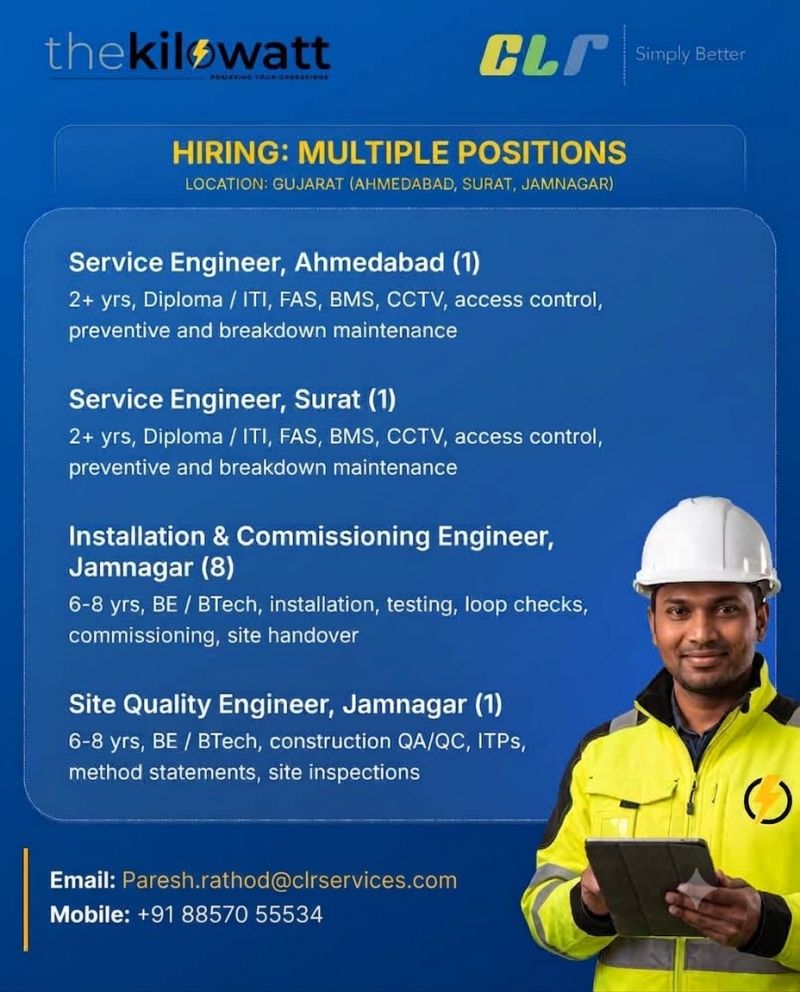
We are Hiring | Facility & Admin Manager
Vodafone Idea Limited is looking for an experienced Facility & Admin Manager to join our team in Chennai.
📍 Location: Chennai
💼 Experience: Minimum 5 years
🏢 Industry: Candidates from any industry can apply
Interested candidates can share their updated resume at:
📧 prabhu.s2@vodafoneidea.com
Please feel free to share this opportun
We are Hiring | Facility & Admin Manager
Vodafone Idea Limited is looking for an experienced Facility & Admin Manager to join our team in Chennai.
📍 Location: Chennai
💼 Experience: Minimum 5 years
🏢 Industry: Candidates from any industry can apply
Interested candidates can share their updated resume at:
📧 prabhu.s2@vodafoneidea.com
Please feel free to share this opportunity with suitable candidates in your network.
Source: LinkedIn
We are looking for a high-ownership Facility Manager who can take charge of our workplace operations and help create a great experience for everyone at Frido.
📍 Location: Pune
💼 Experience: 5–6 Years
👤 Role: Facility Manager
What you’ll be responsible for:
• Managing multiple office locations and ensuring smooth day-to-day operations
• Managing facility staff, vendors
We are looking for a high-ownership Facility Manager who can take charge of our workplace operations and help create a great experience for everyone at Frido.
📍 Location: Pune
💼 Experience: 5–6 Years
👤 Role: Facility Manager
What you’ll be responsible for:
• Managing multiple office locations and ensuring smooth day-to-day operations
• Managing facility staff, vendors and workplace requirements
• Handling senior office administration and ensuring everything runs seamlessly
• Working closely with HR, IT, Finance and other teams on workplace requirements
• Taking ownership of the overall employee experience and making Frido a great place to work
• Proactively identifying gaps, solving problems and continuously improving the workplace
We’re looking for someone who is hands-on, proactive and takes complete ownership — someone who can make things happen rather than just manage them.
📩 Share your CV: jaya.u@myfrido.com
Source: LinkedIn
🚀 #IamHiring | Admin Manager
UKB Electronics Pvt. Ltd. is looking for an experienced Admin Manager to manage overall plant administration and facility operations.
📍 Location: Ranjangaon, Pune
🏭 Industry: Manufacturing / Electronics
💼 Experience: 8–12 Years
🎓 Qualification: Graduate / MBA / PG in relevant discipline
Key Responsibilities
✅ Manage overall plant admin
🚀 #IamHiring | Admin Manager
UKB Electronics Pvt. Ltd. is looking for an experienced Admin Manager to manage overall plant administration and facility operations.
📍 Location: Ranjangaon, Pune
🏭 Industry: Manufacturing / Electronics
💼 Experience: 8–12 Years
🎓 Qualification: Graduate / MBA / PG in relevant discipline
Key Responsibilities
✅ Manage overall plant administration and facility operations
✅ Handle housekeeping, canteen, transport and employee facilities
✅ Manage administrative vendors, contracts and service providers
✅ Ensure smooth day-to-day administrative operations
✅ Coordinate with government authorities and local administration
✅ Maintain MIS, reports and administrative records
✅ Ensure workplace infrastructure and facilities are properly maintained
✅ Drive cost optimization and process improvement initiatives
✅ Handle plant security operations and coordinate with security agencies
Preferred Skills
✔️ Strong experience in Plant Administration & Facility Management
✔️ Manufacturing / automobile / electronics industry experience preferred
✔️ Vendor and contract management
✔️ Strong communication and leadership skills
✔️ Excellent coordination and problem-solving abilities
📩 Interested candidates may share their updated resume at:
recruitmentpune@ukbindia.com
Please share this opportunity within your network.
Source: Linkedin
Compass Group India Service Private Limited is looking for Assistant Facility Manager -Technical from IFM Industry in New Delhi @ CP
Eligibility criteria
1) Having 4-5 Years of relevant experience.
2) B.Tech or Diploma in Electrical
3) Having Experience in working and manging Floor maintenance at MNC corporate Offices.
4) Immediate Joiners is required
CTC - INR 7-8 Lacs Per annum
kindly
Compass Group India Service Private Limited is looking for Assistant Facility Manager -Technical from IFM Industry in New Delhi @ CP
Eligibility criteria
1) Having 4-5 Years of relevant experience.
2) B.Tech or Diploma in Electrical
3) Having Experience in working and manging Floor maintenance at MNC corporate Offices.
4) Immediate Joiners is required
CTC - INR 7-8 Lacs Per annum
kindly share your CV @ Alok.mishra2@compass-group.co.in
or WhatsApp @ 9870396287
Source: LinkedIn
WE’RE HIRING | OPERATIONS MANAGER/ASSISTANT MANAGER /FACILITY MANAGEMENT
📍 Location: Mumbai
🏢 Industry: Facility Management / Integrated Facility Services
We are looking for an experienced and result-oriented Operations Manager / assistant Manager to lead operations across multiple clients and sites.
If you are passionate about people management, client relationships, service excellenc
WE’RE HIRING | OPERATIONS MANAGER/ASSISTANT MANAGER /FACILITY MANAGEMENT
📍 Location: Mumbai
🏢 Industry: Facility Management / Integrated Facility Services
We are looking for an experienced and result-oriented Operations Manager / assistant Manager to lead operations across multiple clients and sites.
If you are passionate about people management, client relationships, service excellence and operational delivery, this opportunity could be for you!
🔑 Key Responsibilities & Requirements
✅ Manage multiple clients, sites and large manpower teams
✅ Ensure smooth day-to-day facility operations and service delivery
✅ Strong experience in manpower planning, deployment & team handling
✅ Build and maintain excellent client relationships
✅ Drive SLA/KPI compliance and operational excellence
✅ Handle client concerns and resolve operational challenges effectively
✅ Conduct regular site reviews, audits and performance monitoring
✅ Coordinate with clients, internal teams and stakeholders
✅ Demonstrate strong leadership, communication and problem-solving skills
🎯 Ideal Candidate
We are looking for someone who can confidently manage multiple stakeholders, diverse client requirements and large teams, while ensuring consistent service quality and operational efficiency.
Experience: Facility Management / Integrated Facility Services
Location: Mumbai
📩 Interested candidates can share their updated CV at: ramdas.wadekar@silagrooup.co.in
Source: LinkedIn
We’re Hiring | Admin Manager
Location: Ghaziabad / Duhai
Industry: Manufacturing / Lithium-Ion Battery / EV Industry
Experience: 10–15 Years
Maxvolt Energy is looking for an experienced Admin Manager to manage and streamline administrative operations at our manufacturing facility.
🔹 Key Responsibilities:
Manage overall administration and facility operations.
Handle housekeeping, secu
We’re Hiring | Admin Manager
Location: Ghaziabad / Duhai
Industry: Manufacturing / Lithium-Ion Battery / EV Industry
Experience: 10–15 Years
Maxvolt Energy is looking for an experienced Admin Manager to manage and streamline administrative operations at our manufacturing facility.
🔹 Key Responsibilities:
Manage overall administration and facility operations.
Handle housekeeping, security, transport, canteen, and other support services.
Manage vendors, contractors, and service providers.
Ensure proper maintenance of office and plant infrastructure.
Monitor security and safety-related administrative activities.
Manage employee transportation and other employee welfare facilities.
Handle purchase of administrative items and maintain inventory.
Ensure compliance with company policies and statutory requirements related to administration.
Coordinate with HR, Finance, Plant Operations, and other departments.
Manage administrative budgets and control operational expenses.
Lead and supervise the administration team.
🔹 Candidate Profile:
Graduate/MBA in HR, Administration, or a related field preferred.
10–15 years of relevant experience in Administration.
Manufacturing/Plant experience preferred.
Strong vendor management, facility management, and team-handling skills.
Good communication and problem-solving abilities.
📩 Interested candidates can share their CV at:
recruitment@maxvoltenergy.com
📞 Contact: 8130200736
Source: Linkedin
📢 We’re Hiring | Admin Manager – Jaipur
We are looking for an experienced Admin Manager to join our team in Jaipur.
🔹 Position: Admin Manager
📍 Location: Jaipur
💼 Experience: 5–7 years in Administration
💰 CTC: Up to ₹10 LPA
Interested candidates can share their updated resume at:
📧 manish.tiwari7@iifl.com
Subject Line: Admin Manager – Jaipur
Please fe
📢 We’re Hiring | Admin Manager – Jaipur
We are looking for an experienced Admin Manager to join our team in Jaipur.
🔹 Position: Admin Manager
📍 Location: Jaipur
💼 Experience: 5–7 years in Administration
💰 CTC: Up to ₹10 LPA
Interested candidates can share their updated resume at:
📧 manish.tiwari7@iifl.com
Subject Line: Admin Manager – Jaipur
Please feel free to share this opportunity with your network or tag suitable candidates.
Source: Linkedin
🚨 URGENT HIRING | PROPERTY MANAGER
YourSpace is looking for experienced and dynamic Property Managers for the following locations:
📍 Pune
📍 Ahmedabad
🔹 Immediate Joiners Preferred
🔹 Strong communication & property management skills
🔹 Experience in property/operations management will be an advantage
📩 Interested candidates can share their CV at:
surbhi.gupta@you
🚨 URGENT HIRING | PROPERTY MANAGER
YourSpace is looking for experienced and dynamic Property Managers for the following locations:
📍 Pune
📍 Ahmedabad
🔹 Immediate Joiners Preferred
🔹 Strong communication & property management skills
🔹 Experience in property/operations management will be an advantage
📩 Interested candidates can share their CV at:
surbhi.gupta@your-space.in
Join YourSpace and be part of a growing team!
Source: LinkedIn
📢 We're Hiring | Front Office Executive | Gurugram
SK Facility Management Services Pvt. Ltd. is looking for dynamic and customer-focused Front Office Executives to join our client's site in Gurugram.
✅ Graduate (Any Discipline)
✅ 1-3 Years of Front Office / Customer Service Experience Preferred
✅ Strong Communication & Interpersonal Skills
✅ MS Office Knowledge & Professional A
📢 We're Hiring | Front Office Executive | Gurugram
SK Facility Management Services Pvt. Ltd. is looking for dynamic and customer-focused Front Office Executives to join our client's site in Gurugram.
✅ Graduate (Any Discipline)
✅ 1-3 Years of Front Office / Customer Service Experience Preferred
✅ Strong Communication & Interpersonal Skills
✅ MS Office Knowledge & Professional Appearance
Key Responsibilities: • Reception & Front Desk Management
• Visitor Handling & Customer Assistance
• Call & Email Coordination
• Meeting Room & Visitor Log Management
• Administrative Support & Site Coordination
Join a team committed to delivering excellence in Integrated Facility Management Services and build a rewarding career with a growing organization.
📧 Send your CV to: kanika@skfacility.com
📌 Subject: Front Office Executive - Gurgaon
Source: Linkedin
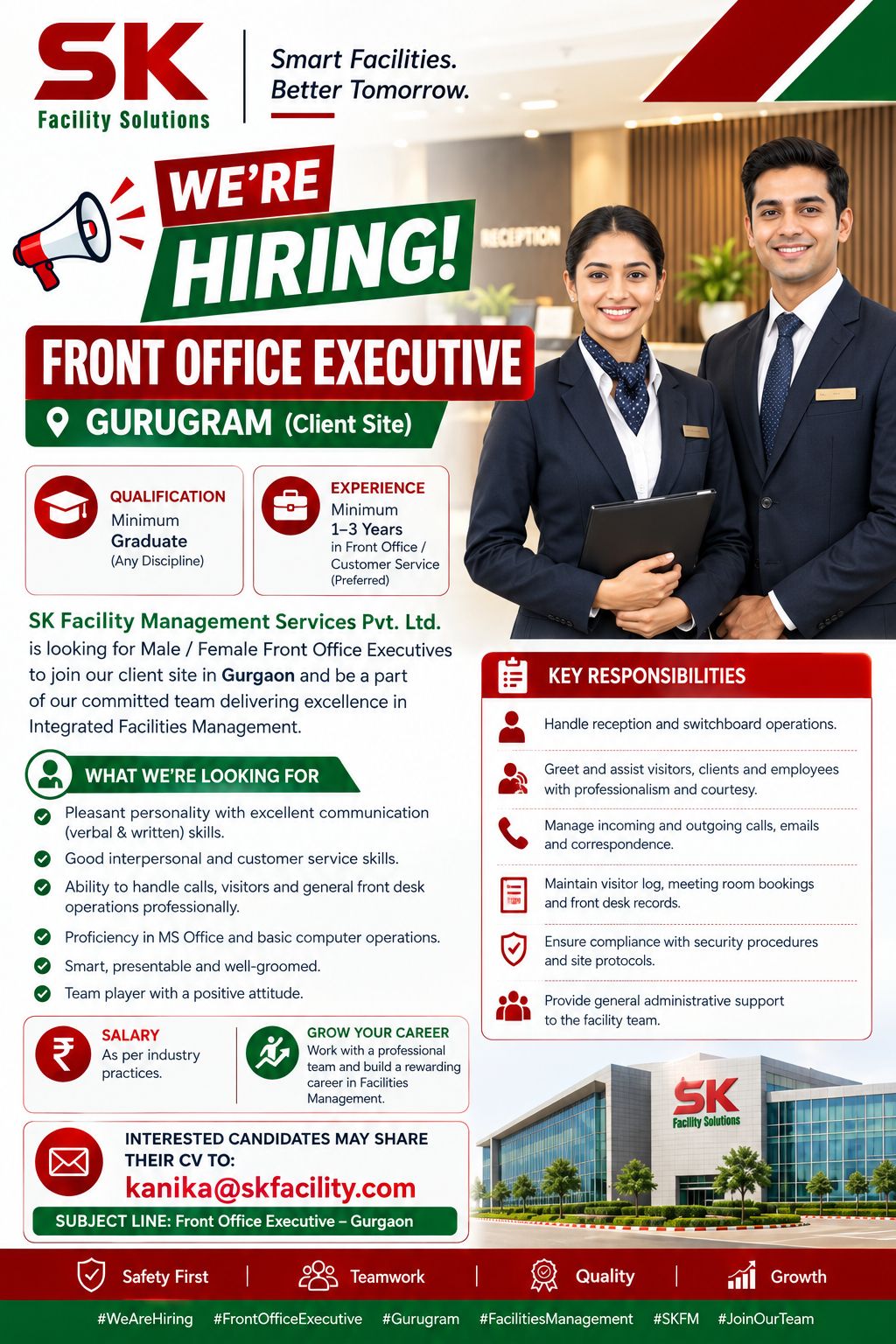
📢 We’re Hiring – Maintenance Manager
Narayan Seva Sansthan is looking for an experienced and technically strong Maintenance Manager to manage and oversee maintenance operations.
📍 Location: Udaipur, Rajasthan
📅 Walk-In Interview: 13 September 2026
⏰ Time: 09:00 AM to 02:00 PM
📌 Venue: World of Humanity, 1-2, Mali Colony, Udaipur
If you have relevant experience in prev
📢 We’re Hiring – Maintenance Manager
Narayan Seva Sansthan is looking for an experienced and technically strong Maintenance Manager to manage and oversee maintenance operations.
📍 Location: Udaipur, Rajasthan
📅 Walk-In Interview: 13 September 2026
⏰ Time: 09:00 AM to 02:00 PM
📌 Venue: World of Humanity, 1-2, Mali Colony, Udaipur
If you have relevant experience in preventive and breakdown maintenance, electrical & mechanical systems, HVAC, equipment maintenance, team management, and facility maintenance, we would be happy to meet you.
📩 Interested candidates can attend the walk-in interview or share their CV for further consideration.
Please feel free to share this post with relevant candidates in your network.
Source:Linkedin
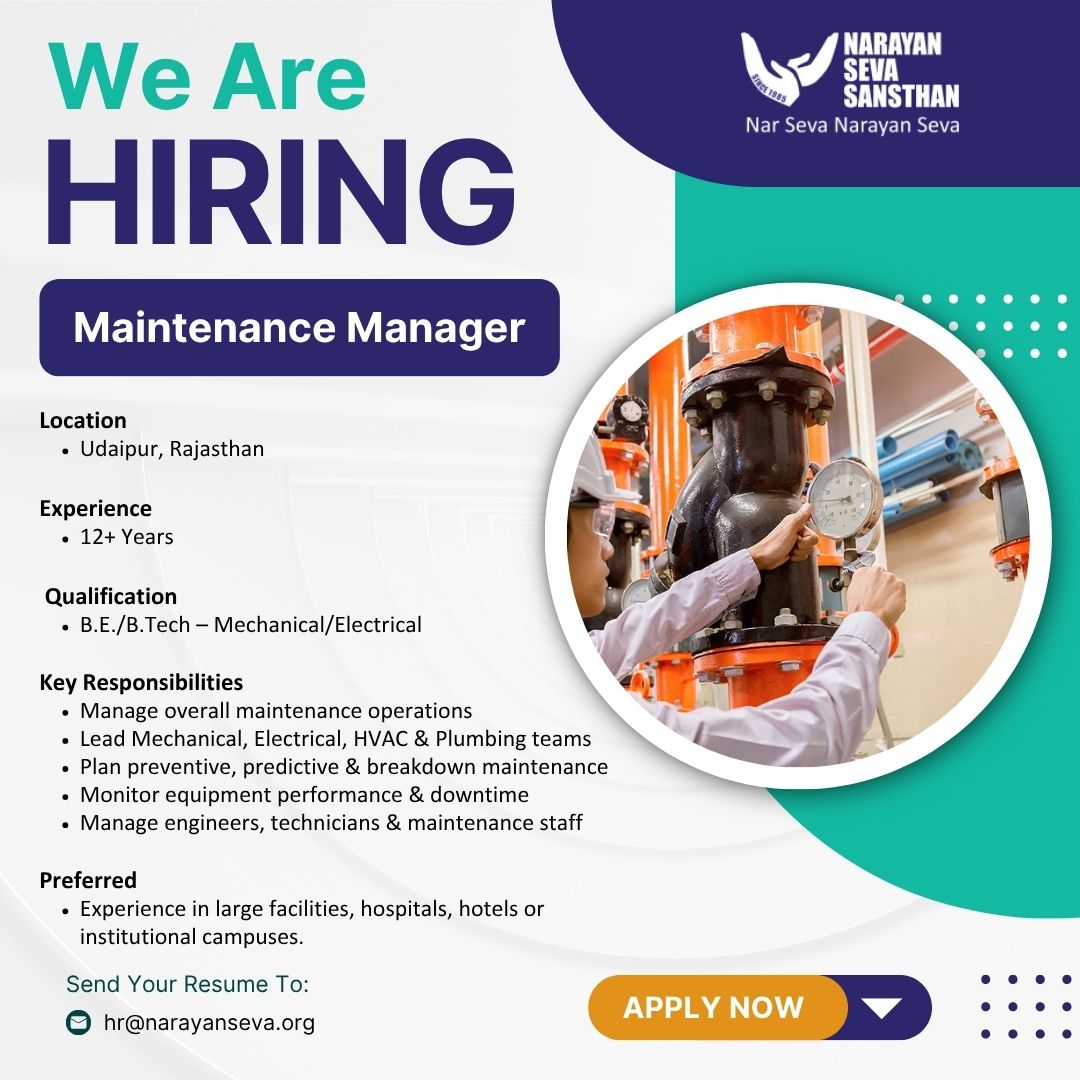
𝑾𝒉𝒂𝒕’𝒔 𝒕𝒉𝒆 𝒎𝒐𝒔𝒕 𝒐𝒗𝒆𝒓𝒍𝒐𝒐𝒌𝒆𝒅 𝒄𝒉𝒂𝒍𝒍𝒆𝒏𝒈𝒆 𝒊𝒏 𝑭𝒂𝒄𝒊𝒍𝒊𝒕𝒚 𝑴𝒂𝒏𝒂𝒈𝒆𝒎𝒆𝒏𝒕 𝒕𝒐𝒅𝒂𝒚?
𝑩𝒆𝒉𝒊𝒏𝒅 𝒆𝒗𝒆𝒓𝒚 𝒔𝒎𝒐𝒐𝒕𝒉 𝒐𝒑𝒆𝒓𝒂𝒕𝒊𝒐𝒏, 𝑭𝑴 𝒕𝒆𝒂𝒎𝒔 𝒏𝒂𝒗𝒊𝒈ð�’
𝑾𝒉𝒂𝒕’𝒔 𝒕𝒉𝒆 𝒎𝒐𝒔𝒕 𝒐𝒗𝒆𝒓𝒍𝒐𝒐𝒌𝒆𝒅 𝒄𝒉𝒂𝒍𝒍𝒆𝒏𝒈𝒆 𝒊𝒏 𝑭𝒂𝒄𝒊𝒍𝒊𝒕𝒚 𝑴𝒂𝒏𝒂𝒈𝒆𝒎𝒆𝒏𝒕 𝒕𝒐𝒅𝒂𝒚?
𝑩𝒆𝒉𝒊𝒏𝒅 𝒆𝒗𝒆𝒓𝒚 𝒔𝒎𝒐𝒐𝒕𝒉 𝒐𝒑𝒆𝒓𝒂𝒕𝒊𝒐𝒏, 𝑭𝑴 𝒕𝒆𝒂𝒎𝒔 𝒏𝒂𝒗𝒊𝒈𝒂𝒕𝒆 𝒄𝒐𝒎𝒑𝒍𝒆𝒙, 𝒉𝒊𝒈𝒉-𝒔𝒕𝒂𝒌𝒆𝒔 𝒑𝒓𝒐𝒃𝒍𝒆𝒎𝒔 𝒅𝒂𝒊𝒍𝒚—𝒚𝒆𝒕 𝒎𝒂𝒏𝒚 𝒐𝒇 𝒕𝒉𝒆 𝒓𝒆𝒂𝒍 𝒑𝒂𝒊𝒏 𝒑𝒐𝒊𝒏𝒕𝒔 𝒔𝒕𝒂𝒚 𝒃𝒆𝒉𝒊𝒏𝒅 𝒕𝒉𝒆 𝒔𝒄𝒆𝒏𝒆𝒔.
Which of these needs more airtime in industry conversations?
1.𝐓𝐚𝐥𝐞𝐧𝐭 & 𝐒𝐤𝐢𝐥𝐥 𝐆𝐚𝐩𝐬: Manpower availability and upskilling
2.𝐂𝐨𝐬𝐭 𝐯𝐬. 𝐏𝐞𝐫𝐟𝐨𝐫𝐦𝐚𝐧𝐜𝐞 Balancing vendor quality with tight budgets
3.𝐃𝐞𝐟𝐞𝐫𝐫𝐞𝐝 𝐌𝐚𝐢𝐧𝐭𝐞𝐧𝐚𝐧𝐜𝐞: The hidden cost of delayed preventive care
4.𝐓𝐞𝐜𝐡 𝐀𝐝𝐨𝐩𝐭𝐢𝐨𝐧: Bridging the gap between new tools and ground-level execution
5.𝐄𝐱𝐞𝐜𝐮𝐭𝐢𝐯𝐞 𝐀𝐥𝐢𝐠𝐧𝐦𝐞𝐧𝐭: Translating operational impact to top management
6.𝐂𝐚𝐫𝐞𝐞𝐫 𝐆𝐫𝐨𝐰𝐭𝐡: Recognition, retention, and leadership pathways in FM
𝐎𝐫 𝐢𝐬 𝐭𝐡𝐞𝐫𝐞 𝐚 𝐜𝐡𝐚𝐥𝐥𝐞𝐧𝐠𝐞 𝐅𝐌 𝐭𝐞𝐚𝐦𝐬 𝐟𝐚𝐜𝐞 𝐞𝐯𝐞𝐫𝐲 𝐝𝐚𝐲 𝐭𝐡𝐚𝐭 𝐫𝐚𝐫𝐞𝐥𝐲 𝐠𝐞𝐭𝐬 𝐭𝐚𝐥𝐤𝐞𝐝 𝐚𝐛𝐨𝐮𝐭?
💬 𝐒𝐡𝐚𝐫𝐞 𝐲𝐨𝐮𝐫 𝐠𝐫𝐨𝐮𝐧𝐝-𝐥𝐞𝐯𝐞𝐥 𝐞𝐱𝐩𝐞𝐫𝐢𝐞𝐧𝐜𝐞 𝐢𝐧 𝐭𝐡𝐞 𝐝𝐢𝐬𝐜𝐮𝐬𝐬𝐢𝐨𝐧 𝐛𝐞𝐥𝐨𝐰. 𝐖𝐡𝐢𝐜𝐡 𝐜𝐡𝐚𝐥𝐥𝐞𝐧𝐠𝐞 𝐝𝐞𝐬𝐞𝐫𝐯𝐞𝐬 𝐦𝐨𝐫𝐞 𝐚𝐭𝐭𝐞𝐧𝐭𝐢𝐨𝐧—𝐚𝐧𝐝 𝐰𝐡𝐲?
𝐘𝐨𝐮𝐫 𝐞𝐱𝐩𝐞𝐫𝐢𝐞𝐧𝐜𝐞 𝐜𝐨𝐮𝐥𝐝 𝐛𝐫𝐢𝐧𝐠 𝐚 𝐩𝐞𝐫𝐬𝐩𝐞𝐜𝐭𝐢𝐯𝐞 𝐭𝐡𝐚𝐭 𝐨𝐭𝐡𝐞𝐫 𝐅𝐌 𝐩𝐫𝐨𝐟𝐞𝐬𝐬𝐢𝐨𝐧𝐚𝐥𝐬 𝐚𝐫𝐞 𝐟𝐚𝐜𝐢𝐧𝐠 𝐭𝐨𝐨.


The most underrated feature of the platform.
Looking for a motivated professional, preferably from the hospitality/hotel industry, to join our Facilities Management team and deliver exceptional workplace experiences as an Assistant Facility Manager.
What You'll Do:
Manage daily facility operations
Coordinate technical operations
Supervise third-party vendor performance and ensure service quality standards
Maintain statutory complian
Looking for a motivated professional, preferably from the hospitality/hotel industry, to join our Facilities Management team and deliver exceptional workplace experiences as an Assistant Facility Manager.
What You'll Do:
Manage daily facility operations
Coordinate technical operations
Supervise third-party vendor performance and ensure service quality standards
Maintain statutory compliance
Manage budgets, track expenses, and support cost optimization initiatives
Conduct regular facility walkthroughs to ensure operational excellence
Handle VIP visits, client meetings, and emergency situations professionally
What You Need:
Strong knowledge of MS Office and facility management systems
Excellent communication, vendor management, and problem-solving skills
Ability to manage multiple priorities
Location: Gurgaon
Preferably a Female Candidate
Interested candidates, please send your resume to saurabh.paul@jll.com.
Source: Linkedin
🚨 WE’RE #HIRING | Hub #Manager – Administration
AU Small Finance Bank is looking for experienced professionals to join its Administration team.
📍 Locations:
• Kochi
• Karnal
• Gurugram
• Motihari
💼 Experience: 5+ Years
🎓 Qualification: Graduate & above
🏢 Department: Administration
🎯 Key Responsibilities:
• Ensure adequate manpower for caretake
🚨 WE’RE #HIRING | Hub #Manager – Administration
AU Small Finance Bank is looking for experienced professionals to join its Administration team.
📍 Locations:
• Kochi
• Karnal
• Gurugram
• Motihari
💼 Experience: 5+ Years
🎓 Qualification: Graduate & above
🏢 Department: Administration
🎯 Key Responsibilities:
• Ensure adequate manpower for caretakers and security across assigned branches.
• Conduct monthly branch visits and identify locations for new branch sourcing.
• Manage rent confirmations, agreement renewals and lease-related activities.
• Ensure hygiene and housekeeping standards across branches.
• Handle repair and maintenance activities within approved limits.
• Ensure proper asset management and upkeep.
• Coordinate and monitor vendor billing.
• Monitor ongoing infrastructure projects.
• Manage incident reporting and follow-up.
• Coordinate with internal teams, vendors and branch stakeholders for smooth administrative operations.
⭐ Candidate Profile:
• Strong experience in branch administration / facilities management.
• Excellent coordination and vendor management skills.
• Ability to manage multiple branches and operational requirements.
• Prior Banking / NBFC experience is mandatory.
📩 How to Apply:
Share your updated resume at:
niharika.purohit@aubank.in
📌 Subject: Profile for Hub Manager Admin – [Location]
⚠️ Note: Only shortlisted candidates with relevant Banking / NBFC experience will be contacted.
🤝 Know someone who could be a great fit? Tag them or share this #opportunity!
📝 Note: Shared for better reach only. Not associated with the #hiring process.
Source: Linkedin
𝐇𝐕𝐀𝐂 isn’t just about cooling—it directly impacts your facility’s energy efficiency, air quality, and bottom line.
To help FM, Procurement, and Operations leaders make smarter sourcing decisions, we’ve rounded up 10 leading HVAC suppliers and companies in India worth exploring.
🔍 Looking for HVAC suppliers or service providers?
Explore trusted vendors on FACILINK.CO.IN
𝐇𝐕𝐀𝐂 isn’t just about cooling—it directly impacts your facility’s energy efficiency, air quality, and bottom line.
To help FM, Procurement, and Operations leaders make smarter sourcing decisions, we’ve rounded up 10 leading HVAC suppliers and companies in India worth exploring.
🔍 Looking for HVAC suppliers or service providers?
Explore trusted vendors on FACILINK.CO.IN
🏢 𝐀𝐫𝐞 𝐲𝐨𝐮 𝐚𝐧 𝐇𝐕𝐀𝐂 𝐜𝐨𝐧𝐭𝐫𝐚𝐜𝐭𝐨𝐫, 𝐬𝐮𝐩𝐩𝐥𝐢𝐞𝐫, 𝐨𝐫 𝐎𝐄𝐌?
𝐋𝐢𝐬𝐭 𝐲𝐨𝐮𝐫 𝐛𝐮𝐬𝐢𝐧𝐞𝐬𝐬 𝐨𝐧 𝐅𝐀𝐂𝐈𝐋𝐈𝐍𝐊 𝐚𝐧𝐝 𝐛𝐨𝐨𝐬𝐭 𝐲𝐨𝐮𝐫 𝐯𝐢𝐬𝐢𝐛𝐢𝐥𝐢𝐭𝐲 𝐚𝐦𝐨𝐧𝐠 𝐭𝐨𝐩 𝐅𝐚𝐜𝐢𝐥𝐢𝐭𝐲 𝐌𝐚𝐧𝐚𝐠𝐞𝐦𝐞𝐧𝐭 𝐝𝐞𝐜𝐢𝐬𝐢𝐨𝐧-𝐦𝐚𝐤𝐞𝐫𝐬..
Follow FACILINK for targeted supplier discoveries, industry insights, and B2B growth opportunities.
List Your Business HERE-
𝐖𝐞𝐛𝐬𝐢𝐭𝐞: 𝐅𝐀𝐂𝐈𝐋𝐈𝐍𝐊.𝐂𝐎.𝐈𝐍
𝐄𝐦𝐚𝐢𝐥: 𝐡𝐞𝐥𝐥𝐨@𝐟𝐚𝐜𝐢𝐥𝐢𝐧𝐤.𝐜𝐨.𝐢𝐧
𝐏𝐡𝐨𝐧𝐞: +𝟗𝟏 𝟕𝟎𝟒𝟓𝟕𝟒𝟓𝟑𝟒𝟓
#FACILINK #HVAC #HVACIndia #HVACSuppliers #HVACCompanies #HVACContractors #CommercialHVAC #IndustrialHVAC #HVACMaintenance #HVACSolutions #Chillers #MEP #FacilityManagement #FacilitiesManagementIndia #FacilityManagers #ProcurementProfessionals #ProcurementIndia #VendorManagement #VendorDevelopment #SupplierNetwork #SupplierOnboarding #SupplierDiscovery #B2BMarketplace #B2BIndia #BuyerSupplier #SourcingIndia #BlueStar #Voltas #DaikinIndia #CarrierIndia #TraneIndia #MitsubishiElectricIndia #LGElectronicsIndia #JohnsonControlsHitachi #SystemairIndia #KirloskarChillers
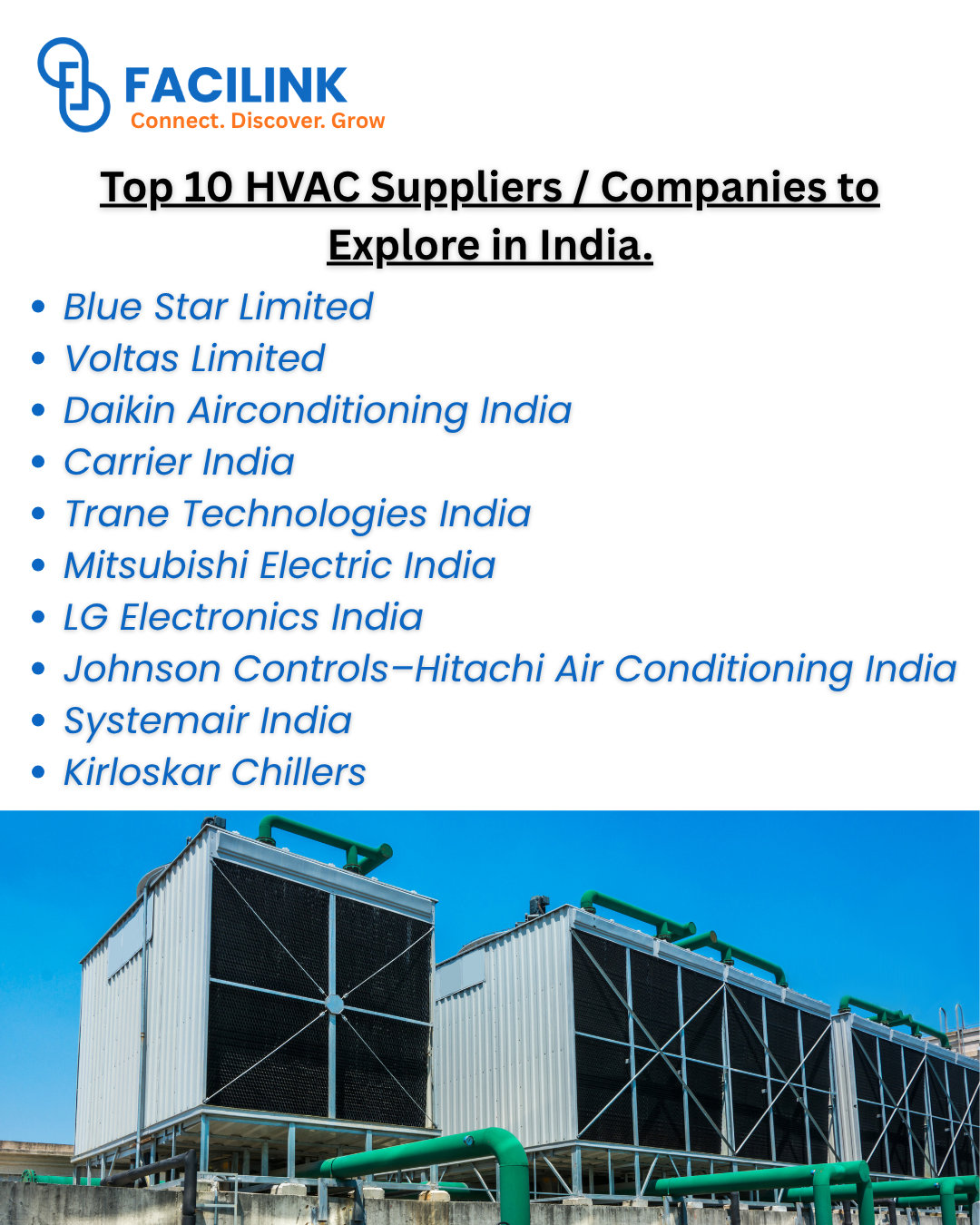
**Genpact is currently hiring for Global Facility Management (GMF)**
We are looking for experienced professionals to join our team.
• **Experience:** 3–10 years
• **Location:** Noida
• **Shift:** Australian Shift
• **Notice Period:** Maximum 15 days
**Key Skills:**
• Global Facility Management
• Facilities Operations & Administration
• Vendor Management
• Workplac
**Genpact is currently hiring for Global Facility Management (GMF)**
We are looking for experienced professionals to join our team.
• **Experience:** 3–10 years
• **Location:** Noida
• **Shift:** Australian Shift
• **Notice Period:** Maximum 15 days
**Key Skills:**
• Global Facility Management
• Facilities Operations & Administration
• Vendor Management
• Workplace & Facility Management
• Stakeholder Management
• Service Management & Issue Resolution
• Facilities Coordination
• Strong Communication & Interpersonal Skills
**Interested candidates can share their updated resume with me with the subject line: “Application for GMF” along with the below details:**
• Total Experience
• Current CTC
• Expected CTC
• Notice Period
📩 **Email:** [Janhvi.Rai@genpact.com]
Source: LinkedIn
🚨 WE’RE HIRING | REGIONAL MAINTENANCE MANAGER – MUMBAI 🚨
🔥 QSR / RETAIL CHAIN EXPERIENCE IS A MUST!
If you’ve managed maintenance across multiple outlets/stores, this opportunity is for you.
📍 Mumbai | 🏢 Barbeque Nation Hospitality Ltd.
🎯 What We’re Looking For
✅ 8+ years of Maintenance experience
✅ Strong experience in QSR / Retail / Multi-Unit Operations
🚨 WE’RE HIRING | REGIONAL MAINTENANCE MANAGER – MUMBAI 🚨
🔥 QSR / RETAIL CHAIN EXPERIENCE IS A MUST!
If you’ve managed maintenance across multiple outlets/stores, this opportunity is for you.
📍 Mumbai | 🏢 Barbeque Nation Hospitality Ltd.
🎯 What We’re Looking For
✅ 8+ years of Maintenance experience
✅ Strong experience in QSR / Retail / Multi-Unit Operations
✅ Engineering Diploma / Degree – Mechanical / Electrical / Civil
✅ Expertise in Preventive Maintenance, AMC, Vendors & Troubleshooting
✅ Strong leadership & willingness to travel
⚡ Immediate / Short Notice Joiners preferred
🚫 Profiles without QSR / Retail Chain / Multi-Unit experience will not be considered.
📩 Share your CV: baidyanath.m@barbequenation.com
👉 Know someone who fits? Tag them or share this post!
Source: Linkedin









There are many variations of passages of Lorem Ipsum available, but the majority have suffered alteration in some form, by injected humour.
Add my business arrow_forward




 Find Trusted Suppliers
 Explore Jobs
 News & Magazines
  Events
  Buy Products
 Blogs
Blogs  Community
 Podcasts
  Service Performance Index


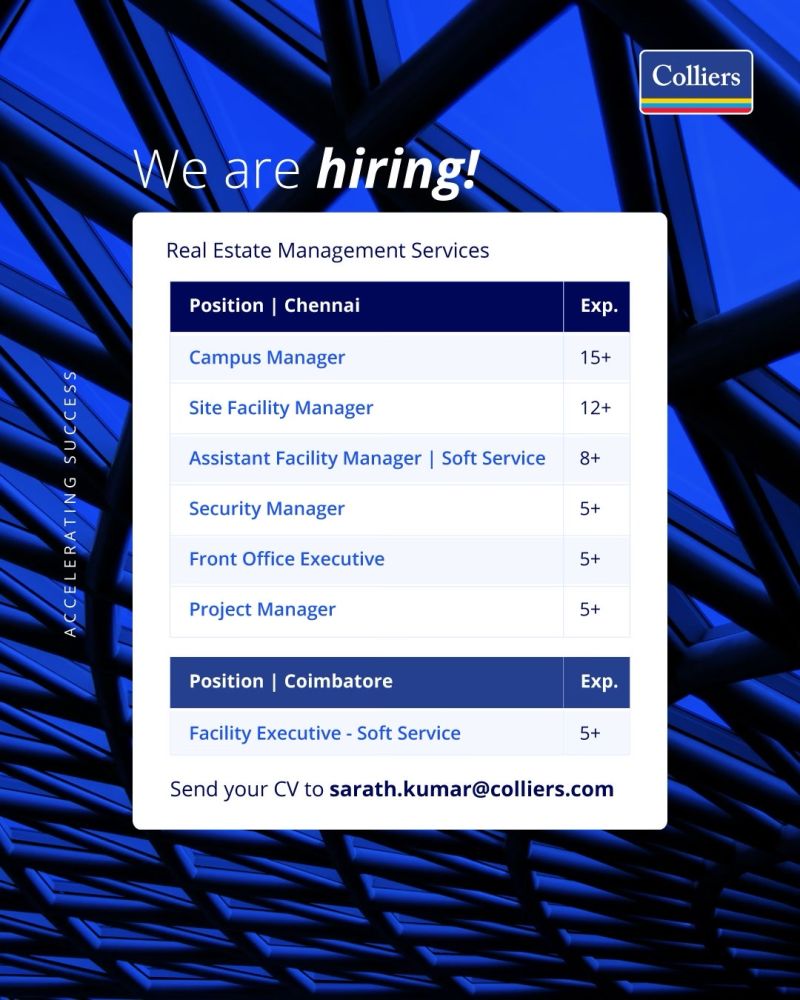




 More
More