Traditional FM vs. Modern FM
Having spent over 20 years in Facilities Management, I’ve seen how much the industry has evolved - and how some mindsets still need to catch up.
When I was an analyst/supervisor, our team was so obsessed with operational efficiency and cost-cutting initiatives. Fast forward to today; and our biggest concerns are sustainability, workplace experience, and helping
Traditional FM vs. Modern FM
Having spent over 20 years in Facilities Management, I’ve seen how much the industry has evolved - and how some mindsets still need to catch up.
When I was an analyst/supervisor, our team was so obsessed with operational efficiency and cost-cutting initiatives. Fast forward to today; and our biggest concerns are sustainability, workplace experience, and helping the business attain its goals.
With those things in mind, you can say that:
-Traditional FM focused on keeping things running.
-Modern FM focuses on helping the business run better.
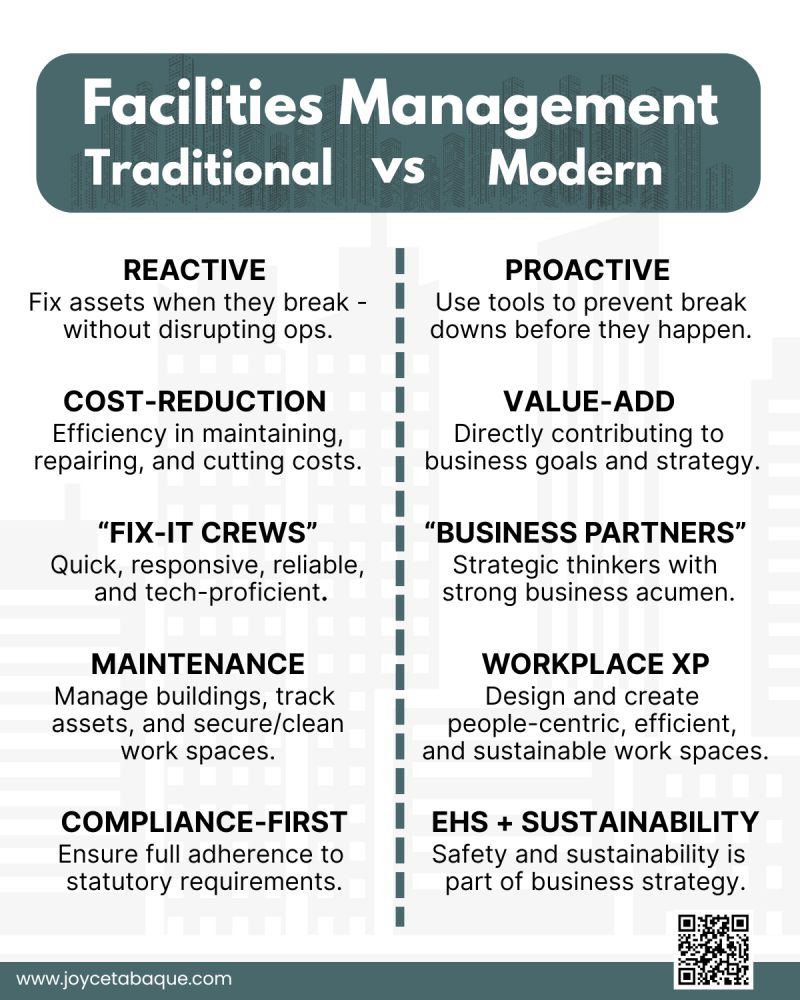
So, how does this paradigm shift look like?
Traditional FM: “Quickly and efficiently fix assets when they break.”
Modern FM: “Use tools like AI and data to prevent breakdowns before they happen.”
Traditional FM: “Cut down on everything that's not essential to operations.”
Modern FM: “Create value-add through smart investments, alignment, and strategic outcomes.”
Traditional FM: “We are your handy-dandy fix-it crew.”
Modern FM: “We are your business partners; and we'll help you drive performance.”
Traditional FM: “We maintain buildings and assets - and we keep your space safe and clean.”
Modern FM: “We directly affect the overall workplace experience and employee satisfaction.”
Traditional FM: “Compliance first.”
Modern FM: “Safety and sustainability are also parts of our strategy.”
Now, don't get me wrong.
I'm not saying that Traditional FM is bad, and Modern FM is good. The point here is that FM - as we previously knew (or currently know) it - needs an UPGRADE.
Today's business environment requires FM teams to both have mastery of the 'Traditional' and the strategic execution of the 'Modern'.
Nowadays, it's about balancing operational excellence and cost-savings with strategic alignment and sustainability - ensuring short-term needs are met without sacrificing the long-term; and vice versa.
Thus, the modern FM team isn’t just managing buildings - they’re also managing outcomes.
Because FM isn’t just about maintaining spaces anymore - it’s about enabling success.
So, my big question to business leaders is... "Is your FM team still stuck at mastering Traditional FM or have they already begun their roles as your strategic partners?"
Source: LinkedIn Page of Joyce Tabaque






There are many variations of passages of Lorem Ipsum available, but the majority have suffered alteration in some form, by injected humour.
Add my business arrow_forward



 Suppliers
 Jobs
Jobs  News & Magazines
  Events
  Blogs
Blogs  Members Lounge
 Podcasts

 Support