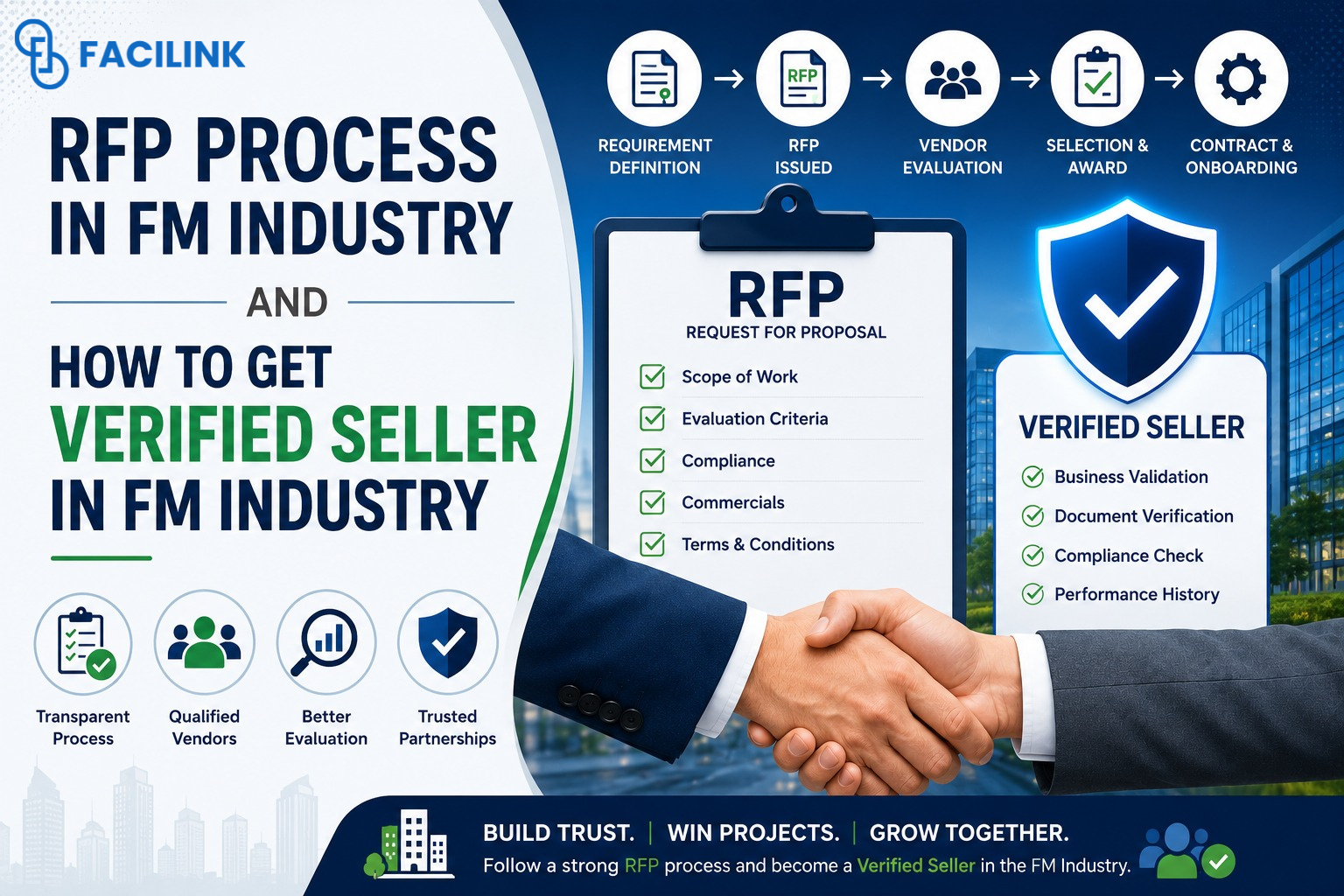
Request for Proposal (RFP) process in FM Industry and How to get Verified seller in FM Industry
The Facility Management (FM) industry itself has been evolving rapidly as companies are increasingly outsourcing services like housekeeping, security, maintenance, landscaping, pest control, HVAC management and technical support. Making the right choice of service provider is now a strategic decision that will have a direct impact on the operational efficiency, employee satisfaction and business continuity itself. It's at this point that the RFP process within FM really starts to play a key part.
A Request for Proposal (RFP) lets organisations judge several suppliers against criteria of quality, pricing, specialisation and regulatory compliance instead of having to rely exclusively on quotations themselves. Also by making the selection of a pre-verified supplier it will be ensured that your chosen facilities management partner will be dependable, experienced and able to provide consistently high-quality services themselves. This guide outlines the RFP process in FM, its advantages and also shows businesses how they can locate pre-verified sellers if they are to enjoy long term success.
What is the RFP Process in FM?
The RFP process in facilities management is a structured procurement method used by organisations to invite qualified facility management companies to submit proposals for certain services. As opposed to a simple price inquiry, an RFP assesses suppliers against many criteria - including their technical ability, operational experience, qualifications, staff, adoption of technology and pricing.
The purpose of an RFP is to ensure total transparency, foster a truly competitive environment and make the choice of supplier one that will deliver the greatest overall value - rather than just being the cheapest option itself. Procurement specialists are well aware that the RFP process is a 'best practice' for obtaining highly complex services where quality, risk management and long-term performance really matter.
Why the RFP Process Matters in Facility Management
Facility management encompasses services having a direct impact on workplace safety, employee comfort and the continuous operation of the facility itself. The selection of a poor vendor can result in service disruptions, problems with compliance and an increase in operational costs.
Using the RFP process in FM really helps businesses lay out their service expectations very clearly before inviting proposals themselves. Vendors get the exact same requirements so that all organizations can compare proposals fairly and quite objectively.
This process also provides greater transparency since each and every bidder will be assessed using predetermined criteria. This reduces prejudice whilst making sure that procurement decisions are determined by quantifiable performance indicators instead of mere assumptions.
Another advantage is improved risk management itself. Organizations are then able to assess vendor qualifications, their financial strength, past projects, manpower capabilities and their legal compliance prior to awarding contracts.
Steps in the RFP Process in FM
Step one is figuring out your facility management needs. An organization really needs to outline the scope of work, locations, how often services will be performed, what level of service is expected, how long the contract should last and all necessary regulatory requirements.
The next phase entails getting ready for the RFP document itself. Really thorough RFPs cover a company's history, the goals of the project, specifications for the service, a timeline and some key dates for evaluation, commercial terms and the deadline for submission.
When you publish the RFP, qualified bidders provide their proposals, along with supporting papers - such as certifications, licenses, client references and cost details too.
Your evaluation committee will then assess every bid they've received on several fronts including their technical capability, their operational experience, their price point, originality, service quality and also whether it meets all necessary regulations. Lots of organizations actually use weighted scoring models so that they can make truly objective comparisons between different vendors.
Vendors who have been shortlisted might be invited to give presentations, carry out site visits or attend clarification meetings right before the actual contract negotiations occur.
Finally, the vendor chosen for the contract gets awarded it, followed by the onboarding process, implementation of a service level agreement (SLA) and actual performance monitoring. Procurement professionals usually advise using very transparent evaluation criteria and setting down your scoring methods so that you improve fairness and accountability over the entire RFP process itself.
How to Get a Verified Seller in FM Industry
Finding a confirmed vendor is just as crucial as running an effective RFP process itself. A confirmed vendor has actually shown credibility through documentation, business results and operational capabilities.
Start by looking over business registrations, statutory licenses, GST registration, labor law compliance and insurance coverage. These documents really will prove that your company is operating completely legally.
Review the company's industry certifications where they're relevant. Certifications linked to quality control, environmental practices and occupational health and safety point out a real commitment to standardised operations.
References from clients offer some very precious insights into service quality itself. Talk to current clients so you get an understanding of how responsive they are, how professional they are and how capable they are of handling problems and issues.
Evaluate the vendor's workforce management methods themselves. Reliable property management companies put money into employee development, background checks, uniforms, supervision and safety systems themselves.
Technology adoption is another really important sign. Verified sellers usually make use of digital tools to monitor attendance, manage complaints, schedule routine maintenance, watch over assets and report on their own performance.
Your financial stability needs to be taken into account too - since financially solid vendors are generally far better set up to support long-term agreements and service responsibilities themselves.
Benefits of Working with Verified FM Sellers
Partnership with verified sellers brings numerous business benefits.
Companies gain assurance that the service will be performed to the agreed-upon standards. Verified suppliers generally hold better documentation, have trained personnel and well-established operating procedures themselves.
Your company also diminishes its legal and compliance risks when dealing with firms that meet all necessary statutory requirements themselves.
The quality of services is going to be higher because verified sellers typically invest in technology, employee development and ongoing improvements themselves.
It becomes much simpler to manage long-term relationships with them because verified vendors usually give very transparent communication, performance reports and structured escalation procedures themselves.
All these benefits will result in a higher operational efficiency, an improved work environment and a better return on investment itself.
Common Mistakes to Avoid During the RFP Process
Many organisations make the mistake of choosing suppliers purely on the basis of the lowest quote. Although cost is crucial, service quality and operational dependability deserve no less attention.
Another very common mistake is formulating somewhat indistinct service specifications themselves. By really defining one's expectations you reduce misunderstandings right after the contract award itself.
Omitting to check vendor references, certifications or compliance documents will also heighten your project risk levels.
Finally, organisations have to frequently evaluate supplier performance themselves once a contract has been awarded so that they can be certain that service standards still live up to their own commercial expectations.
Conclusion
The RFP process in facilities management is a very effective procurement strategy which lets organisations really choose the best facility management partner by carrying out a structured evaluation and making decisions transparently. If you combine this with very close checks on the sellers themselves then businesses can greatly cut down on their operational risks whilst at the same time really improving the quality of services and the long-term value they get from them. Spending time on a well thought out RFP and picking out verified FM providers will help create workplaces that are safer, run more efficiently and professionally managed too.
About FACILINK
FACILINK's RFQ platform simplifies the entire procurement process by enabling buyers to create customized RFQs, define their requirements and invite verified FM service providers to participate. Vendors submit their technical and commercial proposals through the platform, allowing buyers to compare quotations, evaluate vendors based on quality, compliance, experience and pricing, shortlist the best-fit partners and complete vendor selection efficiently. From requirement creation to vendor onboarding and transition support, FACILINK streamlines every stage of FM procurement on a single platform
Frequently Asked Questions
1. What is the RFP process in FM?
It represents a highly organized approach to inviting and evaluating proposals from facility management service providers - all prior to signing a contract.
2. Why is the RFP process significant within facility management?
This ensures that there's complete transparency along with a really equitable evaluation of your vendors so that you get superior service quality and fewer risks associated with procurement itself.
3. How would one even spot a confirmed FM seller?
Examine their business registrations, certifications, client testimonials, compliance papers, workforce methods, and overall financial stability.
4. What files will an FM vendor supply to you?
Typically these might comprise of GST registration, company licenses, insurance policies, statutory compliance files, certifications themselves and then references from past clients.
5. Will a confirmed seller actually help improve your facility management performance?
Yes indeed, verified sellers usually give you better services, much improved compliance rates, enhanced communication channels and far more reliable ongoing assistance over time.

Insightful





There are many variations of passages of Lorem Ipsum available, but the majority have suffered alteration in some form, by injected humour.
Add my business arrow_forward




 Find Trusted Suppliers
 Explore Jobs
 News & Magazines
  Events
  Buy Products
 Blogs
Blogs  Community
 Podcasts
  Service Performance Index













 More
More